
Published Updated
Quick answer: Yes, a baby tracker that syncs between both parents reduces mistakes, lowers mental load, and keeps every caregiver working from the same information.
- Real-time sync prevents double feeds, missed medication, and repeated status questions.
- Shared tracking helps even when parents live together and split shifts.
- Start by tracking feeds and nappies for one week before adding extra logs.
Key takeaways
- A synced baby tracker prevents double feeds, missed medication, and the constant "when did they last..." questions.
- You do not need to be co-parenting across two homes for sync to matter. It helps any household with more than one caregiver.
- The best way to get started is to track just feeds and nappies together for one week before adding anything else.
"Did you feed her already?" "When was his last diaper?" (or "nappy" if you are in the UK) "Has he had his medicine today?"
If you're a parent of a baby or toddler, these questions probably echo through your house several times a day. The information about your child's care almost always lives in one parent's head, and it's usually the same parent carrying that invisible weight every single time.
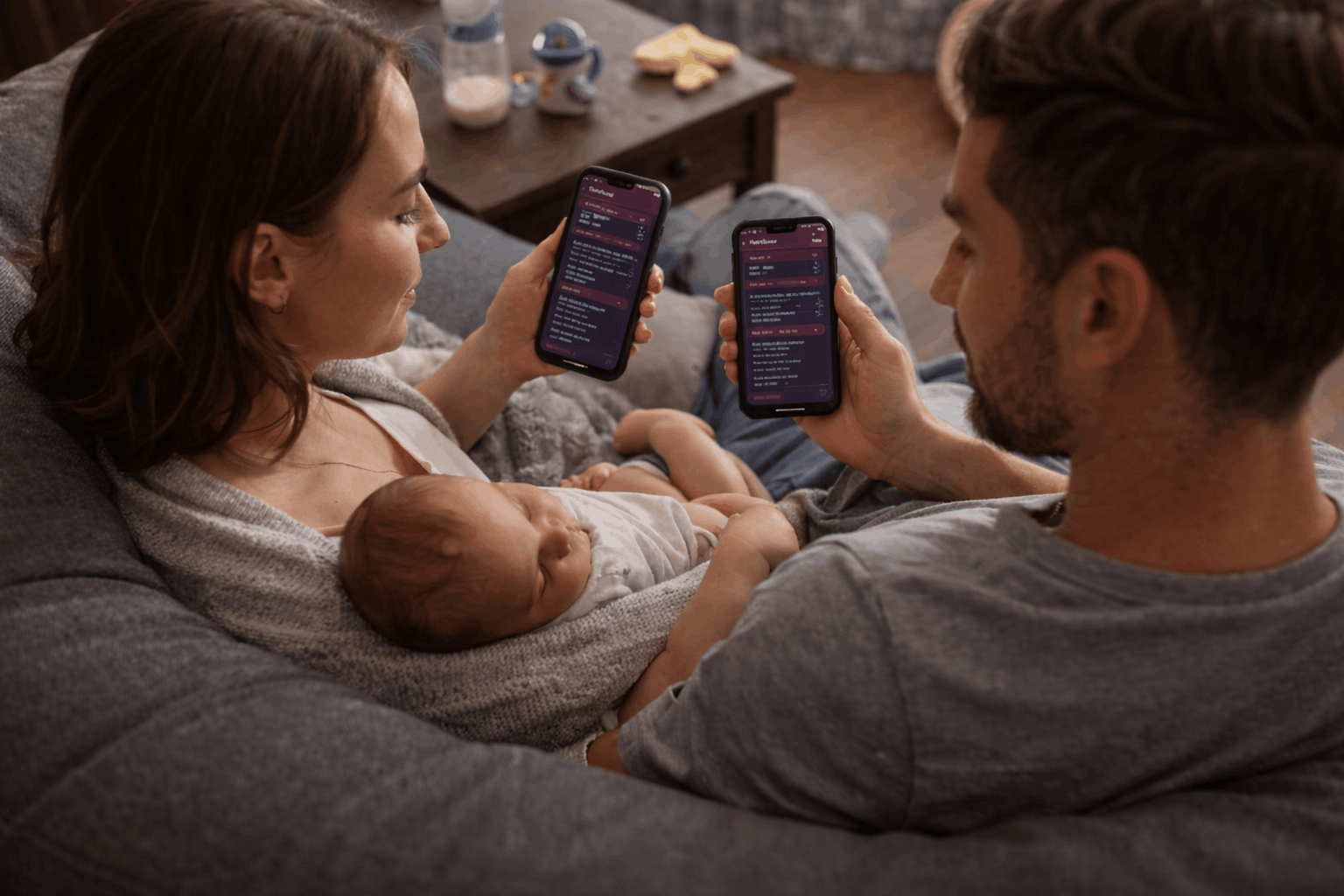
Here's the thing most people don't realise: you don't need to be separated or co-parenting across two homes for synced baby tracking to matter. A baby tracker for both parents isn't a co-parenting tool. It's a partnership tool. Whether you're tag-teaming overnight feeds, coordinating with a nanny, or just trying to remember if the baby ate at 2pm or 3pm, having a shared baby tracker that syncs between phones changes everything.
This post covers why parents start tracking in the first place, where single-user tracking breaks down, who actually benefits from a baby tracker that syncs between devices, what features to look for, and how to get your partner on board without a fight.
Why Parents Use Baby Trackers in the First Place
Let's be honest: nobody dreams about logging nappy changes. But once you're in the thick of newborn life, a baby tracker app becomes something close to a lifeline.
The biggest reason is newborn fog. Sleep deprivation does things to your memory that you can't appreciate until you're living it. You genuinely cannot remember what happened two hours ago. Was the last feed at 1am or 2am? Did you already give the vitamin D drops today? How many wet diapers (nappies) have there been since morning? These details blur together when you're running on three hours of broken sleep, and a baby sleep tracker or baby feeding tracker gives you something solid to reference instead of guessing.
Then there are the pediatrician appointments. Your doctor is going to ask about feeding frequency, diaper output, and sleep patterns, especially in those early weeks. The American Academy of Pediatrics recommends tracking feeding and diaper output closely during the newborn period to ensure adequate nutrition. A breastfeeding tracker or bottle feeding log means you walk into that appointment with real data instead of a vague "I think he's eating well?" And if there's something wrong (slow weight gain, signs of reflux, possible allergies) the data from your baby tracker app is what helps your pediatrician spot the pattern and act quickly.
Beyond medical visits, tracking helps you identify patterns on your own. That mysterious fussy period every evening? Maybe it lines up with a feeding gap. The sudden sleep regression? The nap schedule data shows wake windows getting too long. Tracking feeds, naps, and nappy changes sounds tedious, but the patterns it reveals give you real, actionable insight into what your baby actually needs.
And then there's the peace of mind. When everything feels chaotic (and it will feel chaotic) having a clear record of what happened and when provides a sense of control. It's not helicopter parenting. It's just managing the information that helps you care for a tiny human whose needs change constantly.
For breastfeeding parents specifically, tracking nursing sessions and pumping logs helps monitor supply, spot potential issues with latch or intake, and provides reassurance that the baby is getting enough milk. It's one of the most common reasons parents download a baby tracker in the first place.
The Hidden Problem with Solo Baby Tracking
So tracking is useful. But here's where most families run into trouble: only one parent is actually doing it.
Maybe you download a great baby tracker app, diligently log every feed, every nappy change, every nap. Your data is immaculate. The problem is that all of that information is locked inside your phone, invisible to your partner, your nanny, your mother-in-law, and anyone else involved in your baby's care.
This creates real problems. Not theoretical ones. Real, messy, sometimes scary ones.
The 3am feed scenario. Mum does the 3am boob feed but is so exhausted she doesn't mention it. Dad wakes at 6am, checks the tracker on his phone (or doesn't have access at all), and sees the last logged feed was at 11pm. He tries to give a bottle to a baby who isn't hungry. The baby fusses and refuses, dad gets frustrated, mum gets woken up, and everyone starts the day exhausted and irritated. A baby tracker that syncs in real time between phones would have shown dad that feed instantly, no conversation required.
The medicine mix-up. Dad gives the baby paracetamol for teething pain at 7am before heading to work. He doesn't text mum because he's rushing out the door. Mum sees the baby is fussy at 9am and gives another dose, thinking it's been long enough. That's a potential double-dosing risk, and with infant medication, the margins are slim. The NHS advises careful dose tracking to avoid accidental overdose. A shared baby tracker with a medication reminder visible to both parents prevents this entirely.
The daycare handover. Your nanny arrives and asks, "When did she last nap?" You have no idea, because your partner was on duty all morning and their tracker data is on their phone. The nanny gets incomplete information and has to guess about the baby's schedule for the rest of the day. With a baby tracker for multiple users, the nanny would see everything logged that morning, including the last feed, the last poo, and the nap time, without anyone needing to relay it.
The mental load spiral. This is the big one. When only one parent holds all the baby care information, the other parent is forced to constantly ask questions. "When did he eat?" "How long did she sleep?" "Did you change him?" Over time, the parent holding the information feels like they're the only one who really knows the baby, and they start to resent it. The other parent feels like they can't do anything right without asking permission first. This dynamic damages relationships. It's not about who's a better parent. It's about one person carrying all the context while the other flies blind. A baby tracker for dad and mom together, syncing in real time, gives both parents the same information and eliminates the interrogation cycle.
Who Benefits from a Synced Baby Tracker? (Spoiler: Almost Everyone)
You might be thinking, "Okay, but we communicate well. We don't need an app." And maybe you're right, for now. But the situations where a synced baby tracker makes a difference are far broader than most people expect.
Both parents at home. Even if you're both under the same roof, you're not always in the same room, or awake at the same time. Tag-teaming overnight feeds means one of you is asleep while the other handles care. If one parent stays home while the other works, the working parent comes back to a full day of baby care they know nothing about. Shared parental leave sounds lovely until you're both so tired that neither of you can remember who did what. A baby tracker app for couples keeps you both on the same page even when you're taking turns.
Working parents. The logistics of working parenthood create constant information gaps. The parent who does daycare drop-off knows how the morning went, but the parent doing pickup doesn't. A business trip means one parent is completely disconnected for days. Even working from home with shared childcare creates moments where one parent is in a meeting and the other is managing a feed they don't log. A baby feeding tracker for both parents solves the handover that happens every single evening when one of you walks in the door and asks, "So how was today?"
Extended family caregivers. Grandparents babysitting for the afternoon, a sibling helping out for the weekend, a cousin covering childcare while you're at a medical appointment. They all need to know what's happened so far today. A baby tracker for multiple caregivers means you don't have to write up a briefing document every time someone else takes over. The information is just there.
Paid caregivers. Nannies need real-time information to do their jobs well. Au pairs tracking feeds and naps during their shifts should be adding to the same record, not a separate one. Night nurses documenting what happened overnight need a way to share that with the parents who wake up the next morning. Postpartum doulas providing care in those critical early weeks need context. A baby tracker for nanny use, or any paid caregiver, only works properly if it syncs with the parents' view.
Medical situations. If your baby has NICU tracking requirements, strict medication schedules, multiple specialists who all need data, or is premature with closely monitored feeding targets, a shared baby tracker isn't a nice-to-have. It's essential. Both parents, plus any medical professionals involved, need access to the same accurate, up-to-date information. No one should be guessing about a medically fragile baby's last feed.
Twins and multiples. If you're tracking for a baby tracker for twins or triplets, the information management becomes exponentially more complex. Which baby ate last? Did both get their medication? Who slept longer? Trying to keep this straight in one person's head, or on one phone, is a recipe for mistakes. A synced tracker across multiple users and multiple babies is basically mandatory.
Even solo parents benefit. You might be the only parent, but you're probably not the only caregiver. Sharing your baby's tracker with a babysitter, a grandparent, or your pediatrician means the right information is available in emergencies and everyday life alike. And honestly, even if nobody else ever looks at it, having a reliable record beats your own sleep-deprived memory every time.
Essential Features for Multi-User Baby Tracking
Not all baby tracker apps handle multiple users well. If you're looking for a shared baby tracker that actually works for your family, here's what to prioritise.
Real-time sync. This is non-negotiable. A baby tracker app that syncs in real time means that when one parent logs a feed, the other parent sees it within seconds. Not at the end of the day, not when someone remembers to hit a sync button. Delayed sync defeats the entire purpose, because the whole point is preventing the "Did you already feed her?" problem. You also need cross-platform sync: a baby tracker that syncs between iPhone and Android, because not every family uses the same type of phone.
Offline capability. Babies don't care about your Wi-Fi signal. You'll need to log feeds in hospital basements, during car journeys, in rural areas visiting grandparents, and at 3am when you'd rather not have screen glare from hunting for a connection. Apps like Pebbi offer full offline tracking that syncs once you're back online, perfect for hospitals or overnight when you don't want screen glare. No data loss, no gaps, no frustration.
Easy user management. Adding a new caregiver should take less than a minute. Removing someone (like a nanny who's moved on) should be just as simple. If setting up a second user requires creating accounts, sharing passwords, or following a twelve-step guide, people won't bother. The simpler the setup, the more likely everyone will actually use it. Our step-by-step guide to sharing a baby tracker covers the setup process for partners, nannies, and co-parents.
Notification options. Some families want medication reminders visible to all caregivers. Others want optional alerts when a feed is logged. The key word is "optional" - notifications should be helpful, not nagging. And if your app supports handover summaries, even better: a quick snapshot of what's happened since the last caregiver took over.
Privacy and security. Your baby's data is personal. Before choosing a baby tracker, check who sees your data, whether the app serves ads based on your baby's information, and whether there's third-party data sharing you didn't agree to. Privacy-focused options like Pebbi don't require an account, don't run ads, and don't sell your baby's care data or use it for advertising, which is worth considering if you're concerned about how apps monetise your information. A baby tracker with no ads and a clear privacy policy should be the baseline, not a luxury.
Ease of use when you're exhausted. This might be the most important feature of all. Can you log a feed with one tap? Can your partner figure it out without a tutorial? Is the interface clear enough for a grandparent or nanny to use without help? A baby tracker is only useful if people actually use it, and people will only use it if it's genuinely quick and easy, especially at 3am.
"But Won't My Partner Just Never Check It?"
This is the most common objection, and it's a fair one. Let's walk through the concerns.
"My partner won't use an app." The trick is framing it as something that solves their problem, not yours. Nobody wants to be told, "You need to start logging the baby's feeds." But most partners are perfectly happy to stop being pestered with questions. "Hey, I set this up so you don't have to text me every time you need to know when he last ate - it's all in the app" is a very different pitch. When using the baby tracker means fewer interruptions and fewer awkward "I don't know" moments in front of the nanny, compliance tends to follow naturally. One-tap logging makes it genuinely easy, not another chore.
"It's just another thing to manage." It actually replaces something much more time-consuming: the verbal handover. Think about how long it takes to relay what the baby ate, when they slept, whether they had their medicine, and how many nappies you changed, versus tapping a button as you go. The tracker doesn't add a task. It removes a conversation that takes longer and is less accurate. It also prevents the errors (like double-feeding or missed medication) that create significantly more work downstream.
"We're fine just talking to each other." Talking works brilliantly when you're both awake, both present, and both paying attention. It falls apart at 3am when one of you is half-asleep. It falls apart when one of you is at work and the other forgets to text. It falls apart during the sleep deprivation that makes every parent's memory unreliable. You're not replacing communication. You're backing it up with something that doesn't forget.
"Isn't this a bit much? Feels like helicopter parenting." Tracking the basics (feeds, nappies, sleep, medication) isn't over-parenting. It's practical information management for a stage of life where the details genuinely matter for your baby's health and wellbeing. You're not logging every smile and sneeze. You're making sure nobody double-doses infant paracetamol. Most families naturally stop tracking once routines stabilise and the baby is older. It's a tool for a season, not a lifestyle.
"Free apps don't have sync" or "Sync costs money." Pebbi includes free multi-device sync for 2 carers, so both parents can share a timeline at no cost, with full handovers, reminders, and CSV export included. Pebbi is privacy-focused and built specifically for shared care with offline sync. Premium extends to 5 carers and 5 babies with AI summaries and predictions. Other options like Baby Connect, Huckleberry, and Baby Tracker also offer multi-user features at various price points. Our full comparison of the best baby tracker apps reviews all 10 in detail. When you compare the cost (often nothing) to the peace of mind and prevented mistakes, it's a straightforward calculation.
Pebbi is free for two carers and one baby, with no account and no ads. Both parents see the same timeline in real time. Download for iOS or Android.
The Mental Load Problem Synced Tracking Solves
If you've heard the term "mental load" before, you probably already feel it in your bones. Mental load is the invisible work of carrying all the information in your head: knowing when the baby last ate, when the next nap should be, which medication is due, what the nappy count has been today. It's the constant background processing that never switches off.
In most families (and research backs this up consistently) the mental load of baby care falls disproportionately on the mother. Even in households where both parents are genuinely trying to share care equally, one parent (usually mum) ends up becoming the "human dashboard." She knows everything. He has to ask. And every time he asks, it reinforces the dynamic: she's the expert, he's the assistant. That's corrosive to a relationship, and it's exhausting for the person holding all the context.
A synced baby tracker directly addresses this imbalance. When both parents can see the same real-time information (the last feed, the next nap window, today's nappy log, the medication schedule) neither parent needs to ask the other. Dad can take the baby to the doctor without needing a briefing from mum. Grandma can babysit without asking twenty questions at the door. The working parent feels connected to the baby's day even though they've been in the office since 8am.
This isn't about micromanaging or surveillance. It's about democratising the information so that any caregiver can step in confidently without a download from the person who was last on duty. It reduces the "you should know this" resentment. It means both parents can answer questions at the pediatrician's office. It means nobody is the bottleneck for basic baby care information.
For many couples, this single change, making baby care data visible to both parents, does more for their relationship satisfaction than any conversation about "helping more." It's not about doing more tasks. It's about sharing the cognitive weight.
How to Actually Get Your Partner to Use It
Okay, you're convinced. Now how do you make it happen without it becoming a Thing?
Set up together. Download the app at the same time. Both of you create your profiles, both of you log one feed or one nappy change to confirm sync works. Don't set it up yourself and then hand your partner a fully configured app. That immediately makes it "your" system that they're just participating in. Make it a joint decision from minute one.
Establish simple routines. Agree on who logs what, or decide that both of you log everything and the app handles deduplication. The key habit is: check the tracker before asking a question. If you can see when the last feed was, don't ask. Over time, this breaks the interrogation cycle naturally.
Start small. Don't try to track feeds, naps, nappies, medication, growth milestones, and pumping sessions all on day one. Start with just feeds and diapers, the two things that cause the most confusion. Once that feels automatic (usually within a week), layer in sleep tracking, then medication if relevant. Trying to track everything immediately leads to burnout and abandonment.
Make it physically easy. Keep your phones where you do baby care: next to the changing table, by the nursing chair, on the kitchen counter. If you have to go find your phone to log something, you won't do it at 3am. Offline mode matters here too: you need to be able to log without fumbling for a connection in the middle of the night.
Review together. Once a week, spend five minutes looking at the data together. Not as an audit, but as a conversation. "Huh, she's been sleeping shorter naps this week." "Looks like he's feeding more often. Growth spurt?" This turns the tracker from a logging chore into a shared understanding of your baby. It also gives you a reason to celebrate what you're learning as a team.
It's Not About Perfection - It's About Partnership
Synced baby tracking isn't about becoming obsessive data-logging parents. It's about recognising that baby care is a team effort, and every member of the team deserves the same information.
When both parents, and any other caregivers, have access to the same real-time baby care data, mistakes get prevented. The mental load gets shared. Confidence increases for everyone involved, from dad handling bath time solo to grandma covering a Saturday afternoon. No one has to wonder, guess, or ask.
If you've been on the fence, try it for two weeks. Pick a baby tracker for both parents to use, set it up together, and commit to logging the basics. You'll be surprised how quickly it becomes automatic, and how much calmer your household feels when nobody has to ask, "Did you already feed her?"
If you only do one thing
Set up a shared baby tracker with your partner or co-carer this week and agree to log just feeds for seven days. Do not overthink it. Once you have both experienced checking the app instead of asking "when did they last eat?", the value sells itself.
If you're looking for a baby tracker that prioritises shared care, works offline, and respects your privacy, Pebbi was built specifically for these needs. Multi-device sync is free for 2 carers, so both parents can try it without paying anything. We also have a detailed comparison of Pebbi vs Huckleberry if you're deciding between sleep analysis focus and handover focus.
Ready to try synced baby tracking? Download Pebbi on iOS or Android, and see what shared care actually feels like.