
Published
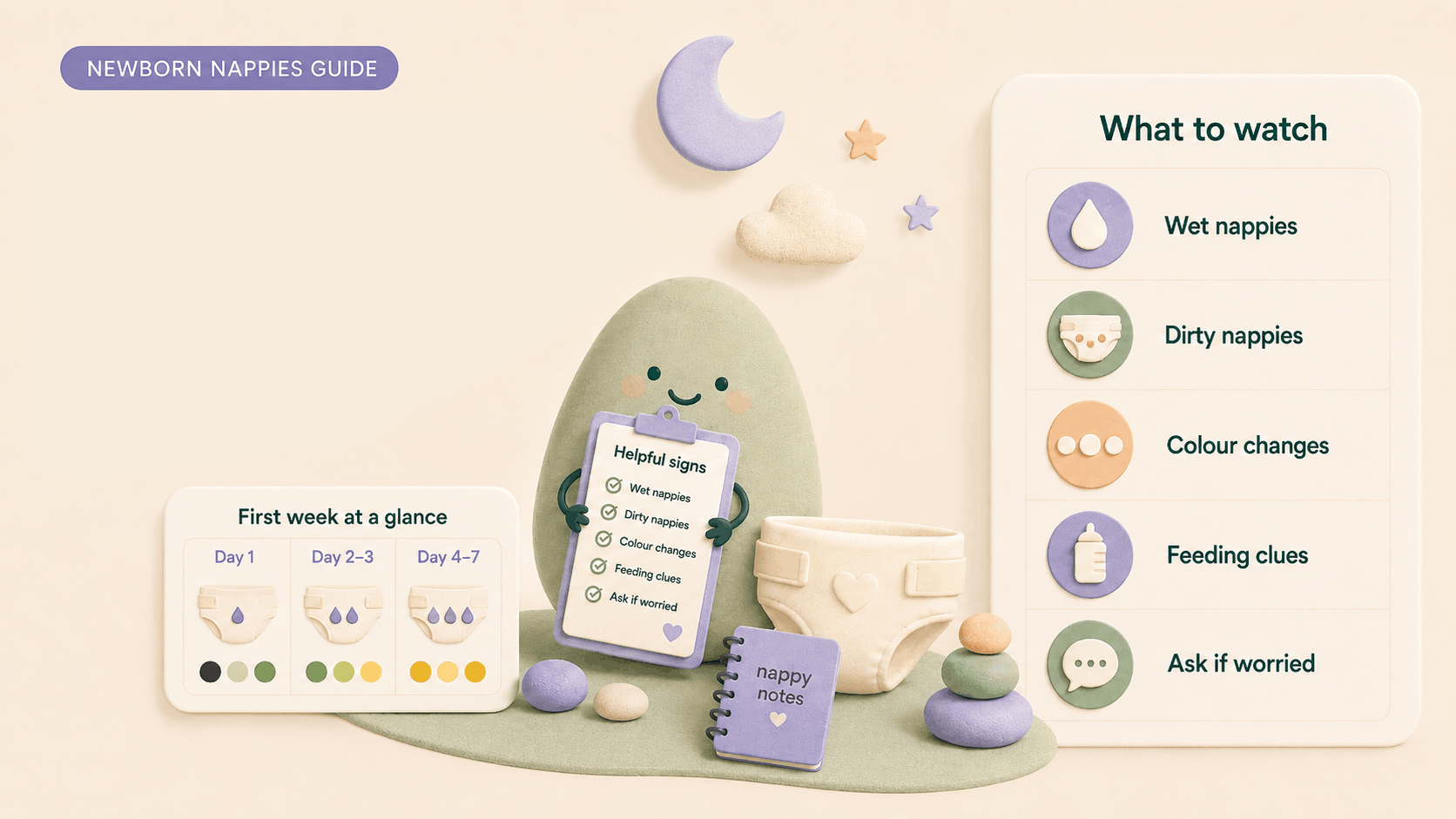
Quick answer: Wet nappies often increase day by day in the first week as feeding becomes established. Dirty nappies usually change from dark meconium to lighter stools. After the early newborn period, many babies have around six or more wet nappies a day.
- Breastfed and formula-fed babies may have different dirty nappy patterns; one unusual nappy is not always a problem.
- Fewer wet nappies, dark urine, poor feeding, unusual sleepiness or dehydration signs should be taken seriously.
- Track nappies when output matters (first week, feeding worries, illness); you do not need to log every nappy long term if all is well.
Newborn nappies are not glamorous.
But in the early days, they can be surprisingly useful.
A wet nappy tells you something is going in and coming out. A dirty nappy can show that feeding and digestion are moving along. A sudden change can be worth noticing. And if you ever need to speak to a midwife, health visitor, GP or paediatrician, nappy output is one of the things they may ask about.
That does not mean you need to track every nappy forever.
But in the first week, during feeding worries, or when something seems different from your baby's usual pattern, a simple nappy record can give you a clearer picture.
This guide explains what wet and dirty nappies can tell you, what changes are common, and when to ask for help.
For feeding amounts and frequency, see how much milk should my baby drink. For breastfeeding signs beyond nappies, see is my breastfed baby getting enough milk.
Key takeaways
- Wet nappies usually increase over the first week; around six or more wet nappies a day is often expected after the early newborn period.
- Dirty nappies change from dark meconium to lighter stools as milk intake increases; patterns differ between breastfed and formula-fed babies.
- Nappies are useful clues alongside feeding and weight, not a scorecard or a diagnosis on their own.
- Fewer wet nappies, dark urine, dehydration signs or very unusual poo need prompt professional advice.
- Log nappies when it helps (first week, concerns, illness); stop when it does not.
Why nappies matter in the newborn stage
Nappies are useful because they are visible.
You cannot always see how much milk a breastfed baby has transferred. You may not remember every feed clearly. You may be too tired to know whether yesterday was different from today.
But nappies leave evidence.
They can help answer questions like:
- Is baby having wet nappies?
- Are wet nappies increasing as feeding gets going?
- Has output suddenly dropped?
- Are dirty nappies changing as expected?
- Is feeding difficulty showing up in nappy output?
- Is this something to mention to a health professional?
Nappies do not tell the whole story, but they are an important clue.
Wet nappies in the first week
Wet nappies often increase over the first week as feeding becomes established.
The exact number varies by baby, feeding method, birth circumstances and professional advice. But the general pattern is:
| Baby's age | What you may notice | What it can suggest |
|---|---|---|
| Day 1 | Very few wet nappies | Small early feeds are common |
| Days 2-3 | Wet nappies gradually increase | Intake may be building |
| Days 4-5 | More regular wet nappies | Feeding may be becoming more established |
| Day 6 onward | Many babies have several wet nappies a day | Output is usually easier to judge |
| After the first week | Around six or more wet nappies is often expected | A useful hydration and feeding clue |
This is a guide, not a guarantee.
If your baby was premature, unwell, jaundiced, losing weight, having feeding difficulties, or you were given a specific monitoring plan, follow the advice from your care team. NHS Start for Life and NHS baby feeding guidance have more on what to expect in the early days.
What counts as a wet nappy?
Modern disposable nappies can make this harder than it sounds because they absorb so quickly.
A wet nappy may feel:
- heavier than a dry one
- slightly swollen
- cool or gel-like inside
- indicated by a colour-change strip, if the nappy has one
If you are unsure what "wet" feels like, you can pour a small amount of water into a clean dry nappy to feel the difference. This can be surprisingly helpful in the first few days.
What should baby wee look like?
Baby urine is usually pale or light yellow.
Things worth noticing:
| What you see | What it may mean |
|---|---|
| Pale or light yellow urine | Usually reassuring |
| Very dark yellow urine | May be concentrated; worth watching |
| Strong-smelling urine | May be worth mentioning if repeated |
| Pink, red or orange "brick dust" stains in early days | Can be urate crystals; ask if persistent or worrying |
| Blood in urine | Seek medical advice |
| No wet nappies for a concerning period | Seek advice promptly |
If your baby has fewer wet nappies than expected, dark urine, dry mouth, unusual sleepiness, sunken soft spot, poor feeding or seems unwell, get medical advice. For urgent concerns in the UK, you can contact NHS 111 or your GP.
Dirty nappies in the first few days
Newborn poo changes quickly.
In the first day or two, many babies pass meconium. This is usually dark, sticky and tar-like.
As milk intake increases, dirty nappies typically change. They may become lighter, softer and more frequent, though patterns vary.
A simple early pattern may look like this:
| Stage | What you may see |
|---|---|
| First poos | Dark, sticky meconium |
| Transitional poos | Greenish or brownish as milk intake increases |
| Later newborn poos | Yellow, mustard, greenish or light brown tones can be common depending on feeding |
| Formula-fed poos | Often slightly firmer and may be tan, yellow or brown |
| Breastfed poos | Often loose, yellow or mustard-like, sometimes seedy |
This is deliberately broad because normal baby poo has a wide range.
The key is not to analyse every nappy in isolation. Look for the pattern and any worrying changes.
Breastfed baby nappies
Breastfed babies can have nappy patterns that change quite a lot.
In the early weeks, dirty nappies are often frequent. Later on, some breastfed babies may poo less often while still being well, feeding normally and having wet nappies.
Useful signs alongside nappies include:
- active feeding
- swallowing at the breast
- wet nappies
- weight gain
- periods of alertness
- baby's usual behaviour
If a breastfed baby has fewer wet nappies than expected, seems very sleepy, is not waking for feeds, has poor weight gain, or you are worried about milk transfer, ask for support.
Formula-fed baby nappies
Formula-fed babies may have different poo patterns from breastfed babies.
Their stools may be:
- slightly firmer
- yellow, tan or brown
- more formed than breastfed stools
- regular, but not identical from baby to baby
Bottle-fed babies may also have more measurable intake, which can make nappy changes easier to connect with feeding changes.
Seek advice if:
- baby has fewer wet nappies than expected
- poo is very hard or baby seems in pain
- diarrhoea is persistent
- there is blood
- baby is vomiting repeatedly
- baby seems unwell
- feeding has dropped noticeably
Do not dilute formula or change preparation instructions to manage nappies unless advised by a health professional. Formula should be prepared safely according to NHS bottle feeding advice.
What about very frequent dirty nappies?
Newborns can poo a lot.
A dirty nappy after many feeds can be normal, especially in the early weeks.
But frequent dirty nappies may need advice if they are:
- very watery
- explosive and persistent
- accompanied by fever
- accompanied by vomiting
- linked with poor feeding
- linked with fewer wet nappies
- bloody or mucus-heavy
- causing signs of dehydration
- very different from your baby's usual pattern
When in doubt, ask.
What about no dirty nappy?
A missed dirty nappy is not automatically a problem, especially as babies get older and patterns change.
But in the early newborn stage, dirty nappies are part of the wider feeding picture. If your newborn has no dirty nappies when you expected them, or if this is paired with poor feeding, fewer wet nappies, sleepiness or weight concerns, seek advice.
For older babies, poo frequency can vary. Some babies poo several times a day; others less often. What matters is comfort, feeding, wet nappies, growth and whether this is normal for your baby.
Nappies and feeding: the important connection
Nappies are one of the reasons feeding posts talk so much about output.
If milk is going in, something should eventually come out.
That does not mean you can assess feeding from nappies alone. But nappy output is useful context alongside:
| Feeding clue | Nappy clue | Bigger picture |
|---|---|---|
| Baby feeding often | Wet nappies normal | Frequent feeding may be normal |
| Baby feeding often | Wet nappies low | Ask for feeding advice; see cluster feeding if feeds are very close together |
| Baby sleepy at feeds | Wet nappies low | Seek advice promptly |
| Bottle amounts lower than usual | Wet nappies normal | Watch the pattern |
| Breastfeeding painful / latch difficult | Dirty/wet nappies changing | Get support early |
| Weight gain concern | Nappies low or changing | Share full pattern with professional |
This is why a simple log can help. It puts feeds and nappies next to each other rather than leaving you to remember everything separately. For what is worth logging when worried (without tracking everything), see what to track in your baby's first week.
When nappy tracking can help
You do not need to track every nappy forever.
But nappy tracking can be genuinely useful when:
- your baby is in the first week home
- breastfeeding is being established
- you are worried about milk transfer
- bottle amounts are lower than usual
- wet nappies seem fewer
- dirty nappies have changed
- baby is ill, vomiting or has diarrhoea
- weight gain is being monitored
- a health professional asked you to keep notes
- more than one person is caring for the baby
In those moments, a nappy log is not busywork. It is a memory aid.
When nappy tracking may not be necessary
If your baby is older, feeding well, having normal wet nappies, pooing in their usual pattern, gaining weight as expected and you are not worried, you may not need to log every nappy.
You might still choose to log occasionally for shared care, but there is no moral victory in recording every wee.
Pebbi's approach is simple:
Track when it helps. Stop when it does not.
What to log if nappies are a concern
If you are concerned, do not worry about writing a long description. Keep it practical.
| Detail | Example |
|---|---|
| Time | 09:40 |
| Type | Wet / dirty / both |
| Amount impression | Small wet nappy, very full nappy |
| Colour note | Very dark urine, pale stool, green poo |
| Feeding context | Poor feed before, sleepy at breast |
| Symptoms | Vomiting, fever, rash, diarrhoea |
| Professional note | Health visitor asked us to monitor nappies |
A few clear notes are usually better than a huge nappy diary.
A simple nappy log example
Here is what a useful day might look like when nappy output is being watched.
| Time | Event | Note |
|---|---|---|
| 06:30 | Breastfeed | Sleepy feed |
| 07:10 | Nappy | Small wet |
| 09:45 | Bottle top-up | 40 ml taken |
| 10:20 | Nappy | Wet |
| 13:15 | Breastfeed | Better, active swallowing |
| 14:00 | Nappy | Wet + dirty |
| 17:30 | Nappy | Wet, normal amount |
| 20:00 | Note | More alert this evening |
This is enough to show the day improving.
It does not need to track every facial expression, every cry or every cuddle.
If you are logging at 3am because you cannot remember the last nappy change, Baby Tracking at 3am covers practical shared-care memory.
Signs to seek advice about nappies
Ask for medical advice if you notice:
- fewer wet nappies than expected
- no wet nappies for a concerning period
- very dark urine repeatedly
- dry mouth or lips
- no tears when crying
- sunken soft spot
- unusual sleepiness, floppiness or difficulty waking
- poor feeding
- repeated or forceful vomiting
- persistent diarrhoea
- blood in the nappy
- very pale or white stools
- fever or low temperature
- baby seems seriously unwell
- your instinct says something is wrong
This is not a "wait and log it" situation. If you are worried, seek help.
What Pebbi can help with
Pebbi can help you keep nappy information in context.
That means:
- wet nappies next to feeds
- dirty nappies next to sleep and symptoms
- notes for a health visitor
- shared handovers between parents or carers
- medication and illness notes if relevant
- a clearer picture when you are too tired to remember
Pebbi will not tell you whether a nappy is medically normal. It is not a diagnostic tool.
But it can help you answer:
- When was the last wet nappy?
- Has output improved since the last feed?
- Were there fewer nappies overnight?
- Did diarrhoea start before or after vomiting?
- What should I mention when I call for advice?
That is practical help, not pressure.
The calm rule for nappies
Nappies are useful information.
They are not a parenting scorecard.
If your baby is well and you are not worried, you do not have to track every nappy. If something changes, or feeding feels uncertain, a simple log can help you spot the pattern and explain it clearly.
Use nappies as clues.
Not as something else to be perfect at.