
Published
Quick answer: Cluster feeding is when a baby feeds several times close together, often over a few hours in the late afternoon or evening. It is common in newborns and young babies, especially around growth spurts. It does not automatically mean low milk supply.
- More reassuring if baby has wet nappies, is gaining weight, feeds actively at times, and seems well between clusters.
- Bottle-fed and formula-fed babies can also want feeds closer together during fussy evenings or growth spurts.
- Ask for help if wet nappies are low, weight gain is poor, feeds are very sleepy or ineffective, latch is painful, or baby seems unwell.
Cluster feeding can make you question everything.
Your baby fed twenty minutes ago. Now they are rooting again. Then they feed for five minutes, doze, wake, fuss, feed again, and repeat the whole cycle until the evening disappears.
It can feel like your baby is constantly hungry.
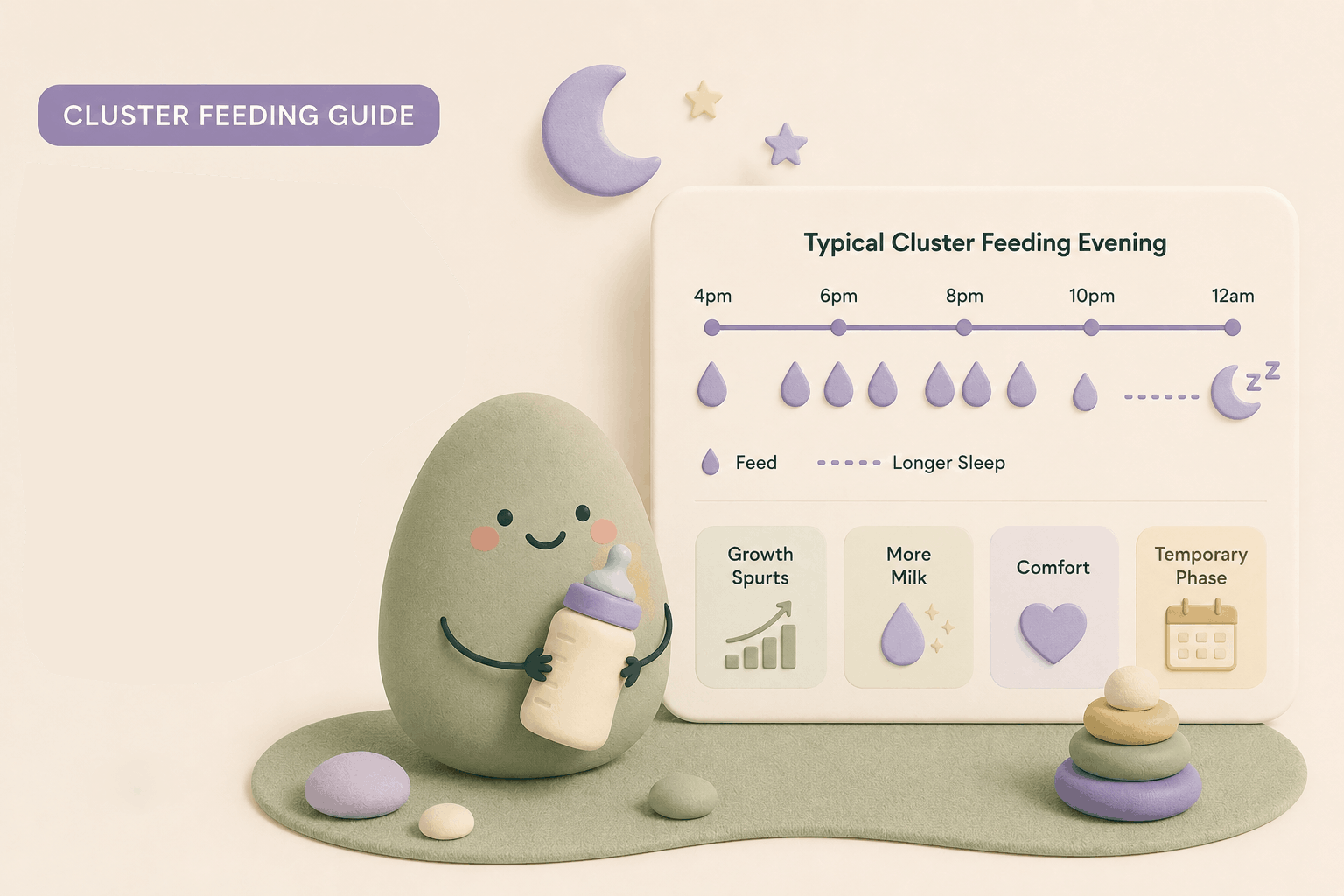
Sometimes, that is simply cluster feeding: several feeds close together over a few hours, often in the late afternoon or evening.
It can be normal. It can be exhausting. And sometimes it is hard to tell the difference between normal cluster feeding and a feeding problem that needs support.
This guide explains what cluster feeding looks like, when it tends to happen, how long it may last, how it affects breastfeeding and bottle feeding, and when to ask for help.
For milk-transfer signs beyond frequent feeds, see is my breastfed baby getting enough milk. For evening crying in context, see why is my baby crying. For concern-based logging when you are unsure what to note, see what to track in your baby's first week.
Key takeaways
- Cluster feeding is several feeds close together, often in the evening or during growth spurts; it is not only a breastfeeding pattern.
- Frequent feeding alone does not prove low supply; wet nappies, weight gain and active swallowing matter more.
- A single session may last a few hours; a phase may last a few days or recur on and off in the early months.
- Coping is an adult-support issue too: snacks, help with nappies, latch support if painful, and asking for help when worried.
- A simple log of cluster timing, nappies and active feeds can clarify whether the pattern is reassuring or needs support.
What cluster feeding looks like
Cluster feeding can look like a loop.
Feed. Rest. Fuss. Feed again. Doze. Wake. Root. Feed again.
A cluster-feeding period might look like this:
| Time | What happens |
|---|---|
| 17:00 | Breastfeed or bottle |
| 17:30 | Baby fusses and roots again |
| 17:40 | Short feed |
| 18:00 | Dozes on caregiver |
| 18:20 | Wakes crying |
| 18:30 | Another feed |
| 19:00 | Nappy and fussing |
| 19:20 | Short feed |
| 20:00 | Longer sleep begins |
That can be normal.
It is also a lot.
Is cluster feeding only a breastfeeding thing?
No.
Cluster feeding is often discussed in breastfeeding because frequent feeding helps stimulate milk supply. But bottle-fed babies, mixed-fed babies and expressed-milk-fed babies can also have periods where they want feeds closer together.
For breastfed babies, cluster feeding may:
- help stimulate supply
- happen around growth spurts
- be more common in the evening
- include comfort nursing
- make parents worry about milk supply
For bottle-fed babies, cluster feeding may:
- look like wanting smaller feeds close together
- happen during growth spurts
- happen during fussy evenings
- make parents wonder whether to offer more milk
- require careful attention to hunger and fullness cues
The same principle applies: look at the whole baby, not just the number of feeds.
Common cluster-feeding ages
There is no perfect cluster-feeding calendar, but common phases include:
| Age | What may happen |
|---|---|
| First few days | Frequent feeding as milk supply and feeding begin |
| 7-10 days | Possible early growth spurt and increased feeds |
| 2-3 weeks | Many babies feed more often |
| 3-6 weeks | Cluster feeding and evening fussiness can peak |
| Around 3 months | Another possible growth/development shift |
| Around 6 months | Feeding patterns may shift again, especially before solids settle |
Some babies cluster feed earlier, later, or not very obviously at all.
A phase may last a few hours, a few evenings, or a few days. If feeding feels relentless for longer, or something else seems wrong, get support.
Cluster feeding or low milk supply?
This is the big question for many breastfeeding parents.
Cluster feeding can make it feel as if there is not enough milk.
But frequent feeding alone does not prove low supply.
| Pattern | More likely normal cluster feeding | More concerning |
|---|---|---|
| Timing | Late afternoon/evening, a few hours | All day with no settled periods |
| Nappies | Wet nappies normal | Fewer wet nappies |
| Weight | Gaining as expected | Slow or poor weight gain |
| Feeding | Some active sucking and swallowing | Very sleepy or ineffective feeds |
| Latch | Comfortable or improving | Painful, shallow, baby slips off |
| Baby after feeds | Eventually settles | Never seems satisfied and seems unwell |
| Duration | A few days around a growth spurt | Persistent and worsening |
If you are unsure, ask for breastfeeding support. You do not have to wait until things are "bad enough". National Breastfeeding Helpline, La Leche League GB, and Association of Breastfeeding Mothers can offer support. NHS Start for Life has feeding guidance for the early weeks.
Cluster feeding or comfort sucking?
Babies suck for food and comfort.
Both are normal.
Nutritive sucking usually includes deeper, rhythmic sucking and swallowing. Comfort sucking may be lighter, faster, fluttery or less swallow-heavy.
During cluster feeding, babies may do both.
A baby might actively feed, then comfort suck, then wake and feed again.
That does not mean you are doing anything wrong. It does mean the evening can feel endless.
If you are worried baby is not transferring milk well, look at nappies, weight gain, swallowing and latch comfort, and seek help if needed.
Cluster feeding at night
Cluster feeding often happens in the evening or early night.
This can be especially hard because it lands exactly when adults are most tired.
Evening cluster feeding may be linked to:
- normal fussy period
- growth spurts
- baby trying to increase milk supply
- tiredness building through the day
- wanting contact
- shorter naps
- overstimulation
- milk flow changes across the day
It may help to treat cluster-feeding evenings as a temporary mode rather than a normal evening.
Lower expectations. Prepare water and snacks. Settle somewhere comfortable. Ask someone else to handle nappies, burping, dinner or older children if possible.
For night feeds between parents, see breastfeeding and shared care or shared care baby tracking.
How long does cluster feeding last?
A single cluster-feeding session might last a few hours.
A phase may last:
- one evening
- several evenings
- a few days around a growth spurt
- on and off during the early weeks
Many babies cluster feed less as they get older, though some continue to have periods of frequent feeding around growth, illness, teething or comfort needs.
If cluster feeding seems constant, baby is not having wet nappies, weight gain is a concern, feeds are painful, or you are worried, ask for advice.
What if baby wants to feed every hour?
A newborn feeding every hour can be normal for a period, especially during cluster feeding.
But context matters.
Hourly feeding is more reassuring if:
- baby has wet nappies
- baby is gaining weight
- baby is alert at times
- some feeds include active swallowing
- latch is comfortable
- this is a phase, not a worsening pattern
Hourly feeding needs support if:
- baby is very sleepy at feeds
- baby rarely swallows
- latch is painful or shallow
- wet nappies are low
- weight gain is slow
- baby seems unwell
- you are exhausted and unable to cope
You deserve support too. Even normal cluster feeding can be extremely draining.
Cluster feeding and bottle feeding
If your bottle-fed baby seems to want milk again soon after feeding, look for hunger and fullness cues rather than automatically pushing larger bottles.
Hunger cues may include:
- rooting
- sucking hands
- opening mouth
- turning towards the bottle
- becoming more alert
- fussing that settles with feeding
Fullness cues may include:
- turning away
- relaxed hands
- slowing down
- pushing bottle away
- falling asleep
- no longer sucking
Bottle-fed cluster feeding might mean smaller feeds closer together, not necessarily very large bottles.
If baby repeatedly seems distressed after feeds, vomits often, takes much more or much less than usual, has fewer wet nappies or seems unwell, ask for advice.
How to cope with cluster feeding
Cluster feeding is not just a baby-feeding issue. It is an adult-support issue.
Try:
| Challenge | What may help |
|---|---|
| You feel trapped on the sofa | Prepare water, snacks, charger, remote, muslins |
| You are breastfeeding constantly | Ask someone else to do nappies, winding and settling |
| You are worried about supply | Watch nappies and weight, and ask for feeding support |
| Evenings feel impossible | Lower expectations for dinner, cleaning and messages |
| Your body hurts | Check feeding position, use pillows, seek latch support |
| You feel overwhelmed | Put baby somewhere safe and ask for help |
If you are breastfeeding, cluster feeding can be physically intense. If feeding is painful, get help with latch and positioning.
What to log during cluster feeding
You do not need to record every tiny feed forever.
But a simple log can help if you are trying to understand whether this is a pattern.
Useful notes include:
| Detail | Example |
|---|---|
| Cluster time | "17:00-21:00 most evenings" |
| Feed frequency | "Feeds every 20-40 minutes" |
| Active feeding | "Swallowing at start, then comfort sucking" |
| Nappies | "Wet nappies normal today" |
| Weight/professional notes | "Health visitor happy with gain" |
| Parent concern | "Worried about supply in evenings" |
| Settling | "Eventually sleeps after 21:30" |
This is where Pebbi can help: not by judging the feeds, but by showing whether the same pattern is happening over several days.
A cluster-feeding log example
A simple evening log might look like this.
| Time | Event | Note |
|---|---|---|
| 16:40 | Feed | Good active feed |
| 17:15 | Nappy | Wet |
| 17:30 | Feed | Short feed, fussy |
| 18:00 | Crying | Rooting, settled at breast |
| 18:15 | Feed | Active for 5 minutes, then comfort sucking |
| 19:00 | Feed | Short |
| 19:30 | Nappy | Wet + dirty |
| 20:15 | Feed | Longer feed |
| 21:00 | Sleep | Settled for longer stretch |
That log tells a useful story:
- frequent evening feeds
- wet nappies present
- some active feeding
- eventual sleep
If that pattern repeats but nappies and weight are reassuring, it may be normal cluster feeding. If wet nappies drop or weight becomes a concern, the same log becomes useful information for a professional.
When cluster feeding is not the whole explanation
Sometimes frequent feeding is not just cluster feeding.
Ask for help if:
- baby is not gaining weight as expected
- wet nappies are fewer than expected
- baby is very sleepy at the breast or bottle
- baby cannot stay latched
- breastfeeding is painful
- nipples are damaged
- baby rarely seems to swallow
- baby is vomiting repeatedly
- baby has signs of dehydration
- baby seems unwell
- you feel unable to continue safely
A feeding supporter can help you work out whether this is normal frequent feeding, latch difficulty, low transfer, supply concern, reflux, allergy, bottle-flow issue or something else.
Cluster feeding and parental anxiety
Cluster feeding can trigger a very specific fear:
My baby wants to feed again, so I must not be enough.
That fear is common. It is also not always true.
A baby who wants to feed repeatedly may be growing, regulating, seeking comfort, building supply or having a normal fussy evening.
That does not mean your concern is silly. It means the answer needs context.
Feeds. Nappies. Weight. Swallowing. Latch. Baby's wellbeing. Your wellbeing.
If those signs are reassuring, cluster feeding may simply be a hard phase. If they are not reassuring, you deserve support quickly.
When to ask for help urgently
Seek medical advice promptly if your baby:
- is not feeding
- refuses multiple feeds
- has fewer wet nappies
- is unusually sleepy, floppy or hard to wake
- has signs of dehydration
- has a fever or low temperature
- vomits repeatedly or forcefully
- has green vomit
- has blood in vomit or stool
- has breathing difficulty
- is not gaining weight as expected
- seems seriously unwell
- triggers your instinct that something is wrong
If you feel overwhelmed, unsafe, or afraid you might lose control, put baby down somewhere safe and call someone. You matter too.
The simple rule for cluster feeding
Cluster feeding is usually about a pattern over hours, not one feed.
It can be normal. It can be exhausting. It can be reassuring if nappies, weight and baby's wellbeing look good. It can need support if those signs are worrying.
Do not try to decide from one feed.
Look at the evening. Look at the day. Look at the nappies. Ask for help early if something feels off.