
Published
Quick answer: Many newborns sleep around 16-18 hours in 24 hours, and some sleep closer to 20 hours in the earliest days. Sleep is usually broken into short stretches across day and night. Wake windows are often 30-60 minutes in the earliest weeks, lengthening gradually.
- Frequent night waking is normal because newborns need feeding; day/night confusion is common in the first weeks.
- What matters alongside hours: feeding, wet and dirty nappies, weight gain, and whether baby seems well and can be woken for feeds.
- Track sleep when it helps (unusual sleepiness, shared care, feeding concerns); you do not need to log every nap if nothing is worrying you.
Newborn sleep is strange.
Your baby may sleep for most of the day, then wake every hour overnight. They may be awake for only 45 minutes before needing another nap, or suddenly stay awake for two hours while you wonder whether you have done something wrong.
So when parents ask "how much sleep does a newborn need?", the real question is usually:
Is this normal, or should I be worried?
A useful answer needs two things.
It needs actual numbers: sleep totals, wake windows, nap ranges, and what a typical day might look like.
But it also needs reassurance that newborn sleep is not tidy. Some babies sleep 16 hours. Some sleep closer to 20 hours in the earliest days. Some have long alert spells. Some wake constantly. One baby's "normal" can look very different from another's.
This guide gives you practical newborn sleep ranges, without turning them into rules.
For using sleep logs across caregivers (not newborn sleep norms), see baby sleep tracking for shared care.
Key takeaways
- Many newborns sleep around 16-18 hours in 24 hours; some sleep closer to 20 hours in the earliest days, usually in short blocks.
- Wake windows are often 30-60 minutes at first, lengthening to around 60-90 minutes by 1-2 months; these are hints, not stopwatches.
- Very sleepy babies who are hard to wake, feed poorly, or have fewer wet nappies need advice, not just more sleep tracking.
- Short naps and frequent night waking are often normal newborn biology, not a parenting failure.
- Safer sleep guidance applies to every sleep; Pebbi can help with patterns and handovers, not sleep training.
Newborn sleep by age: useful ranges, not strict targets
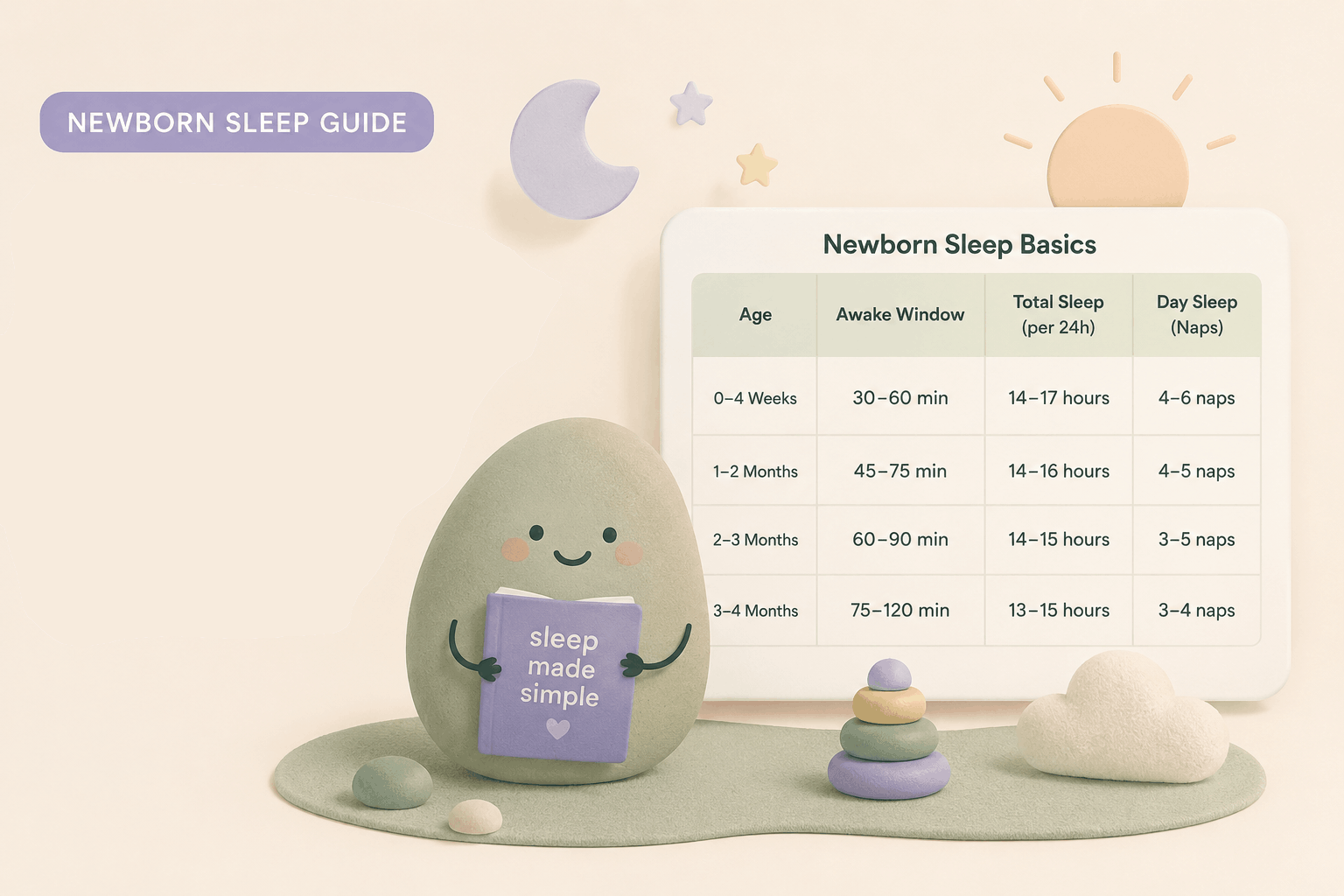
Use this table as a reference point, not a schedule.
| Age | Total sleep in 24 hours | Typical awake window | Naps / sleep blocks | Longest stretch you may see | What is reassuring |
|---|---|---|---|---|---|
| 0-1 week | Around 16-20 hours | 30-60 minutes | Many short sleeps, often 6+ blocks | Often 1-3 hours | Wakes for feeds, has wet/dirty nappies, not unusually hard to wake |
| 1-4 weeks | Around 15-18 hours | 45-75 minutes | 5-8+ sleep blocks | Often 2-4 hours | Feeds regularly, has wet nappies, has some alert periods |
| 1-2 months | Around 14-17 hours | 60-90 minutes | 4-6+ naps/sleeps | Some babies manage 3-5 hours | Feeding and growth are on track, sleep gradually becomes less random |
| 2-3 months | Around 14-16 hours | 75-120 minutes | 3-5 naps plus night sleep | Some babies manage 4-6 hours | Day/night rhythm may begin to appear |
| 3-6 months | Around 12-16 hours | 1.5-2.5 hours | Usually 3-4 naps, then gradually fewer | Some longer night stretches | Baby is feeding, growing, alert when awake and generally well |
The most important column is not the exact number. It is "what is reassuring".
A newborn who has a 45-minute wake window and sleeps most of the day can be completely normal. A newborn who stays awake for two or three hours sometimes can also be fine, especially if they are feeding, having nappies, and not distressed or unwell.
The numbers are there to give you context, not to create a target.
What does "16-20 hours of sleep" actually look like?
When people hear "newborns sleep up to 18 or 20 hours a day", they often imagine one long peaceful stretch.
That is usually not what happens.
A newborn's day might look more like this:
| Time | What happens |
|---|---|
| 06:00 | Wake and feed |
| 06:45-08:15 | Sleep |
| 08:15 | Wake, nappy, feed |
| 09:00-10:30 | Sleep |
| 10:30 | Wake, short alert period |
| 11:15-12:00 | Sleep |
| 12:00 | Feed |
| 13:00-15:00 | Sleep |
| 15:00 | Feed, nappy |
| 16:00-16:40 | Short nap |
| 17:30 | Feed |
| 18:15-19:00 | Sleep |
| Evening | Cluster feeds / short naps / fussiness |
| Overnight | Wakes every 2-3 hours for feeds |
That can still add up to a lot of sleep.
It just does not feel like a lot of sleep to the adults.
Wake windows: helpful, but not a stopwatch
A wake window is the time your baby is awake between sleeps.
For newborns, wake windows are often short:
| Age | Typical wake window |
|---|---|
| 0-2 weeks | 30-60 minutes |
| 2-4 weeks | 45-75 minutes |
| 1-2 months | 60-90 minutes |
| 2-3 months | 75-120 minutes |
| 3-4 months | 90 minutes-2 hours |
| 4-6 months | 1.5-2.5 hours |
These are rough ranges.
Some newborns will only manage a feed and nappy change before needing sleep again. Others will stay awake for longer, especially during fussy evenings, after visitors, or when they are struggling to settle.
A longer wake window is not automatically a problem.
It becomes more useful to pay attention if:
- baby is regularly overtired and hard to settle
- feeds are affected
- crying escalates after long awake periods
- naps become very short all day
- baby seems unusually sleepy or unusually unsettled
- the pattern changes suddenly
Think of wake windows as a hint, not an instruction.
Is 20 hours of newborn sleep too much?
Not always.
Some newborns sleep a huge amount, especially in the first days. Around 16-20 hours in 24 hours can be within a normal newborn range.
The more important question is whether your baby is waking and feeding effectively.
A very sleepy baby needs advice if they are:
- difficult to wake for feeds
- too sleepy to feed properly
- having fewer wet nappies than expected
- losing weight or not gaining as expected
- unusually floppy or quiet
- jaundiced and increasingly sleepy
- feverish, cold, breathing differently or otherwise unwell
So the question is not only "how many hours did they sleep?"
It is:
Are they sleeping a lot and feeding, weeing, pooing and waking well enough?
That is the useful distinction. For nappy clues, see newborn wet and dirty nappies. For feeding amounts, see how much milk should my baby drink.
Is my newborn awake too long?
Sometimes newborns are awake for longer than the table says.
That does not automatically mean something is wrong.
A newborn might stay awake for a few hours because:
- they are cluster feeding
- they have wind
- they want contact
- they are overstimulated
- they are overtired and struggling to switch off
- they are uncomfortable
- the household is busy
- they are just having an alert spell
If baby is otherwise well, feeding, having nappies and eventually sleeping, a long awake stretch can simply be one of those newborn days.
It is more concerning if long awake periods are paired with:
- constant inconsolable crying
- poor feeding
- fewer wet nappies
- fever or low temperature
- vomiting repeatedly
- breathing concerns
- baby seeming in pain
- baby seeming unusually floppy or unwell
A single long wake window is not usually the issue. The wider pattern matters.
Why newborn sleep is so broken
Newborns wake often because they are newborns.
They have small stomachs. They need frequent feeds. Their body clock is immature. They are still adjusting to light, noise, temperature, hunger, wind, nappies and being outside the womb.
Broken sleep is not a sign that you have failed to create a routine.
It is biology.
Common reasons newborns wake include:
- hunger
- needing a nappy change
- wind or discomfort
- wanting contact
- being too hot or too cold
- noisy digestion
- startle reflex
- day/night rhythm not yet developed
- normal short sleep cycles
That does not make the sleep deprivation easier. But it may make it feel less personal.
"My newborn sleeps all day": is that normal?
Many newborns sleep for a large part of the day.
That can be normal, especially in the earliest weeks. But sleep should not stop your baby from feeding effectively.
Sleepiness needs advice if your baby:
- is hard to wake for feeds
- does not feed effectively once awake
- falls asleep immediately every feed
- has fewer wet nappies than expected
- seems floppy or unusually quiet
- has a fever or low temperature
- is jaundiced and very sleepy
- is not gaining weight as expected
- seems unlike themselves
A sleepy newborn can still be a well newborn, but if sleepiness is affecting feeding or output, do not simply watch and wait. Ask for help.
"My newborn won't sleep unless held"
This is very common in the early weeks.
Newborns often settle best close to a caregiver. They have spent months being warm, held and surrounded by movement. A still, flat sleep space can feel like a big change.
That said, safer sleep matters. For sleep, follow safer sleep guidance: baby on their back, in a clear, firm, flat sleep space, with appropriate room-sharing advice and no loose bedding or unsafe surfaces.
If your baby only sleeps on you, it is worth thinking practically:
- can another adult take a safe awake shift?
- can you place baby down once deeply asleep?
- are feeds, wind or discomfort making settling harder?
- are you at risk of falling asleep on a sofa or chair?
- do you need more support overnight?
The problem is not that your newborn wants contact. The risk is exhausted adults accidentally falling asleep in unsafe places.
Day and night confusion
Many newborns do not know that night is for sleeping.
They may sleep deeply during the day and wake frequently at night. This can be brutal, but it is common.
You can gently help day and night feel different:
| During the day | At night |
|---|---|
| Open curtains | Keep lights low |
| Use normal household sounds | Keep voices quiet |
| Offer interaction when awake | Keep feeds boring and brief |
| Go outside if possible | Avoid play |
| Do normal daytime care | Change only when needed |
This is not sleep training. It is just helping your baby gradually learn the difference.
Short naps are normal
Newborn naps can be tiny.
Some babies nap for 20 minutes. Some sleep for two hours. Some do both in the same day.
Short naps may happen because:
- baby needs feeding
- baby has wind
- baby is in active sleep
- baby startles
- baby wants contact
- baby is overtired
- baby has simply finished that sleep cycle
One short nap does not mean the day is ruined.
If every sleep is short, baby is constantly distressed, feeding poorly or seems unwell, that is different. But short naps by themselves are often part of newborn life.
Newborn sleep and feeding are linked
Sleep and feeding are closely connected.
A baby who sleeps for long stretches may miss feeds. A baby who feeds very often may sleep in shorter chunks. A baby who is struggling to feed may become sleepy at the breast or bottle. A baby who is overtired may feed less effectively.
That is why sleep makes more sense when viewed with feeds and nappies.
| Pattern | What it may suggest |
|---|---|
| Baby sleeps long stretches but feeds well and has nappies | May be normal, but follow age-specific advice |
| Baby sleeps long stretches and is hard to wake for feeds | Ask for advice |
| Baby wakes hourly but feeds and nappies are normal | May be normal newborn behaviour |
| Baby wakes hourly and seems distressed or unwell | Look at feeds, nappies and symptoms |
| Baby sleeps all day and has fewer wet nappies | Seek advice |
| Baby has short naps but is feeding and growing | Often normal |
A sleep log is most useful when it sits beside feeds and nappies, not when it is judged alone. For what to log when something feels off, see what to track in your baby's first week.
Should you track newborn sleep?
You do not have to track every nap.
For some parents, detailed sleep tracking becomes another source of pressure. If your baby is well and you are not worried, rough awareness may be enough.
Sleep tracking can help when:
- baby seems unusually sleepy
- baby is hard to wake for feeds
- you are trying to understand day/night confusion
- care is shared between parents or caregivers
- you want to know what happened overnight
- crying seems linked to overtiredness
- illness, medication or feeding concerns are affecting sleep
That is where Pebbi can be useful: not to optimise every nap, but to give tired adults a shared memory of the day. For 3am logging when your brain will not hold the last feed, see Baby Tracking at 3am.
A simple sleep log example
A low-friction sleep record might look like this.
| Time | Event | Note |
|---|---|---|
| 06:20 | Woke | Fed after waking |
| 07:10-08:30 | Sleep | Cot |
| 09:00 | Feed | Short feed |
| 09:40-10:05 | Sleep | Contact nap |
| 11:15-12:45 | Sleep | Longer nap |
| 13:00 | Nappy | Wet + dirty |
| 14:10-14:35 | Sleep | Woke crying |
| 16:00 | Note | Hard to settle, likely overtired |
| 18:30-19:10 | Sleep | Carrier nap |
This is not a perfect sleep schedule. It is a sketch of the day.
That is often enough.
What to note if sleep seems concerning
If you are worried about your baby's sleep, useful notes include:
| Detail | Example |
|---|---|
| Hard to wake | "Needed repeated attempts to wake for feed" |
| Feeding link | "Fell asleep immediately at breast" |
| Nappy link | "Only two wet nappies today" |
| Temperature/symptoms | "Felt hot, checked temperature" |
| Change from usual | "Much sleepier than yesterday" |
| Crying pattern | "Wakes screaming after 10-15 minutes" |
| Professional advice | "Health visitor asked us to monitor feeds and sleepiness" |
This is where simple tracking is genuinely useful. It gives you a timeline if you need advice.
Safer sleep basics
Every sleep matters: naps and night sleep.
Use up-to-date safer sleep guidance from trusted sources such as the NHS and The Lullaby Trust. In general, safer sleep advice includes:
- place baby on their back for sleep
- use a firm, flat, clear sleep space
- keep loose bedding, pillows and soft toys out of the sleep space
- avoid sleeping with baby on a sofa or armchair
- keep baby in the same room as you for at least the first 6 months
- avoid overheating
- make sure anyone caring for baby knows the safer sleep setup
This section is not here to frighten you. It is here because sleep advice is only helpful if it is safe.
What Pebbi can help with
Pebbi can help you answer practical sleep questions:
- When did baby last sleep?
- How long was the last nap?
- Did they wake to feed?
- Did sleep change after illness or vaccination?
- Are short naps happening all day or just in the evening?
- What happened overnight while one parent slept?
- Is baby unusually sleepy compared with yesterday?
It can also make shared care easier.
If one person did the early morning shift, another person can see the broad pattern without needing a half-asleep handover.
But Pebbi is not there to make sleep a competition. It does not need every nap logged forever. Use it when the pattern helps. Skip it when logging is just adding pressure.
When to ask for help
Speak to your health visitor, GP, midwife, NHS 111 or emergency services as appropriate if your baby:
- is unusually sleepy
- is hard to wake for feeds
- is feeding poorly
- has fewer wet nappies than expected
- is floppy or unusually quiet
- has a fever or low temperature
- has breathing difficulties
- is vomiting repeatedly
- seems seriously unwell
- has a sleep pattern that has changed suddenly and worryingly
- triggers your instinct that something is wrong
You do not need to wait until you have perfect notes. If you are worried, ask.
The anti-anxiety rule for newborn sleep
A sleep chart can be useful.
A sleep scorecard is not.
Your newborn does not need perfect nap blocks, a tidy routine or a predictable night. They need safe sleep, regular feeding, care from adults who are supported, and help if something seems wrong.
If tracking sleep helps you see the pattern, use it.
If tracking every nap makes you feel worse, step back.
The aim is not to optimise your baby.
The aim is to understand enough to care for them well.