
Published
Quick answer: A wake window is the time your baby is awake between sleeps. As a broad guide: 0-2 weeks around 30-60 minutes, 2-4 weeks 45-75 minutes, 1-2 months 60-90 minutes, 2-3 months 75-120 minutes, and 4-6 months around 1.5-2.5 hours. These are prompts, not rules.
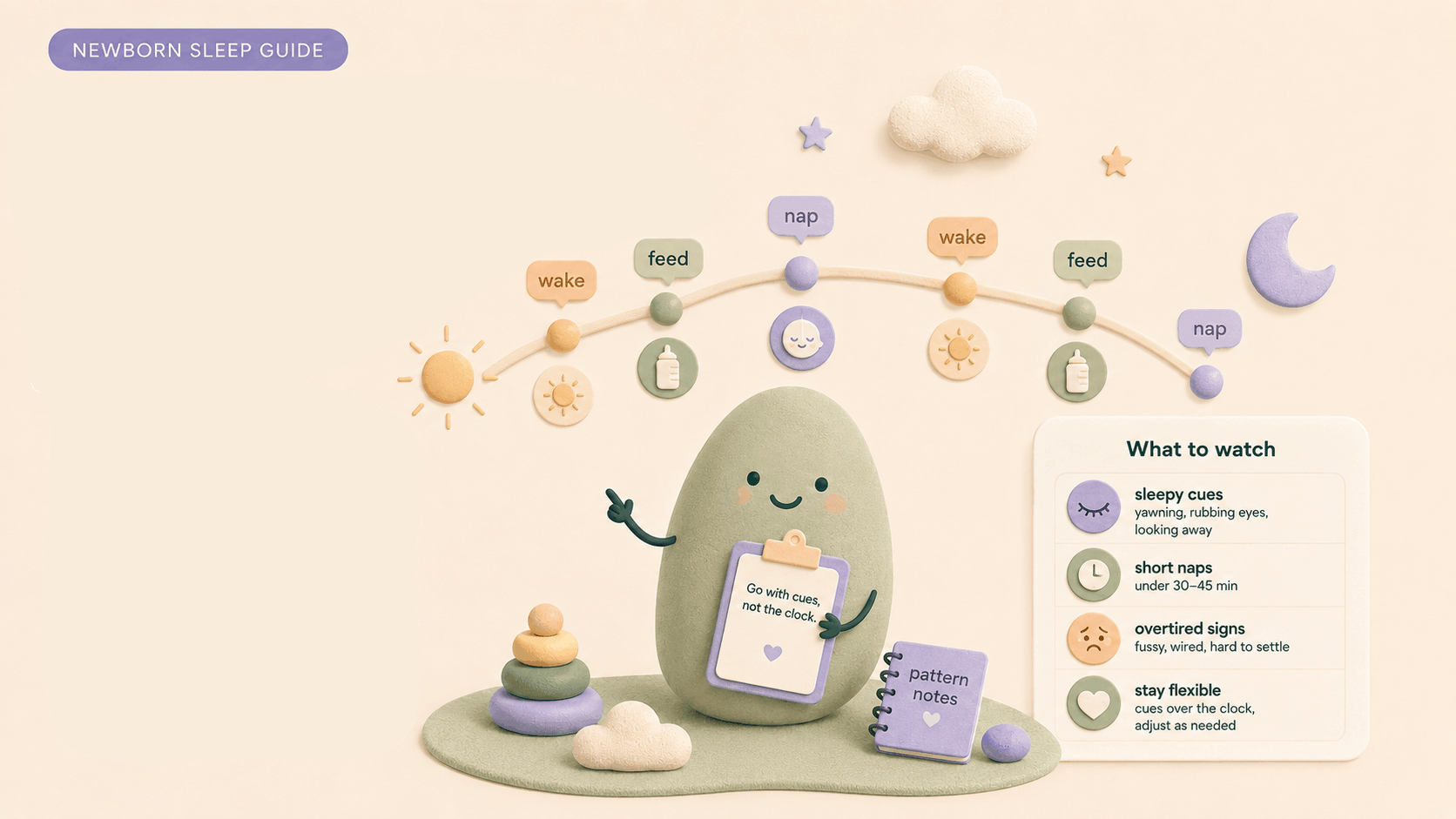
- Watch sleep cues and your baby's mood as much as the clock; early cues are easier to work with than overtired fussing.
- Short nap, shorter next wake window: a 20-minute nap often means baby may need sleep again sooner.
- Use wake windows to notice when sleep might help, not to score the day if baby stays awake longer or naps earlier than the table.
"Wake windows" sound like they should make baby sleep easier.
Then suddenly you are watching the clock, counting minutes, wondering whether your baby has been awake too long, not long enough, or just long enough to ruin the next nap.
That is not how this is meant to work.
Awake windows can be helpful. They give you a rough idea of how long babies at different ages may manage before they need sleep again.
But they are not a rulebook. They are not a test. They are not proof that you have failed if your newborn stays awake for two hours or your 3-month-old naps after 55 minutes.
This guide gives you practical awake-window ranges from newborn to 6 months, explains sleep cues and overtired signs, and shows how to use wake windows without turning baby sleep into another source of pressure.
For total sleep amounts and what a newborn day can look like, see how much sleep does a newborn need. For sleep logs across caregivers, see baby sleep tracking for shared care.
Key takeaways
- Wake windows are the time between sleeps; they are useful prompts, not a stopwatch or a pass/fail test.
- Ranges widen with age (roughly 30-60 minutes for newborns up to 1.5-2.5 hours by 4-6 months), but your baby's cues matter more than the exact minute.
- Overtired babies may fight sleep; undertired babies may also resist naps: look at mood, feeds and pattern over several days.
- After a short nap, try a shorter next wake window.
- Pebbi can help spot patterns over a few days when shared care makes the day hard to hold in your head.
Wake windows by age
Use this table as a practical reference.
| Age | Typical wake window | What that might look like | Useful reminder |
|---|---|---|---|
| 0-2 weeks | 30-60 minutes | Wake, feed, nappy, brief alert time, back to sleep | Feeding and changing can fill the whole window |
| 2-4 weeks | 45-75 minutes | Feed, nappy, short cuddle or look around, sleep cues | Long wake spells can happen, especially evenings |
| 1-2 months | 60-90 minutes | More alert time, some interaction, then nap | Watch cues as much as the clock |
| 2-3 months | 75-120 minutes | Longer play/interaction, clearer tired signs | Short naps can still disrupt the day |
| 3-4 months | 90 minutes-2 hours | More predictable rhythm may begin | Some babies still need shorter windows |
| 4-6 months | 1.5-2.5 hours | More defined naps and longer awake periods | Sleep needs still vary widely |
If your baby was premature, unwell, struggling to feed, not gaining weight as expected, or you have been given specific advice, follow your health professional's guidance.
Why awake windows can help
Babies can get overtired.
That sounds simple, but overtired babies do not always just fall asleep. Sometimes they do the opposite.
They may:
- cry more
- arch away
- fight sleep
- feed less effectively
- take a very short nap
- wake quickly after being put down
- seem wired, not sleepy
- need much more help settling
An awake window gives you a rough point at which sleep might become easier if you start winding down.
For example, if your 3-week-old has been awake for 70 minutes and is starting to fuss, you might think:
This could be tiredness. Let's try a quieter room and a nap.
That is useful.
What is less useful is thinking:
The table says 60 minutes and we are at 73 minutes, so the day is ruined.
It is not.
What a 45-minute newborn wake window can look like
A newborn wake window can disappear quickly.
Here is a completely normal example:
| Time | What happens |
|---|---|
| 08:00 | Baby wakes |
| 08:05 | Feed starts |
| 08:25 | Feed ends |
| 08:30 | Nappy change |
| 08:35 | Short cuddle / wind / look around |
| 08:45 | Baby yawns and fusses |
| 08:50 | Settling for sleep |
| 09:00 | Asleep |
That was a one-hour wake window, and it barely included any "play".
That is normal.
For a newborn, feeding and changing are activity. They do not need a full sensory development programme before every nap.
Sleep cues: what to watch for
The clock is only one clue. Your baby gives clues too.
Common sleep cues include:
| Early cues | Later cues |
|---|---|
| Staring away | Fussing |
| Slower movements | Red eyebrows or eyes |
| Zoning out | Jerky movements |
| Yawning | Crying |
| Looking less engaged | Arching or pushing away |
| Turning head away | Becoming harder to settle |
Early cues are easier to work with. Later cues may mean baby is already overtired.
But babies are not consistent. Some yawn when they are bored. Some rub their eyes because they are tired. Some show almost no cues until they are suddenly furious.
That is why awake windows are helpful alongside cues: they give you context when cues are unclear.
Overtired or undertired?
Sometimes babies fight sleep because they are overtired.
Sometimes they fight sleep because they are not tired enough.
This is where parents can tie themselves in knots.
Here is a practical comparison.
| Pattern | More likely overtired | More likely undertired |
|---|---|---|
| Time awake | Longer than usual for age or your baby | Shorter than usual for age or your baby |
| Mood | Frantic, crying, arching, hard to soothe | Alert, smiling, looking around |
| Settling | Seems desperate but cannot switch off | Calm but not sleepy |
| Nap | Very short, wakes upset | Short or delayed, wakes content |
| Feed | May feed poorly or fuss at breast/bottle | Usually feeds normally |
| Body language | Jerky, tense, red-eyed | Engaged, curious |
This is not exact science. It is pattern-spotting.
If the same thing happens for several days, that is when a simple record can help.
"My newborn is awake for hours": is that okay?
Sometimes, yes.
A newborn might stay awake for hours because:
- they are cluster feeding
- they have wind
- they are overstimulated
- they want contact
- they are uncomfortable
- they are overtired
- visitors or household noise made sleep harder
- they are having an alert spell
- evening fussiness has arrived
A long awake stretch is less worrying if your baby is feeding, having wet nappies, eventually sleeping and otherwise seems well.
It is more concerning if your baby is:
- inconsolable
- feeding poorly
- having fewer wet nappies
- vomiting repeatedly
- feverish or unusually cold
- breathing differently
- floppy or unusually sleepy afterwards
- seeming in pain
- generally unwell
One long wake window can be normal. A worrying cluster of symptoms needs advice.
"My baby seems sleepy after only 20 minutes"
This can also be normal, especially for newborns.
A baby might seem tired quickly because:
- they had a short previous nap
- feeding took a lot of energy
- they are in the early newborn stage
- they are recovering from birth
- they are unwell or jaundiced
- they are overstimulated
- they need contact and quiet
If your newborn has only been awake for 20-30 minutes but is showing clear sleep cues after a feed and nappy change, it is usually fine to help them sleep.
But seek advice if they are repeatedly too sleepy to feed, difficult to wake, floppy, having fewer wet nappies, or not gaining weight as expected.
Awake windows and short naps
Short naps can make wake windows tricky.
If your baby only slept for 20 minutes, they may not manage a full usual wake window afterwards. They may need another nap sooner.
A simple rule:
Short nap, shorter next wake window.
For example:
| If baby's usual wake window is… | After a short nap, try watching around… |
|---|---|
| 60 minutes | 40-50 minutes |
| 90 minutes | 60-75 minutes |
| 2 hours | 90 minutes |
| 2.5 hours | 2 hours |
This is not a strict formula. It is just a way to avoid asking an already-tired baby to stay awake for too long.
Awake windows and feeding
Feeding can make wake windows look odd.
A newborn might wake, feed for 40 minutes, need a nappy change, and already be ready for sleep. Another baby may wake hungry, feed quickly, then have a longer alert spell.
Both can be normal.
Awake windows are especially useful when you look at them beside feeds:
| Pattern | Possible explanation |
|---|---|
| Baby wakes hungry after every short nap | Normal newborn feeding, growth spurt or short sleep cycle |
| Baby falls asleep immediately at every feed | May be normal, but ask if feeds are ineffective or nappies are low |
| Baby has long awake stretches after cluster feeds | Evening fussiness or difficulty settling |
| Baby cries after long awake periods | Overtiredness may be part of the picture |
| Baby is awake for hours and feeding poorly | Seek advice |
This is why Pebbi can be helpful for some families: it lets you see sleep, feeds and nappies together, instead of trying to remember each piece separately.
How to use wake windows without obsessing
Try this approach.
1. Start with the rough range
Use the age table as a loose guide.
For a 1-month-old, you might know that 60-90 minutes awake is common.
2. Watch your baby
Look for sleep cues, feeding cues, overstimulation, wind, discomfort and mood.
3. Start winding down before things unravel
A nappy change, dimmer room, quieter voice or familiar settling rhythm can help.
4. Do not panic if the nap does not happen
Some babies need more help. Some days are off. Some naps fail.
That does not mean the whole day is broken.
5. Look for patterns over several days
One weird wake window means very little. A repeated pattern can be useful.
A practical wake-window example
Here is how a day might look with a 6-week-old.
| Time | Event | Note |
|---|---|---|
| 06:30 | Wake | Wet nappy |
| 06:40 | Feed | Good feed |
| 07:30-08:20 | Sleep | 50-minute nap |
| 08:20 | Wake | Alert |
| 09:30-10:10 | Sleep | Settled after 70-min wake window |
| 10:15 | Feed | Shorter feed |
| 11:05-11:25 | Sleep | Short nap |
| 12:05 | Sleep attempt | Earlier window after short nap |
| 12:15-13:30 | Sleep | Longer nap |
| Evening | Fussy | Short feeds and short naps |
This is messy, but it tells a story.
Short nap, shorter next wake window. Longer nap, more manageable next window. Evening, normal chaos.
That is much more useful than trying to force every nap into an exact time.
When a simple log helps
You do not need to log every wake window forever.
But a few days of notes can help if:
- naps are suddenly very short
- baby is hard to settle
- evenings are getting intense
- feeds seem affected by tiredness
- baby seems unusually sleepy
- care is shared between adults
- you want to understand whether wake windows are too long or too short
- you need to explain a pattern to a health visitor or GP
A helpful log might include:
| Detail | Example |
|---|---|
| Wake time | 07:10 |
| Sleep time | 08:05 |
| Wake window | Around 55 minutes |
| Feed | Fed before nap |
| Nappy | Wet nappy before settling |
| Mood | Fussing after 45 minutes |
| Nap result | Slept 35 minutes |
| Note | Settled better when started earlier |
This is enough. You do not need a nap spreadsheet.
If you are logging at 3am, Baby Tracking at 3am covers practical memory when you are exhausted.
What Pebbi can help with
Pebbi is useful when you want a simple shared picture of the day:
- when baby last woke
- when baby last slept
- how long the last wake window was
- whether short naps are repeating
- whether feeds and naps are clashing
- whether a caregiver needs context before taking over
- whether baby seems more overtired than usual
It is especially helpful when more than one person is caring for the baby. One adult can see that the last nap was only 20 minutes, or that baby has been awake for nearly two hours, without needing a whispered handover. See shared care baby tracking for the broader handover picture.
But Pebbi is not there to make you chase perfect wake windows.
Use it to reduce guesswork, not to create another target.
When wake windows are not the problem
Sometimes sleep difficulty is not about timing.
It might be:
- hunger
- wind
- reflux or discomfort
- illness
- temperature
- overstimulation
- developmental change
- teething
- separation or contact needs
- unsafe or unsuitable sleep environment
- parental exhaustion and lack of support
If you keep adjusting wake windows and nothing improves, it may be worth stepping back.
The question may not be "what is the perfect window?"
It may be:
What else is making sleep hard?
Safer sleep still comes first
No wake window is more important than safer sleep.
For every sleep, including naps, use trusted safer sleep guidance from the NHS and The Lullaby Trust. In general:
- place baby on their back
- use a firm, flat, clear sleep surface
- avoid loose bedding, pillows and soft toys
- avoid sofa or armchair sleeping with baby
- keep baby in the same room as you for at least the first 6 months
- avoid overheating
- make sure other caregivers know the safer sleep setup
If baby falls asleep in a bouncer, swing, car seat or carrier, follow current safety guidance for that product and move them to a safer sleep space when appropriate.
When to ask for advice
Speak to your health visitor, GP, midwife, NHS 111 or emergency services as appropriate if your baby:
- is unusually sleepy
- is hard to wake for feeds
- is feeding poorly
- has fewer wet nappies than expected
- is floppy or unusually quiet
- has a fever or low temperature
- has breathing difficulties
- is vomiting repeatedly
- seems in pain
- is inconsolable
- has a sudden worrying change in sleep
- triggers your instinct that something is wrong
Wake windows are not a substitute for medical advice.
The anti-anxiety rule for awake windows
Wake windows are useful when they help you notice:
"Ah, baby has been awake a while. Sleep might help."
They are not useful when they become:
"The app says 73 minutes and now I have ruined the day."
Your baby does not need perfect timing. They need feeding, nappies, safe sleep, comfort, and adults who are not being made to feel like sleep managers.
Use the range. Watch your baby. Track only when it helps.
Then let the rest be flexible.