
Published
Quick answer: Babies cry for many reasons: hunger, tiredness, wind, discomfort, nappy needs, overstimulation, wanting contact, evening fussiness, or illness. A single cry is hard to decode; look at the pattern around feeds, nappies, sleep and symptoms.
- Ask when baby last fed, had a wet or dirty nappy, slept, and how long they have been awake; note if crying is new or different for your baby.
- Evening crying is common; cluster feeding, tiredness and overstimulation may all play a part without meaning something is seriously wrong.
- Seek advice if baby is inconsolable, feeds poorly, has fewer wet nappies, fever, breathing difficulty, repeated vomiting, or your instinct says something is wrong.
Few sounds cut through a room like your own baby crying.
It can make time feel urgent. It can make your body tense before your brain has caught up. And when you are tired enough, it can make every possible explanation feel equally likely.
Are they hungry? Overtired? Windy? Too hot? Too cold? Unwell? Just having a hard evening?
There is no perfect baby-cry translator.
But there is a practical way to make crying feel less impossible to understand: look at the context around it.
Feeds. Nappies. Sleep. Awake time. Symptoms. Time of day. What changed.
This guide will not tell you that every cry has a neat meaning. It will help you spot the patterns that are actually useful.
Key takeaways
- You cannot decode every cry on sound alone; what happened before the crying often matters more.
- Feeds, nappies, sleep, wake windows and symptoms sit together in a useful picture.
- Crying after feeding, before sleep, during nappy changes, or every evening each has common (often overlapping) explanations.
- A short timeline over a day or two can clarify patterns; logging every squeak usually does not help.
- Seek advice for worrying symptoms; get support for yourself if crying feels overwhelming.
The first rule: you cannot decode every cry
Some baby content suggests every cry can be translated exactly.
Hungry cry. Tired cry. Wind cry. Pain cry.
Sometimes that is obvious. Often it is not.
A hungry baby can sound tired. An overtired baby can root like they are hungry. A windy baby can cry after feeding. A baby who wants contact can seem unsettled even when every practical need has been met.
So instead of trying to identify the perfect cry category, it is often more useful to ask:
What happened before the crying?
That is where patterns begin.
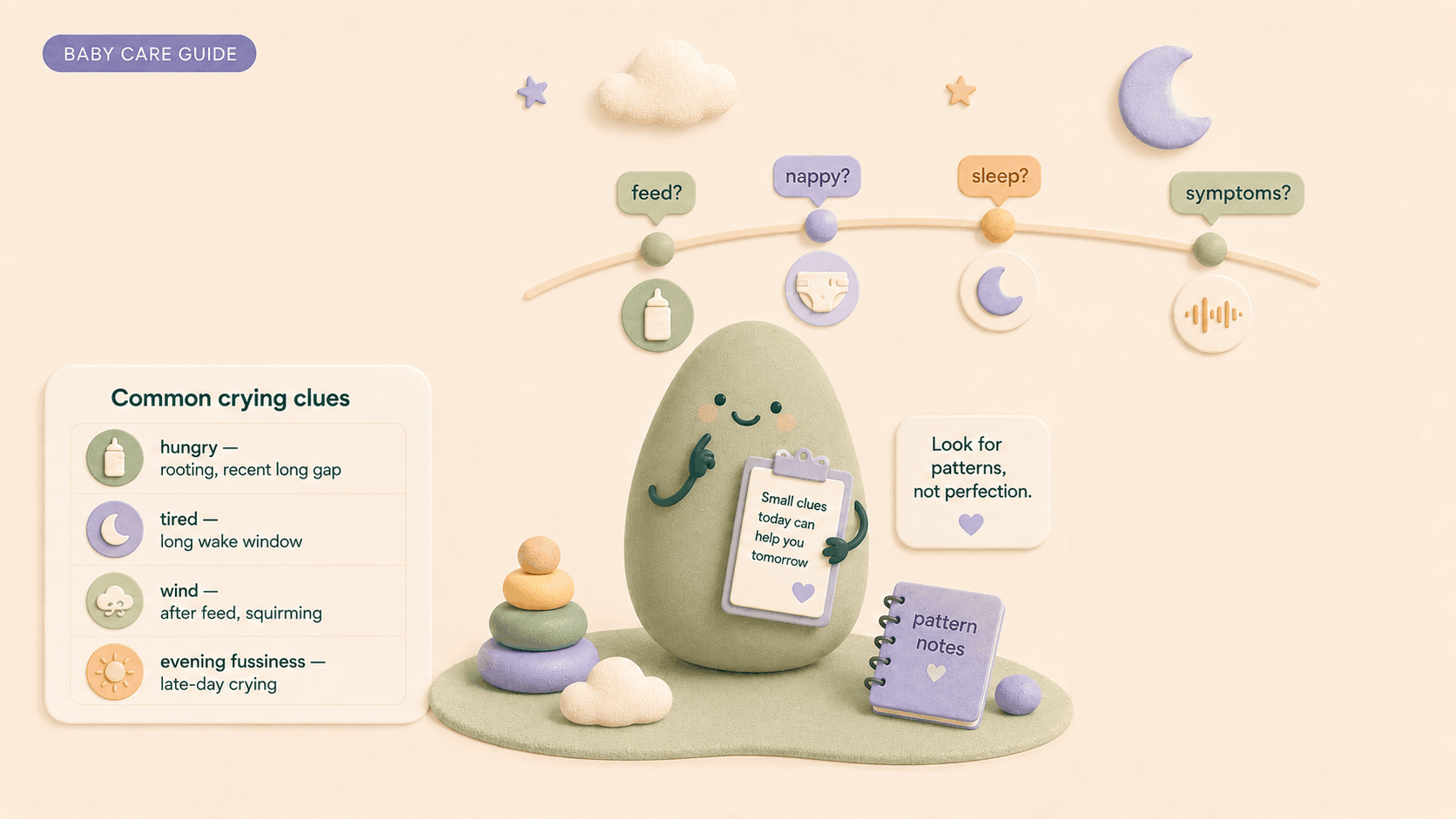
Common crying clues
This table is not a diagnostic tool. It is a way to think.
| Crying pattern | Possible context | What to check |
|---|---|---|
| Crying and rooting | Hunger, cluster feeding, comfort sucking | Last feed, feeding cues, nappies |
| Crying after feeding | Wind, reflux, still hungry, tiredness, discomfort | Feed quality, burping, vomiting, position, nappies |
| Crying before sleep | Overtiredness, overstimulation, needing help settling | Wake window, sleep cues, last nap |
| Crying during nappy change | Cold, surprise, sore skin, dislike of being undressed | Rash, temperature, gentle handling |
| Crying every evening | Witching hour, cluster feeding, tiredness, overstimulation | Time of day, feeds, naps, settling |
| Crying with fewer wet nappies | Possible low intake or dehydration concern | Feeds, wet nappies, alertness, seek advice |
| Sudden high-pitched or unusual crying | Pain, illness or urgent issue | Symptoms, temperature, medical advice |
The point is not to solve every cry instantly.
The point is to move from panic to useful checks.
Hungry baby crying signs
Hunger can be one of the easier patterns to spot, especially if you catch it early.
Early hunger cues may include:
- stirring
- turning head
- rooting
- sucking hands
- opening mouth
- becoming more alert
- mouthing or lip smacking
Crying is often a later hunger cue.
If your baby is already crying hard, feeding may be more difficult because they are distressed. A short pause to hold, soothe or help them latch or bottle calmly may help.
Hunger is more likely if:
- the last feed was a while ago
- the last feed was short or sleepy
- baby is rooting or sucking hands
- baby settles at the breast or bottle
- they are in a growth spurt or cluster-feeding phase
But hunger is not the only reason babies cry. If feeds are constant and nappies, weight gain or latch are worrying you, ask for support. See is my breastfed baby getting enough milk and cluster feeding.
Baby crying after feeding
"Why is my baby crying after feeding?" is one of the most common parent searches for good reason.
It feels confusing. Feeding was supposed to help.
Crying after feeding might be linked to:
| Possible reason | What you might notice |
|---|---|
| Wind | Squirming, pulling legs up, unsettled after bottle/breast |
| Still hungry | Rooting, sucking hands, settling when offered more |
| Overtiredness | Crying after a long wake window, hard to soothe |
| Reflux or discomfort | Frequent spit-up, arching, distress after feeds |
| Fast flow | Coughing, spluttering, gulping, pulling off |
| Slow flow or poor transfer | Frustration, long feeds, still unsettled |
| Normal fussiness | Short unsettled spell but otherwise well |
One unsettled feed is not necessarily a problem.
Ask for advice if crying after feeds is persistent, baby is vomiting repeatedly or forcefully, has fewer wet nappies, feeds poorly, seems in pain, has blood in stools, is not gaining weight as expected, or seems unwell.
Baby crying before sleep
Crying before sleep is often linked to tiredness, but it is not always simple.
An overtired baby may:
- yawn
- stare away
- rub eyes
- have red eyebrows or eyes
- fuss
- arch
- push away
- cry even when held
- fight sleep despite seeming exhausted
This is where wake windows can help.
If your newborn has been awake for 90 minutes and is crying before a nap, tiredness may be part of the story. If your 4-month-old has only been awake 20 minutes and is happily alert, sleep may not be the answer yet.
Useful checks:
- When did baby last sleep?
- Was the last nap short?
- How long have they been awake?
- Are they showing sleep cues?
- Is the room overstimulating?
- Are they hungry as well as tired?
Babies often cry when more than one need overlaps. Hungry and overtired is a classic combination. For newborn sleep totals, see how much sleep does a newborn need.
Baby crying after a nappy change
Some babies hate nappy changes.
They may cry because:
- they feel cold
- they dislike being undressed
- the wipe is cold
- they are hungry and you interrupted the feed
- they have nappy rash
- they are startled
- they want to be held differently
- they are already tired or overstimulated
If crying happens only during changes and baby settles afterwards, it may simply be dislike.
Check for:
- rash
- broken skin
- swelling
- unusual discharge
- blood
- signs of pain when touched
- fewer wet nappies
- diarrhoea or very hard stools
If the cry seems painful or something looks unusual, seek advice. For what normal output looks like, see newborn wet and dirty nappies.
Why does my baby cry every evening?
Evening crying is very common.
You may hear it called:
- the witching hour
- evening fussiness
- colic
- purple crying
- cluster feeding
- "that awful bit before bedtime"
It often starts when babies are a few weeks old and may peak around six weeks, though every baby is different.
Evening crying may be linked to:
- tiredness building through the day
- cluster feeding
- lower evening milk supply for some breastfeeding parents
- overstimulation
- immature digestion
- wind
- needing contact
- normal developmental changes
A useful pattern might look like this:
| Time | Pattern |
|---|---|
| 16:00 | Short nap |
| 17:00 | Feed |
| 17:30 | Fussy |
| 18:00 | Wants more feeding |
| 18:30 | Crying unless held |
| 19:30 | Short sleep |
| 20:00 | Wakes crying again |
This can be normal, but it is still hard.
The fact that something is common does not mean you should be left unsupported.
Colic: what it means and what it does not mean
Colic is often used to describe repeated, intense crying in an otherwise healthy baby.
A traditional definition is crying for more than three hours a day, more than three days a week, for more than three weeks. Real life is usually messier than that.
The important part is this:
Colic should not be used to dismiss your concern if something feels wrong.
Before assuming "just colic", consider whether there are warning signs:
- fever or low temperature
- poor feeding
- fewer wet nappies
- repeated vomiting
- blood in nappies
- breathing difficulty
- poor weight gain
- unusual sleepiness
- baby seems in pain
- crying is very different from usual
If any of those are present, seek advice. NHS guidance on crying babies may help; for urgent concerns use NHS 111 or emergency services as appropriate.
What to try when baby is crying
Start simple.
| Check | What to try |
|---|---|
| Feed | Offer breast or bottle if hungry cues are present |
| Nappy | Check wet/dirty nappy or rash |
| Sleep | Reduce stimulation, try settling |
| Wind | Hold upright, gentle burping, time |
| Temperature | Check baby is not too hot or cold |
| Contact | Hold, rock, carrier, skin-to-skin if safe |
| Environment | Dim lights, reduce noise, step outside briefly |
| Symptoms | Check temperature, breathing, rash, vomiting, nappies |
Not every technique works for every baby. You are not failing if the first thing does not fix it.
If crying leads to unsafe sleep situations (sofa, armchair, exhausted parent), follow The Lullaby Trust safer sleep advice.
What to note if crying worries you
If crying is becoming a concern, notes can help you spot whether it is linked to feeds, nappies, sleep or symptoms.
Useful details include:
| Detail | Example |
|---|---|
| Time of day | "Mostly 17:00-21:00" |
| Feed link | "Cries 20 minutes after bottles" |
| Sleep link | "Worse after short naps" |
| Nappy link | "Fewer wet nappies today" |
| Symptoms | "Vomited twice, no fever" |
| Settling | "Settles upright, cries lying flat" |
| Duration | "Cries 45-60 minutes, then sleeps" |
| Change from usual | "Much higher-pitched cry than normal" |
This is where Pebbi can help. Not because crying should be turned into a graph, but because it is hard to remember patterns when everyone is tired.
A simple timeline can show:
- crying mostly follows feeds
- crying happens after long wake windows
- crying is worse on low-nap days
- crying started with diarrhoea
- crying improved after feeding support
- crying is not as constant as it feels in the moment
That can be reassuring, or it can help you explain the concern clearly. For what is worth logging when worried (without tracking everything), see what to track in your baby's first week.
A crying pattern example
Here is a useful, simple record.
| Time | Event | Note |
|---|---|---|
| 14:00 | Feed | 80 ml bottle, finished |
| 14:30 | Crying | Squirming, pulled legs up |
| 14:45 | Nappy | Wet |
| 15:00 | Sleep | Slept 35 minutes |
| 16:00 | Wake | Fussy quickly |
| 16:20 | Feed | Short feed |
| 17:00 | Crying | Worse when lying flat |
| 17:30 | Note | Settled upright on shoulder |
This does not diagnose anything.
But it gives you something practical to discuss if the pattern repeats.
When tracking crying is not helpful
Tracking crying can become too much.
If you find yourself logging every squeak, counting every minute, or feeling worse after looking at the app, simplify.
Try tracking only:
- crying that feels unusual
- crying linked to feeds
- crying linked to sleep
- crying with symptoms
- crying you plan to ask someone about
You do not need a complete crying archive.
You need useful context.
When to seek advice about baby crying
Seek medical advice if your baby:
- has a fever or low temperature
- is feeding poorly
- has fewer wet nappies
- is unusually sleepy, floppy or hard to wake
- has breathing difficulty
- vomits repeatedly or forcefully
- has green vomit
- has blood in vomit or stools
- has a rash that worries you
- has a swollen or hard tummy
- has a weak, high-pitched or unusual cry
- is inconsolable and this is not normal for them
- seems in pain
- is not gaining weight as expected
- triggers your instinct that something is wrong
Also get help for yourself if the crying is making you feel overwhelmed, unsafe, or afraid you might lose control.
Put baby down somewhere safe, step away for a moment, and call someone. Never shake a baby.
The anti-anxiety rule for crying
A cry is not a puzzle you have to solve perfectly.
Sometimes the answer is obvious. Sometimes it takes trial and error. Sometimes your baby is having a hard hour and you are doing everything you can.
Look for patterns, not perfection.
Use feeds, nappies, sleep and symptoms as clues.
And if something feels wrong, ask for help.
What Pebbi can help with
Pebbi can help you see crying in context with feeds, nappies, sleep and notes on one timeline. It cannot diagnose why your baby is crying, but it can make patterns easier to explain to a partner, health visitor, GP or paediatrician.
That is especially useful with shared care: the person on the next shift can see what happened before the crying spell without a long handover.
Use it when the timeline helps. Skip it when logging every cry adds pressure.