
Published
Quick answer: Your breastfed baby may be getting enough milk if they have wet nappies appropriate for their age, dirty nappies changing as expected in the early days, steady weight gain after the first few days, active sucking and swallowing, and periods of alertness. Ask for help if wet nappies are low, latch is painful, weight gain is slow, or baby is very sleepy at feeds.
- You cannot see how much milk transferred at the breast; nappies, weight gain, swallowing and latch comfort are more useful than feed length alone.
- Cluster feeding can look like low supply but is often normal if nappies, weight and alertness are reassuring.
- A calm log of feeds, nappies and latch notes can help you explain the pattern to a midwife or lactation supporter; it cannot diagnose milk transfer.
Breastfeeding can come with a very specific kind of worry.
With a bottle, you can see the amount. With breastfeeding, you cannot.
So you might find yourself asking:
Is my baby actually getting enough milk? Was that feed long enough? Are they swallowing or just comfort sucking? Why do they want to feed again already? Should I be worried about my supply?
These are common questions, especially in the early days.
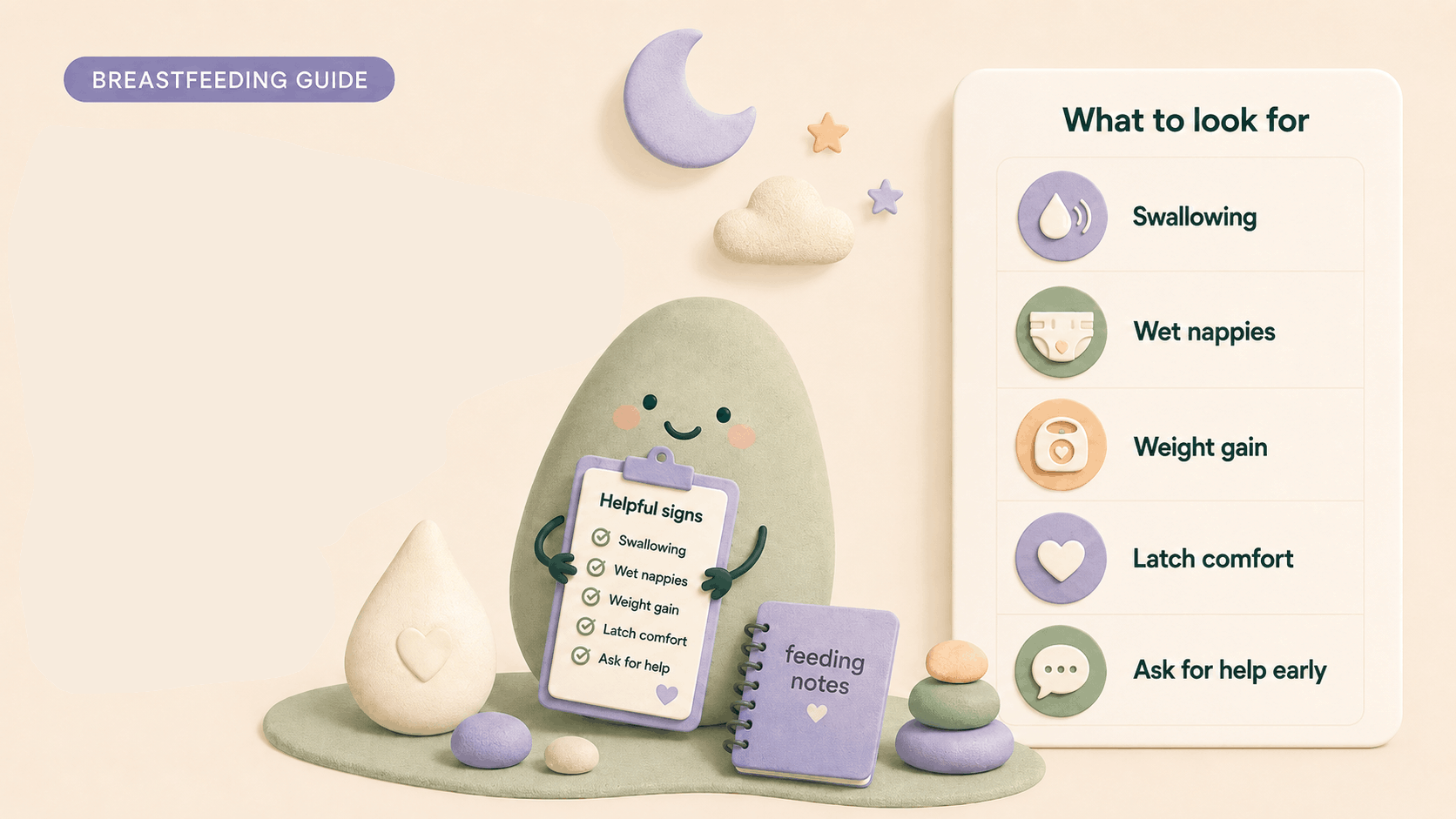
The reassuring answer is that you do not need to measure every millilitre to know whether breastfeeding is going well. There are other signs: wet nappies, dirty nappies, weight gain, active feeding, swallowing, latch comfort and your baby's general wellbeing.
But if something feels off, you also do not need to sit with that worry alone.
A few clear notes (feeds, nappies, latch concerns, sleepy feeds, weight checks) can help you explain the pattern to a midwife, health visitor, GP, lactation consultant or breastfeeding supporter.
For bottle amounts and feeding frequency across methods, see how much milk should my baby drink. For what to write down when something feels uncertain more broadly, see what to track in your baby's first week. For frequent feeds close together, see cluster feeding.
Key takeaways
- Feed length, crying and pumping output are not reliable enough on their own to judge milk intake.
- Wet nappies, weight gain, active swallowing, latch comfort and how your baby seems are more useful signs.
- Cluster feeding can be normal; low nappies, poor weight gain or ineffective feeds need support.
- Ask for breastfeeding help early if latch is painful, nipples are damaged, or you are worried about transfer.
- A short log can help you explain the pattern; it cannot replace professional assessment.
The hardest part of breastfeeding: you cannot see the amount
Breastfeeding is not like bottle feeding.
You cannot look at the breast afterwards and know your baby took 40 ml, 80 ml or 120 ml. You cannot measure transfer by sight. Pumping output does not reliably tell you what your baby can take from the breast. Feed length alone can be misleading.
That uncertainty is why breastfeeding can feel emotionally intense.
But the body gives you other clues.
Instead of asking only "how much did they drink?", it is usually more useful to ask:
- are they feeding actively?
- are they swallowing?
- are nappies happening?
- are they gaining weight?
- are they waking enough to feed?
- does the latch feel manageable?
- is this pattern improving, staying the same, or getting worse?
That is the picture you are trying to build.
Signs your breastfed baby may be getting enough milk
No single sign tells the whole story, but these are the reassuring things to look for.
| Sign | Why it helps |
|---|---|
| Wet nappies | A practical sign that milk is going in and fluid is coming out |
| Dirty nappies | Especially useful in the early days as feeding becomes established |
| Weight gain | One of the most important longer-term signs |
| Active sucking and swallowing | Suggests baby is transferring milk, not only comfort sucking |
| Baby wakes for feeds | Very sleepy babies may need feeding support |
| Periods of alertness | A useful wellbeing sign alongside feeds and nappies |
| Feeds gradually feel easier | Can suggest latch and transfer are improving |
| Some settled periods after feeds | Helpful context, though not every feed ends with a sleepy baby |
Notice the phrase "may be".
Breastfeeding is not assessed by one perfect sign. It is assessed by the whole pattern.
Wet nappies: one of the clearest early clues
Wet nappies matter because they are visible.
In the very early days, wet nappy counts usually build gradually as milk intake increases. After the first several days, many babies have more regular wet nappies.
If wet nappies seem fewer than expected, very dark, or you are worried about dehydration, seek advice promptly.
Useful things to note:
| What to notice | Why it matters |
|---|---|
| Number of wet nappies | Helps show whether output is increasing or dropping |
| Very small wet nappies | May matter if repeated or combined with poor feeding |
| Dark urine | Can be a concern, especially with low output |
| Change from usual | Your baby's pattern matters |
| Wet nappies plus feeding behaviour | More useful than either sign alone |
You do not need to become obsessed with nappy counting forever. But in the early days, or when feeding feels uncertain, nappies are one of the most useful clues.
Dirty nappies: helpful context, especially at the start
Dirty nappies also tell part of the story.
In the first days, poo usually changes as feeding becomes established. Many parents are told to watch for changes in colour and frequency, especially while breastfeeding is getting going. NHS breastfeeding guidance covers what to expect in the early days.
What is useful to notice:
- whether dirty nappies are happening
- whether they are changing as expected
- whether there is a sudden change that worries you
- whether your midwife or health visitor has asked you to monitor them
Do not try to diagnose from a single nappy. But if nappies, feeding and weight gain all seem concerning, get support.
Weight gain: the bigger-picture sign
Weight checks are one of the strongest ways professionals assess whether feeding is working over time.
It is normal for newborns to lose some weight after birth, then regain and continue gaining. Your midwife, health visitor or doctor will interpret your baby's weight in context.
Seek advice if:
- baby is not regaining weight as expected
- weight gain is slow or inconsistent
- feeding is difficult and nappies are low
- you have been told to monitor weight
- you are anxious about whether baby is transferring milk
This is one place where Pebbi can help lightly: not by interpreting weight for you, but by keeping related context together (feeds, nappies, notes from appointments, and questions you want to ask).
Breastfeeding duration is not the same as milk intake
This is important.
A 7-minute feed is not automatically too short. A 45-minute feed is not automatically better. A baby who feeds often is not automatically starving. A baby who sleeps after a feed is not automatically full.
Duration is only context.
More useful questions are:
| Instead of asking… | Ask… |
|---|---|
| "Was the feed long enough?" | "Was baby actively sucking and swallowing?" |
| "Why did they feed again so soon?" | "Is this cluster feeding, comfort, or a feeding difficulty?" |
| "Was that short feed bad?" | "Are nappies, weight and behaviour reassuring?" |
| "Why are feeds taking forever?" | "Is baby sleepy, latched shallowly, or not transferring well?" |
A breastfeeding log can include duration, but duration should not become the score.
What active feeding can look like
Active feeding usually looks different from light comfort sucking.
You may notice:
- deeper sucks
- pauses between bursts of sucking
- visible or audible swallowing
- jaw movement
- baby becoming more relaxed during the feed
- breast feeling softer afterwards, though this is not reliable for everyone
Comfort sucking may look more fluttery or shallow, with little swallowing.
Both can happen in the same feed. Comfort at the breast is not "bad". But if your baby is spending long periods at the breast with little active feeding, seems unsatisfied, has fewer wet nappies, or is not gaining weight well, ask for help.
Cluster feeding or not enough milk?
Cluster feeding is common, especially in the early weeks. It can look like baby wants to feed again and again over a few hours.
That can be normal. It can also be exhausting.
The tricky part is that cluster feeding can feel very similar to "not enough milk" anxiety.
Here is a practical comparison.
| Pattern | More likely to be normal cluster feeding if… | Ask for help if… |
|---|---|---|
| Frequent evening feeds | Baby has wet nappies, wakes normally and weight is okay | Nappies are low, baby seems weak or weight gain is poor |
| Short feeds close together | Baby has periods of active swallowing and alertness | Baby is too sleepy to feed effectively |
| Baby wants comfort at breast | Baby also has effective feeds across the day | Baby never seems to transfer milk well |
| Unsettled after some feeds | There are also settled periods | Baby is persistently distressed or unwell |
| Feeds feel intense for a few days | Pattern improves or shifts | Pattern worsens or concerns build |
You do not need to solve this alone. If you are unsure, ask.
Signs breastfeeding may need support
Breastfeeding is common, but that does not mean it is always easy.
Get help if:
- latch is painful
- pain lasts through the feed
- nipples are cracked, bleeding, blistered or misshapen after feeds
- baby clicks, slips off or cannot stay latched
- baby seems frustrated at the breast
- feeds are always very long and tiring
- baby is too sleepy to feed effectively
- you rarely hear or see swallowing
- wet nappies are fewer than expected
- baby is not gaining weight as expected
- you are using top-ups and want a plan
- you are worried about supply
- feeding is affecting your mental health
Support might come from a midwife, health visitor, GP, lactation consultant, infant feeding team, breastfeeding counsellor or trained peer supporter. La Leche League GB, the Association of Breastfeeding Mothers, and the National Breastfeeding Helpline can also offer support. NHS Start for Life has infant feeding guidance for the early weeks.
Asking early is not a failure. It is often the most practical thing you can do.
When to seek medical advice urgently
Some signs need prompt medical advice rather than waiting for a breastfeeding appointment.
Seek urgent advice if your baby:
- is not feeding
- refuses multiple feeds
- is unusually sleepy, floppy or hard to wake
- has fewer wet nappies than expected
- shows signs of dehydration
- has a fever or low temperature
- vomits repeatedly or forcefully
- has breathing difficulties
- has blood in vomit or stool
- is not gaining weight as expected
- seems seriously unwell
- triggers your instinct that something is wrong
A blog cannot assess your baby. If you are worried, get help.
Less reliable signs on their own
Some signs feel meaningful, but they do not tell you enough by themselves.
| Sign | Why it can mislead |
|---|---|
| Baby wants to feed often | Could be normal newborn behaviour or cluster feeding |
| Baby cries after feeding | Could be wind, tiredness, discomfort, normal fussiness or hunger |
| Breasts feel soft | Supply may have settled; softness does not mean empty |
| Pumping output is low | Pump output does not equal what baby can transfer |
| Feed was short | Baby may have fed efficiently |
| Feed was long | Baby may have been sleepy or comfort sucking |
| Baby slept after feeding | Sleepiness does not always prove a full feed |
| Baby did not settle | Unsettled behaviour has many possible causes |
This is why nappies, weight gain, active feeding and professional assessment matter.
What to note before asking for breastfeeding help
If you are planning to speak to a midwife, health visitor, lactation consultant or breastfeeding supporter, a few simple notes can make the conversation easier.
You do not need a perfect log. You need useful context.
| Detail | Example |
|---|---|
| Feed frequency | "Feeding about every 1-2 hours today" |
| Feed behaviour | "Sleepy at breast, needs waking" |
| Latch | "Pinching pain, nipple flattened after feeds" |
| Swallowing | "Few swallows heard after first minute" |
| Nappies | "Only 3 wet nappies today" |
| Weight | "Asked to reweigh in 48 hours" |
| Top-ups | "30 ml expressed milk after some feeds" |
| Pumping | "Pumping after feeds as advised" |
| Parent wellbeing | "Feeling anxious and dreading feeds" |
This is where Pebbi can be useful.
Not because every breastfeed needs to be tracked forever. But because, when you are tired and worried, details disappear quickly. A calm record can help you avoid retelling the story from memory. For night feeds between parents, see breastfeeding and shared care or how to share a baby tracker with your partner.
A simple breastfeeding note example
Here is an example of useful, non-obsessive logging.
| Time | Event | Note |
|---|---|---|
| 06:20 | Breastfeed | Left side, active swallowing at start |
| 08:10 | Nappy | Wet, small |
| 09:00 | Breastfeed | Painful latch, came off twice |
| 10:30 | Note | Baby sleepy, hard to keep feeding |
| 11:15 | Nappy | Wet + dirty |
| 12:00 | Breastfeed | Better latch on right side |
| 14:30 | Health visitor note | Ask about latch pain and sleepy feeds |
This does not track everything.
It tracks the concern: latch pain, sleepy feeds, nappies and what to ask next.
That is the useful middle ground.
How Pebbi can help without making feeding feel like homework
Pebbi is helpful when breastfeeding information needs to be remembered or shared.
For example:
- which side you last used
- whether feeds were active or sleepy
- whether wet nappies are increasing
- whether latch pain is improving or getting worse
- whether top-ups or expressing were used
- what happened overnight
- what to ask your midwife or lactation supporter
- what your partner or another caregiver needs to know
But Pebbi should not make you feel as if breastfeeding has to become data entry.
Use it when it gives you confidence, clarity or a better handover. Simplify when it starts to feel like pressure.
The goal is not a perfect breastfeeding dashboard.
The goal is a calmer parent, a better conversation, and a baby who gets the support they need.
Pebbi cannot measure milk transfer at the breast. If you are logging at 3am because you cannot remember the last feed, Baby Tracking at 3am covers practical shared-care memory. For shared care baby tracking more broadly, see our dedicated guide.
If you are worried about supply
Worrying about supply is common.
Sometimes there is a real milk transfer or supply issue. Sometimes the worry comes from normal newborn behaviour: frequent feeding, evening fussiness, softer breasts, short feeds, cluster feeding, or a baby who wants comfort.
Because it can be hard to tell the difference, try not to rely on one sign alone.
Instead, look at:
- wet nappies
- dirty nappies
- weight gain
- active swallowing
- latch comfort
- baby's alertness
- professional checks
If those signs are worrying, ask for help.
If those signs are reassuring but you still feel anxious, you still deserve support. Breastfeeding anxiety is real, and reassurance from a knowledgeable person can make a big difference.
If you only remember one thing
You do not need to know exactly how many millilitres your breastfed baby drank.
You need to know whether the overall picture is reassuring.
Feeds. Swallowing. Nappies. Weight. Latch comfort. Baby's wellbeing. Your own stress level.
If the picture feels unclear, write down the pattern and ask for help early.