
Published
Quick answer: In the first days, babies usually take very small feeds. Over the first few weeks, feeds generally become larger and more established. Newborns often feed at least 8-12 times in 24 hours when breastfeeding; bottle-fed newborns may feed roughly every 2-4 hours.
- The best guide is not just millilitres or ounces: wet and dirty nappies, weight gain, feeding cues, and whether your baby seems well all matter.
- First feeds may be tiny, especially in the first 24-48 hours; by the end of the first month many bottle-fed babies take larger feeds than in week one.
- If you are worried about feeding, nappies, weight gain, dehydration, vomiting, sleepiness, fever, breathing or your baby's general wellbeing, seek professional advice promptly.
"How much milk should my baby drink?" is one of the most common newborn questions, and one of the hardest to answer neatly.
A baby in their first few days may take tiny amounts. A baby at one month may suddenly seem much hungrier. A breastfed baby may feed often, but you cannot see the volume. A bottle-fed baby may leave half a bottle one feed and drain the next.
So yes, feeding amounts matter.
But they are not the whole story.
This guide gives you realistic milk amounts and feeding frequencies from birth to around 6 months, while keeping the most important point in view: babies are not machines. One feed rarely tells you much on its own. The wider pattern matters more.
For what to write down when feeding feels uncertain (rather than daily amounts), see what to track in your baby's first week home. For breastfeeding signs beyond amounts, see is my breastfed baby getting enough milk.
Key takeaways
- Newborn feeds are usually small and frequent; amounts and spacing change over the first weeks and months.
- For breastfeeding, nappies, weight gain, swallowing and how your baby seems often matter more than minutes at the breast.
- For bottle feeding, amounts are useful context, but babies should be guided by hunger and fullness cues, not forced to finish a bottle.
- One smaller feed is often normal; look at the next feed, nappy output and overall pattern before worrying.
- Ask for help early if feeding is painful, latch is difficult, wet nappies are low, weight gain is slow, or your baby seems unwell.
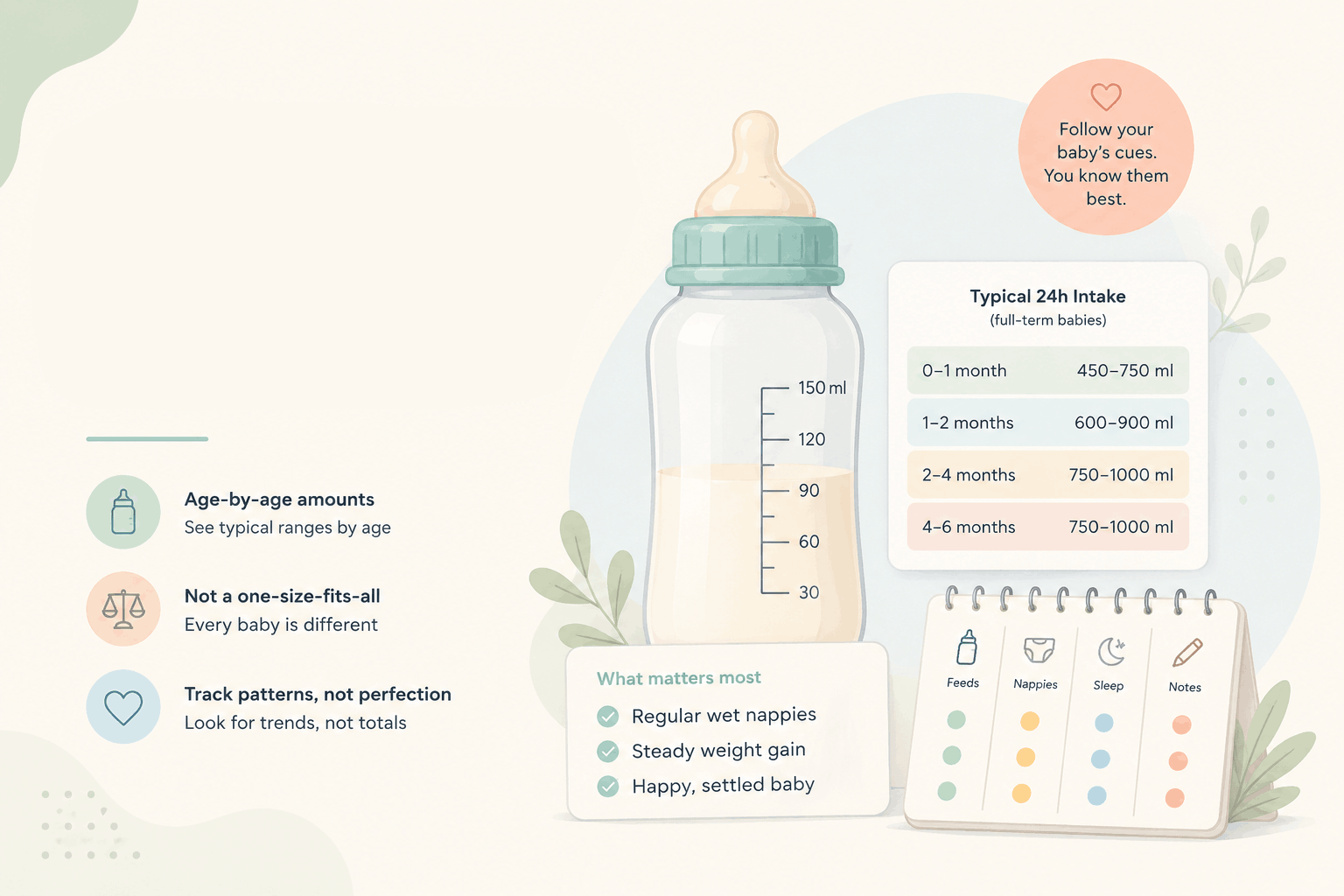
Baby feeding amounts by age
This table is a practical reference, not a rulebook.
Use it to understand the shape of feeding over time, not to judge every feed.
| Age | Breastfeeding pattern | Bottle-feeding pattern | What matters most |
|---|---|---|---|
| First 24 hours | Small amounts of colostrum, frequent opportunities to feed | Very small feeds if bottle-fed | Skin-to-skin, feeding support, early nappies, baby waking to feed |
| Days 2-3 | Frequent feeds; cluster feeding can happen | Small but increasing feeds | Wet/dirty nappies, baby alert enough to feed, latch or bottle comfort |
| Days 4-7 | Milk often increases; feeds may still be frequent | Amounts gradually increase | Nappies, weight checks, baby settling after some feeds |
| Weeks 2-4 | Often 8-12 feeds in 24 hours, sometimes more | Often roughly every 2-4 hours | Weight gain, nappy output, feeding becoming more manageable |
| 1-2 months | Still variable; some babies space feeds slightly | Feeds may become larger and more predictable | Daily pattern, growth, baby's cues |
| 2-4 months | Some babies become more efficient at the breast | Often fewer feeds than newborn stage, larger amounts | Growth, wet nappies, alertness, usual pattern |
| 4-6 months | Milk remains the main food before solids are established | Milk remains the main food before solids are established | Continued growth, readiness for solids closer to 6 months, feeding cues |
If your baby was premature, has medical needs, has been losing weight, is not gaining weight as expected, or you have been given a feeding plan, follow professional advice over general ranges.
First 24 hours: tiny feeds are normal
In the first day, babies do not usually take large feeds.
For breastfeeding parents, the first milk (colostrum) is produced in small quantities. That does not mean it is unimportant: colostrum is concentrated and designed for the early days. NHS breastfeeding guidance has more on what to expect in the first days.
For bottle-fed babies, amounts are also usually small at first. A newborn's stomach capacity is tiny, and feeds gradually increase. See NHS bottle feeding advice for preparation and responsive feeding.
What matters in the first 24 hours is not achieving a large number. It is:
- offering feeds responsively
- getting support with latch or bottle technique if needed
- watching that baby is waking and able to feed
- monitoring nappies as advised
- following any hospital, midwife or health visitor guidance
If baby is too sleepy to feed, hard to wake, not feeding effectively, or you are worried, ask for help straight away.
Days 2-3: feeding may feel constant
Days 2 and 3 can be intense.
Breastfed babies may want to feed very frequently. This can be normal and may help stimulate milk production, but it can also feel alarming if nobody warned you.
Bottle-fed babies may still take relatively small feeds, gradually increasing as their appetite and stomach capacity increase.
You may notice:
- feeds close together
- baby seeming unsettled between feeds
- lots of rooting or sucking
- sleepy feeds
- uncertainty about whether baby is getting enough
This is where support matters. If breastfeeding is painful, latch feels shallow, baby is not staying on, baby seems very sleepy, or nappies are not progressing as expected, speak to your midwife, health visitor or a breastfeeding specialist. La Leche League GB and the Association of Breastfeeding Mothers can also offer peer support.
Days 4-7: milk, nappies and weight checks start to tell a story
By the later part of the first week, feeding usually begins to show more of a pattern.
For breastfeeding parents, milk often feels as though it is "coming in" around this stage, though timing varies. Breasts may feel fuller, baby may swallow more obviously, and nappies should become an increasingly useful sign.
For bottle-fed babies, feed amounts often increase gradually.
Useful signs to pay attention to include:
| Sign | Why it matters |
|---|---|
| Wet nappies increasing | Suggests fluid intake is improving |
| Dirty nappies changing | Can be a useful early feeding sign |
| Baby waking for feeds | Very sleepy feeds may need support |
| Audible swallowing at breast | Can suggest active feeding |
| Baby settling sometimes after feeds | One small part of the wider picture |
| Weight checks | Important professional context |
Do not try to diagnose feeding from one feed. Look at the whole picture.
The first month: feeds usually get bigger, but not perfectly
By weeks 2-4, many babies are feeding more strongly than they did in the first few days.
Breastfed babies may still feed often. Bottle-fed babies may take larger feeds than they did in week one. Some babies develop a rhythm. Others stay unpredictable for a while.
A common first-month pattern is:
| Age | What may be typical |
|---|---|
| Week 1 | Small, frequent feeds |
| Week 2 | Feeds gradually become more established |
| Weeks 3-4 | Larger or more efficient feeds, though cluster feeding may still happen |
Growth spurts can make feeding feel suddenly more intense. A baby who was feeding every few hours may want several feeds close together. That does not automatically mean something is wrong. See cluster feeding for what frequent evening feeds can look like.
But if your baby is not gaining weight as expected, has fewer wet nappies, seems unusually sleepy, cannot stay latched, coughs or chokes with feeds, vomits repeatedly or seems unwell, seek advice. Newborn nappy output is one of the clearest early clues.
1-2 months: larger feeds, but still baby-led
Around 1-2 months, many babies begin to take larger feeds or become more efficient.
Breastfed babies may spend less time at the breast than before, not because they are getting less, but because they may be feeding more effectively. Others still take their time.
Bottle-fed babies may have more predictable amounts, but there will still be variation from feed to feed.
Try not to judge the day by one bottle or one breastfeed.
Ask:
- is baby having wet nappies?
- are they gaining weight as expected?
- do they seem alert at times?
- are feeds generally manageable?
- is this different from their usual pattern?
That last question matters. Your baby's own pattern is often more useful than someone else's chart.
2-6 months: milk is still the main food
From around 2-6 months, many babies take fewer feeds than they did as newborns, but larger amounts per feed. Some breastfed babies become quicker. Some bottle-fed babies settle into a more predictable rhythm.
Milk remains the main food during this period. Solids are usually introduced around 6 months when babies show readiness (NHS Start for Life has guidance on readiness signs), but milk remains central as solids begin.
Feeding can still change with:
- growth spurts
- illness
- teething discomfort
- developmental leaps
- changes in sleep
- nursery or childcare routines
- switching between breast, bottle, expressed milk or formula
A temporary change is not always a problem. A persistent or worrying change is worth discussing.
Bottle-feeding: useful amount guidance without forcing the bottle
Bottle feeds are easier to measure, which can be helpful.
They can also become stressful because the number is right there.
A bottle amount is useful context, but it should not become a target your baby is forced to hit. Babies should usually be guided by hunger and fullness cues.
Bottle-feeding tips:
- hold baby semi-upright
- keep the bottle more horizontal so milk flows steadily
- allow pauses
- watch for signs baby has had enough
- do not force baby to finish the bottle
- throw away unused milk after the feed according to safety guidance
- follow formula preparation instructions carefully
If baby often seems distressed with bottles, coughs, chokes, takes much less than usual, vomits frequently or seems in pain, seek advice.
Breastfeeding: why minutes are not the same as milk
For breastfeeding, the hardest part is that you cannot see the amount.
That can make parents focus on feed length:
- "They only fed for 7 minutes."
- "They were on for 45 minutes."
- "They keep asking again after half an hour."
But minutes do not equal milk.
A short feed can be effective if baby is actively sucking and swallowing. A long feed can be normal, or it can be sleepy, comfort-led, or inefficient. Context matters.
More useful breastfeeding signs include:
| Sign | What it can suggest |
|---|---|
| Comfortable latch | Baby may be attached well |
| Audible or visible swallowing | Milk transfer may be happening |
| Rhythmic sucking with pauses | Often a sign of active feeding |
| Wet nappies | Useful intake context |
| Dirty nappies in early weeks | Helpful early sign |
| Weight gain | One of the most important measures |
| Baby alert at times | General wellbeing context |
| Feeds becoming easier | Often reassuring over time |
If feeding hurts, something may need adjusting.
Breastfeeding can feel intense, but ongoing pain, nipple damage, poor latch or a baby who is not transferring milk well should not simply be endured.
When to seek a lactation consultant or breastfeeding specialist
You do not need to wait until breastfeeding feels impossible before asking for help.
It is sensible to seek breastfeeding support if:
- latch is painful beyond the initial attachment
- nipples are cracked, bleeding or badly damaged
- baby keeps slipping off the breast
- baby cannot seem to latch deeply
- feeds are always very long and baby still seems hungry
- feeds are very short and baby seems unsatisfied
- baby is very sleepy and hard to keep feeding
- you rarely hear or see swallowing
- wet nappies are fewer than expected
- baby is not gaining weight as expected
- you are worried about supply
- you are using shields, expressing, topping up or following a feeding plan and want support
- you feel anxious or upset about feeding
A lactation consultant, infant feeding specialist, midwife, health visitor, breastfeeding counsellor or trained peer supporter may be able to help with positioning, latch, milk transfer, supply concerns, expressing, mixed feeding or pain.
Asking early is not overreacting. It can prevent a small feeding problem becoming a much bigger emotional and physical strain.
When to seek medical advice urgently
Some feeding worries need prompt medical advice rather than watchful waiting.
Seek advice urgently if your baby:
- is not feeding or refuses multiple feeds
- is unusually sleepy, floppy or hard to wake
- has fewer wet nappies than expected
- shows signs of dehydration
- has a fever or low temperature
- vomits forcefully or repeatedly
- has breathing difficulties
- has blood in vomit or stool
- is not gaining weight as expected
- seems seriously unwell
- triggers your instinct that something is wrong
A feeding guide can help you understand general patterns. It cannot assess your baby.
How to think about one "bad" feed
One smaller feed does not always mean a problem.
Babies may feed less because:
- they fed recently
- they are tired
- they need winding
- they are distracted
- they are coming down with something
- the bottle teat flow is not right for them
- breastfeeding latch was less effective than usual
- they simply are not as hungry this time
The better question is:
Does the next feed, nappy output, behaviour and overall pattern look reassuring?
If yes, it may just be a normal variation.
If no, it is worth asking for help.
What is useful to note if feeding feels off
If you are concerned, a few clear notes are more useful than trying to record everything perfectly.
Useful details include:
| Detail | Example |
|---|---|
| Feed time | 09:20 |
| Breast/bottle | Breastfeed, left side / bottle |
| Amount taken, if bottle | 60 ml taken from 90 ml offered |
| Latch note | Shallow latch, came off repeatedly |
| Swallowing note | Few swallows heard |
| Baby's state | Sleepy, hard to wake |
| Nappies | Fewer wet nappies today |
| Vomiting/sickness | Sick after two feeds |
| Weight/professional note | Health visitor asked us to monitor feeds |
This is where Pebbi can be useful: not as a feeding coach, but as a calm place to keep the pattern when you need to explain it or share care with someone else. For night feeds between parents, see best baby tracker for breastfeeding and shared care.
A calm 24-hour feeding example
Here is what a simple feeding record might look like if you are trying to understand a pattern.
| Time | Feed | Note |
|---|---|---|
| 06:15 | Breastfeed | Right side, active swallowing at start |
| 08:40 | Bottle | 80 ml offered, 65 ml taken |
| 10:30 | Breastfeed | Sleepy, needed waking |
| 11:20 | Wet nappy | Normal |
| 13:15 | Bottle | 90 ml taken |
| 15:45 | Breastfeed | Better latch |
| 17:00 | Wet + dirty nappy | Normal |
| 19:30 | Cluster feeds | Several short feeds |
| 22:10 | Bottle | 70 ml taken |
This is not about producing perfect data.
It is about seeing enough of the day to answer practical questions.
The gentlest rule: feed the baby, not the chart
Charts are helpful when they reassure you that variation is normal.
They are not helpful if they make every feed feel like a pass/fail test.
Use feeding amounts as context. Watch your baby. Trust your concerns. Ask for help when something feels off.
Your baby does not need to match a table perfectly to be doing well.
And if you are worried, you do not need to wait until the pattern is "bad enough" to deserve support.
How Pebbi fits in
Pebbi can help when feeding information needs to be remembered or shared:
- night feeds between parents
- bottle amounts
- breastfeeding notes
- expressing and top-ups
- wet and dirty nappies alongside feeds
- questions for a health visitor or lactation supporter
- patterns that are hard to hold in your head when you are tired
But feeding is not supposed to become data entry.
Use Pebbi when it gives you clarity. Leave it alone when it does not.
If you are logging at 3am because you cannot remember the last feed, Baby Tracking at 3am covers practical shared-care memory. For shared care baby tracking more broadly, see our dedicated guide.