
Published
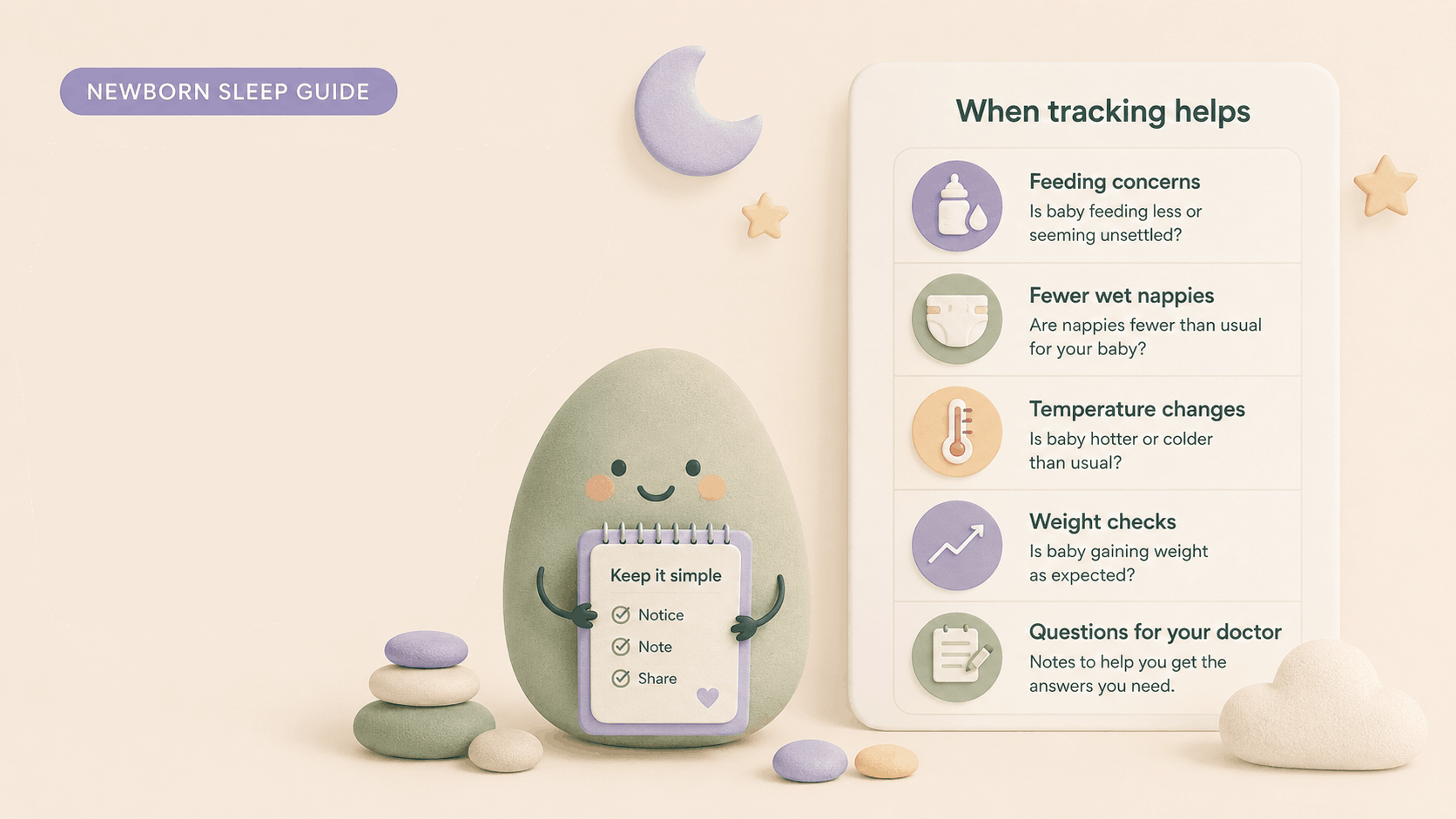
Quick answer: In your baby's first week home, you do not need to track every feed, nappy, nap or cry by default. Tracking is most useful when something worries you, seems different from usual, is hard to remember, or you need clear information for a health professional.
- If feeding, nappies, sleep and behaviour seem normal and you are not worried, you may not need to track much at all.
- Log the specific concern: feeding difficulty, wet or dirty nappies, sleepiness, vomiting, medication, temperature, symptoms, or changes from your baby's usual pattern.
- A good baby log should reduce uncertainty and help you communicate clearly, not make you feel judged or pushed to record every detail.
You do not need to track everything your newborn does.
That might sound strange coming from a baby tracking app, but it is important.
If your baby is feeding well, having wet and dirty nappies, waking for feeds, gaining weight as expected, and you are not worried, you may not need a detailed log at all. You can simply care for your baby, rest when you can, and write things down only when they are useful.
Tracking becomes helpful when something feels uncertain.
A feed that seemed difficult. Fewer wet nappies than expected. A baby who seems sleepier than usual. A medication dose you do not want to miss. A pattern you want to explain clearly to your midwife, health visitor, GP or paediatrician.
That is what this guide is about.
Not tracking for the sake of tracking. Not earning points. Not keeping a perfect newborn record.
Just knowing what is worth writing down when you need a little more clarity.
This is different from logging everything at 3am because your brain will not hold the next feed time. For that practical, sleep-deprived memory, see Baby Tracking at 3am. Here, the focus is intentional tracking: what to log when you are concerned, what to ignore when everything feels normal, and how to avoid tracking anxiety.
If your worry is about a specific area, these guides go deeper: how much milk babies drink, wet and dirty nappies, and crying patterns alongside feeds and sleep.
Key takeaways
- You do not have to track everything.
- A baby log should reduce anxiety, not create it.
- Track concerns, changes, symptoms and questions.
- Log what a doctor, midwife or health visitor might ask you about.
- Stop tracking things that are not helping.
- Pebbi is there when you need a calm record, not to make your baby into a data project.
The problem with tracking everything
Baby apps can accidentally make parents feel as if everything needs to be measured.
Every feed. Every nappy. Every nap. Every cry. Every mood. Every tiny change.
That can sound helpful at first. In the early days, certainty is tempting. But too much tracking can create a new kind of worry: instead of asking "is my baby okay?", you start asking "did I log that correctly?"
That is not the goal.
A log should not become another thing you are failing to keep up with.
The healthiest approach is usually intentional tracking:
Track what helps. Ignore what does not.
If tracking has already started to feel obsessive, our guide on whether baby trackers increase anxiety may help you scale back without losing the information you actually need.
A better rule: track the concern, not the baby
Instead of asking:
What should I track for a newborn?
Ask:
What am I worried about, and would writing it down help?
That changes the whole purpose of the log.
| If you are worried about… | It may help to track… | Why |
|---|---|---|
| Feeding | Feed times, latch difficulty, bottle amounts, sleepy feeds, notes | Helps you explain the pattern clearly |
| Hydration | Wet nappies, dark urine, fewer nappies than expected | Useful context if seeking advice |
| Dirty nappies | Frequency, colour/texture changes if unusual | Helps show whether things are changing |
| Weight gain | Feeds, nappies, professional weigh-ins | Gives context around growth concerns |
| Sleepiness | Wake times, feeds missed, hard-to-wake periods | Helps show whether baby is unusually sleepy |
| Vomiting or reflux | Time, amount impression, relation to feeds | Helps identify whether it is occasional or repeated |
| Medication | Time, dose, who gave it | Prevents missed or double doses |
| Symptoms | Temperature, rash, cough, behaviour changes | Gives a clear timeline if you need help |
If you are not worried about a category, you may not need to track it.
That is the point.
When feeding is worth tracking
If feeding seems normal, you do not necessarily need a detailed feeding log.
You might simply remember roughly when baby last fed, especially if you are the only person caring for them at that moment.
But feeding is worth tracking if:
- baby is struggling to latch
- feeds are very sleepy or very short
- baby is not waking well for feeds
- bottle amounts seem much lower than usual
- baby is vomiting repeatedly
- weight gain is being monitored
- nappies are fewer than expected
- you have been advised to follow a feeding plan
- more than one adult is sharing feeds and handovers
A useful feeding note does not need to be long.
| Less helpful | More helpful |
|---|---|
| "Bad feed" | "09:10: tried breast, would not latch, sleepy, offered expressed milk after" |
| "Didn't drink enough" | "14:30: 90 ml offered, 35 ml taken, fell asleep quickly" |
| "Feeding weird today" | "Feeds shorter than usual since morning, fewer wet nappies so far" |
You are not trying to prove anything. You are trying to create a clear picture.
When more than one adult is involved, a shared timeline helps handovers stay calm. See how to share a baby tracker with your partner or our shared care baby tracking overview.
When nappies are worth tracking
Nappies can be useful because they are one of the more visible signs of what is going in and coming out.
But again, you do not need to turn every nappy into a detailed report if everything seems fine.
Nappy tracking is especially useful if:
- wet nappies seem fewer than expected
- dirty nappies suddenly change in a way that worries you
- baby seems dehydrated
- feeding is difficult
- weight gain is being monitored
- a health professional has asked you to keep an eye on output
A simple nappy log can be enough:
| Time | Type | Note |
|---|---|---|
| 07:20 | Wet | Normal |
| 11:45 | Dirty | Less than usual |
| 15:10 | Wet | Very small |
| 18:30 | Wet + dirty | Better |
This is the kind of information that can be hard to remember later.
If you are worried about nappies, feeding, dehydration, blood, very pale stools, persistent diarrhoea, fever, unusual sleepiness, or your baby seems unwell, seek medical advice promptly.
When sleep is worth tracking
Newborn sleep is chaotic.
That is not a failure. That is a newborn.
You usually do not need to track every sleep minute unless it is helping you understand a concern or support shared care.
Sleep tracking may be useful if:
- baby is too sleepy to feed
- baby is unusually hard to wake
- nights and days feel completely blurred
- one caregiver needs to know when baby last slept
- you are trying to understand whether crying is linked to overtiredness
- illness or medication is affecting sleep
But if sleep tracking makes you feel like every nap is a test, simplify it.
Try tracking only:
- when baby last woke
- when baby last slept
- whether sleepiness is affecting feeds
That is enough for most practical purposes.
When crying is worth tracking
You do not need to log every cry.
Newborns cry. Sometimes the reason is obvious. Sometimes it is not. Tracking every cry can make normal newborn noise feel like a crisis.
Crying is worth logging if:
- it is much more intense than usual
- it happens at a consistent time
- it seems linked to feeds
- it comes with vomiting, fever, rash, breathing concerns, poor feeding or fewer wet nappies
- you need to explain the pattern to a professional
A helpful crying note might be:
"Evening crying from around 18:00-21:00 for three nights, feeds normal, nappies normal."
That is much more useful than twenty separate cry entries.
What a doctor, midwife or health visitor may need to know
If you are worried enough to ask for advice, a simple log can make the conversation easier.
You may be asked about:
| Question | Useful information to have |
|---|---|
| How is baby feeding? | Feed times, latch/bottle issues, amount if bottle feeding |
| Are they having wet nappies? | Wet nappy count or noticeable changes |
| Are they pooing? | Frequency and unusual changes |
| Are they waking for feeds? | Sleepiness, hard-to-wake periods |
| Have they vomited? | When, how often, relation to feeds |
| Any temperature or symptoms? | Times, readings, visible changes |
| Any medication? | Dose, time, response |
| Has anything changed? | A short timeline |
This is where tracking is genuinely helpful.
Not because the app needs data. Because you need a calm memory under pressure.
What not to track unless it helps
You can ignore more than you think.
| You may feel tempted to track | Usually skip unless… |
|---|---|
| Every cry | The crying pattern worries you or you need advice |
| Every cuddle | You are tracking comfort for a specific reason |
| Every nap minute | Sleepiness is affecting feeds or handovers |
| Every feed detail | Feeding is a concern or shared care needs it |
| Every nappy detail | Output is a concern or you were asked to monitor it |
| Every mood | There is a clear change in behaviour |
| Every routine step | You are trying to solve a specific problem |
If the information will not help you, another caregiver, or a health professional, you probably do not need it.
A simple decision test
Before logging something, ask:
- Am I worried about this?
- Is this unusual for my baby?
- Is this changing over time?
- Might a health professional ask about it?
- Would another caregiver need to know?
If the answer is yes, log it.
If the answer is no, it may be safe to let it go.
Example: intentional tracking in the first week
Here is what a useful concern-based log might look like.
| Time | Event | Why it was logged |
|---|---|---|
| 06:40 | Breastfeed attempt | Would not latch, sleepy |
| 07:15 | Wet nappy | Smaller than yesterday |
| 09:30 | Expressed milk bottle | 40 ml taken |
| 11:00 | Note | Still very sleepy, hard to wake |
| 12:20 | Wet nappy | Normal amount |
| 14:00 | Midwife call note | Asked to monitor feeds and nappies today |
| 16:30 | Bottle | 55 ml taken, more alert |
| 18:15 | Wet + dirty nappy | Reassuring change |
This log is not a complete record of the baby's day. It is a record of the concern.
That is much more useful.
How Pebbi fits in
Pebbi is designed for light, useful tracking: not tracking for tracking's sake.
You can use it when:
- something feels off and you want a clear record
- you are sharing care and need a calm handover
- you need to remember medication times
- you want to explain a pattern clearly
- you want reassurance that things are improving
And when you do not need it, you can leave it alone.
That matters.
Pebbi is not there to make you keep feeding the app. It is there when the information helps you care for your baby.
If you are unsure whether you need an app at all, read Do I Need a Baby Tracker App?. If privacy is on your mind, see baby tracking app privacy concerns.
Pebbi logs feeds, nappies, sleep, medication and notes in a few taps. Free for two carers. No account needed. Works offline. Download for iOS or Android.
If tracking starts making you anxious
This is important: if tracking is making you feel worse, reduce it.
Try one of these:
| If you feel… | Try… |
|---|---|
| Overwhelmed by logging | Track only the specific concern |
| Worried about every number | Look at the 24-hour pattern, not one entry |
| Guilty when you forget | Remember that the log is optional |
| Tempted to compare | Compare your baby to their own usual pattern, not another baby |
| Unsure what matters | Ask what a health professional would need to know |
You are allowed to stop tracking categories that are not helping.
A healthy baby log should feel like support, not surveillance.
If you only remember one thing
You do not need to track your baby's whole first week.
Track what worries you. Track what changes. Track what you may need to explain. Track what another caregiver needs to know.
Then let the rest be parenting, not data entry.