
Published
Quick answer: Baby tracker apps can increase anxiety when they encourage constant monitoring, comparison to averages, and guilt about gaps in data. The solution is not to stop tracking entirely, but to track less, track selectively, and choose tools that do not reward obsessive logging.
- Over-tracking creates a monitoring loop where more data leads to more worry, not more confidence.
- Apps that show averages, streaks, and notifications make anxiety worse for parents prone to it.
- Tracking only what changes your decisions, and ignoring the rest, breaks the cycle.
Key takeaways
- Baby tracking apps can genuinely increase parental anxiety, especially for parents who are already prone to worry. This is not a personal failing; it is a design problem.
- The mechanism is straightforward: more data creates more opportunities for comparison, more gaps to feel guilty about, and more patterns to over-interpret.
- The answer is not "stop tracking" but "track differently": fewer categories, no streaks, no averages, and a tool that treats gaps as normal rather than failures.
The Promise vs the Reality
Baby tracking apps promise peace of mind. Know exactly when your baby last ate. See their sleep patterns. Have data for the paediatrician. Feel in control during the most chaotic period of your life.
For some parents, this works beautifully. The data is reassuring. The patterns are calming. The record provides proof that everything is fine, even when it does not feel fine.
But for a significant number of parents, something different happens. The tracking that was supposed to reduce worry starts creating it. You notice the baby slept 30 minutes less than yesterday and wonder if something is wrong. You see that today's feed total is below the "average" the app shows and start to panic. You forgot to log the 2am nappy change and now the data has a gap that bothers you more than it should.
This is not rare. It is not a sign of weakness. And it is worth taking seriously.
The feeling has many faces. A new parent might describe it as obsessive checking, compulsive logging, or a 2am spiral over a shorter nap. Postnatal anxiety can sit underneath; the app is not always the cause, but it can become the place where worry lands. Anxiety amplified by constant monitoring is exhausting, not a character flaw.
How Tracking Creates an Anxiety Loop
The psychology is well understood, even if baby tracker apps rarely acknowledge it. Monitoring any variable closely tends to increase sensitivity to variation, which in turn increases anxiety about that variation.
Here is how the loop works in practice:
Step 1: You start tracking with good intentions. Your midwife suggested keeping an eye on feeds. A friend recommended an app. You log everything because the app has fields for everything.
Step 2: You notice a deviation. The baby slept 40 minutes at 10am yesterday but only 25 minutes today. The app shows this as a shorter bar on the sleep chart. Your brain registers it as a problem.
Step 3: You seek explanation. Was the room too warm? Did the neighbour's dog bark? Should you have waited another ten minutes before putting her down? You start reviewing the data looking for causes.
Step 4: You increase monitoring. Tomorrow you track more carefully. You add temperature. You note the exact time you started the nap routine. You log environmental factors. More data will give you more answers, you think.
Step 5: More data creates more deviations to worry about. Now you are tracking six variables instead of two, and each one has its own set of normal variation that your brain interprets as signal rather than noise.
Step 6: The loop becomes self-sustaining. More tracking leads to more noticed deviations, more anxiety, and then more tracking.
This is not a design flaw that only affects anxious people. It is a predictable outcome of detailed monitoring applied to an inherently variable system. Babies are not machines. Their sleep, feeding, and mood vary constantly, for reasons that often have no actionable explanation. But when you have a chart showing that variation in colour-coded detail, it is very hard not to search for meaning in the noise.
Which App Design Choices Make It Worse?
Not all baby trackers create equal amounts of anxiety. Certain design choices amplify the monitoring loop:
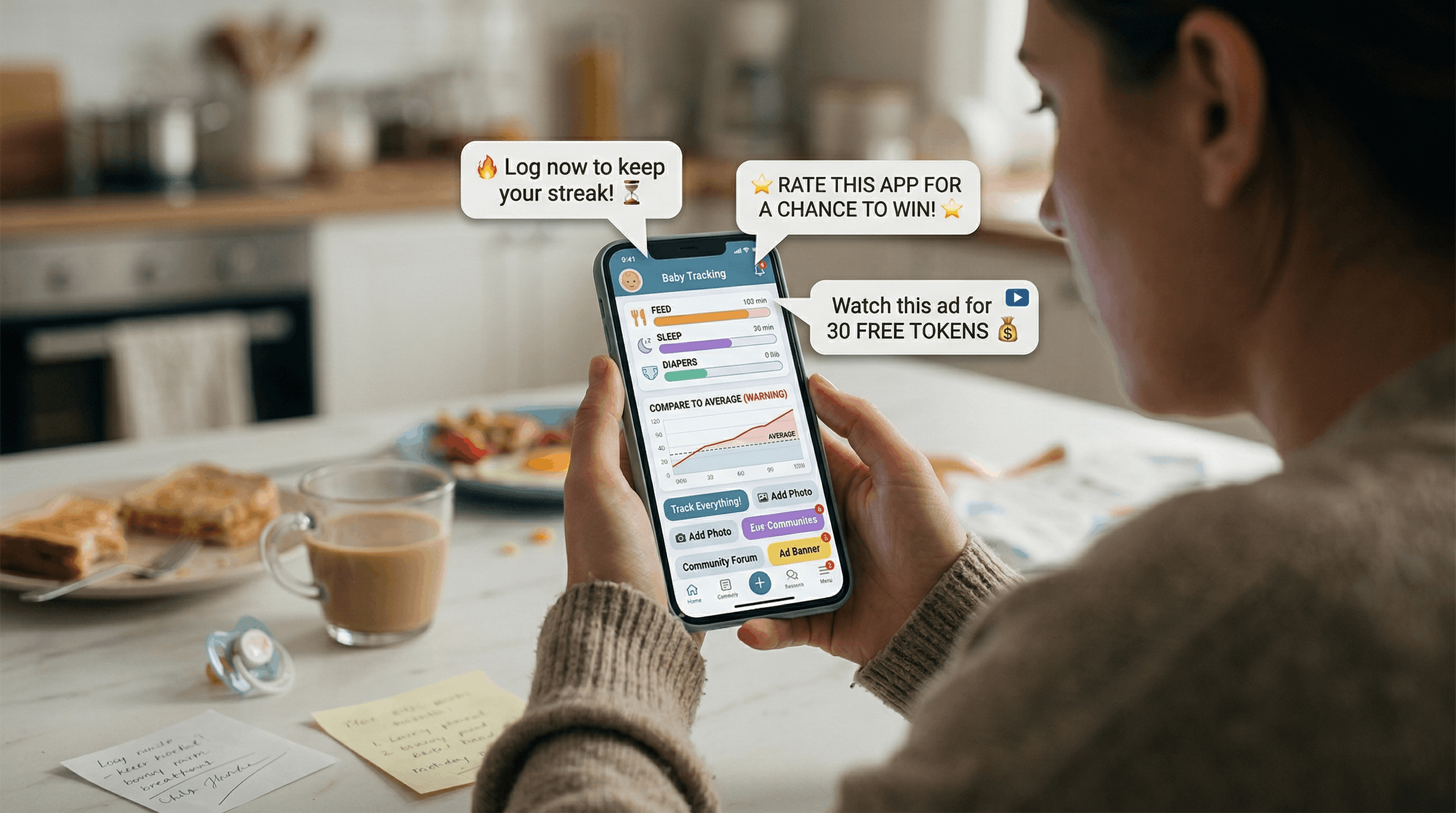
Averages and comparisons. Apps that show "average feed duration for babies this age" or "typical sleep at 4 months" invite comparison. Your baby is not average (no baby is), and deviations from a statistical norm feel like warning signs even when they are completely healthy.
Streaks and consistency metrics. Any feature that rewards unbroken logging creates guilt when you miss an entry. If the app tracks your "logging streak" or shows empty days as gaps in a calendar view, it subtly punishes you for having a day where tracking was not your priority.
Notifications and reminders. "It's been 3 hours since the last feed" is useful information for some parents and anxiety fuel for others. When the notification arrives and the baby is happily playing, you are left wondering whether you should interrupt to feed, not because the baby is hungry, but because the app said so.
Detailed analytics dashboards. Charts showing week-over-week trends are designed for parents who find data calming. For parents who find data stressful, a screen full of lines and bars is an invitation to look for problems that may not exist.
Community features. Forums and feeds where other parents share their data create indirect comparison. Someone else's baby is sleeping twelve hours at four months and yours is not. The plural of anecdote is not data, but it feels like it when you are sleep-deprived and worried.
What the Research Suggests
Academic research on parental technology use and anxiety is still emerging, but the direction is consistent. A 2023 study in the Journal of Medical Internet Research found that parents who used health monitoring apps reported higher anxiety about their infant's health compared to parents who did not, even when the infants were equally healthy. The effect was strongest among first-time parents and parents with pre-existing anxiety.
This does not mean tracking causes anxiety. The relationship is more nuanced: parents who are already anxious may be more drawn to tracking, and tracking may then amplify their existing tendencies. But the practical implication is the same: if you notice that using a baby tracker makes you feel worse rather than better, the evidence supports trusting that instinct.
Signs That Tracking Is Increasing Your Anxiety
Some signs are obvious. Others are subtle. Here are the ones worth paying attention to:
- You check the app more than five times a day outside of logging events
- You feel a spike of worry when you see a shorter nap or a smaller feed logged
- You spend time before bed reviewing charts instead of sleeping
- You feel guilty about gaps in the timeline, even when nothing was wrong
- You compare your baby's data to averages and feel concerned about differences
- You have arguments with your partner about who forgot to log something
- You find yourself logging events during moments when you would rather be present with your baby
- You have Googled something because the tracker data worried you, and the Google results made it worse
If three or more of these resonate, your tracker is likely working against you. That does not mean you need to delete it immediately, but it does mean something needs to change.
How to Track Without the Anxiety
The answer for most parents is not "stop tracking entirely." Often there are legitimate reasons to track, such as coordinating with a partner or spouse, managing medication, or sharing information with a nanny, childminder, or grandparents. The answer is to change how you track.
Track fewer categories. Pick the one or two categories that actually change your decisions. For most parents, that is feeds and medication. Everything else is optional. Drop the optional categories and notice whether you feel lighter.
Choose an app that does not show averages. If your tracker shows how your baby compares to norms, switch to one that does not. You want to see what happened today, not how today compares to a statistical abstraction.
Turn off all non-essential notifications. Keep medication reminders if they prevent missed doses. Turn off everything else. "It's been 3 hours since the last feed" is information you can get by glancing at the timeline when you choose to, not information that needs to interrupt your day.
Redefine what a "complete" day looks like. A complete day is one where everyone who cares for the baby has the information they need. It is not a day where every event is logged with timestamps. If there are gaps, that is normal. If you are tempted to fill them in later from memory, resist. Reconstructed data is not useful data.
Set check-in limits. Open the app twice a day: once in the morning to see what happened overnight, and once when you get home or when caregivers switch. Between those times, trust the process. If something urgent happens, someone will tell you directly.
Use the tracker for coordination, not surveillance. If you share the tracker with a partner or nanny, use it as a shared record of what happened, not as a tool for evaluating how well someone is caring for the baby. Data used as evidence in arguments is data that poisons the tool for everyone.
The Right Kind of Tracking Tool
If you recognise yourself in this article, the problem may not be tracking itself. It may be the specific tool you are using.
Some trackers are designed for depth. They assume you want comprehensive data, detailed analysis, and long-term trends. These are excellent tools for parents who genuinely enjoy data. They are genuinely harmful tools for parents who do not.
Look for a tracker that:
- Shows a simple timeline rather than charts and dashboards
- Does not display averages or norms
- Does not have streaks, consistency tracking, or gamification
- Does not send notifications except for medication
- Treats gaps in the timeline as normal rather than highlighting them
- Lets you log quickly and move on without requiring detail
The goal is a tool that answers "what happened?" without asking "why isn't this better?"
If you only do one thing
This week, notice how you feel after you use your baby tracker. Not while you are using it, but afterwards. If closing the app leaves you calmer, the tool is working. If closing the app leaves you thinking about the data, comparing numbers, or worrying about what you saw, something needs to change.
You can scale back. You can switch to a simpler tool. You can stop entirely. Your baby does not need a perfect data record. They need a parent who is present and calm, and if deleting an app helps you be that parent, that is the right call.
If you want a tracker that stays out of your way (no averages, no streaks, no guilt), Pebbi is designed to be used when it helps and ignored when it does not. It shows a shared timeline, lets you log in a few taps, and never tells you that you are not tracking enough. Free for two carers. Download on iOS or Android.
For a calmer approach to what is worth logging in the first place, see what to track in your baby's first week home.