
Published Updated
Quick answer: Many baby tracking apps collect more data than parents expect and may share it with third parties, so you should choose privacy-first apps with minimal data collection.
- Your baby's app data is often not protected like medical records.
- Privacy policies frequently allow analytics, ad partners, or broad data sharing.
- Prefer apps with no data selling, clear deletion controls, and offline-first design.
Key takeaways
- Most baby tracking apps collect far more data than necessary and share it with third parties.
- Your baby's health information is not protected by medical privacy laws like HIPAA.
- Privacy-first alternatives exist that work without harvesting your family's data.
Your baby's feeding schedule, sleep patterns, medication doses, and health symptoms are some of the most intimate details of your family's life. You track them to be a better parent, to coordinate with caregivers, to share with your pediatrician when needed.
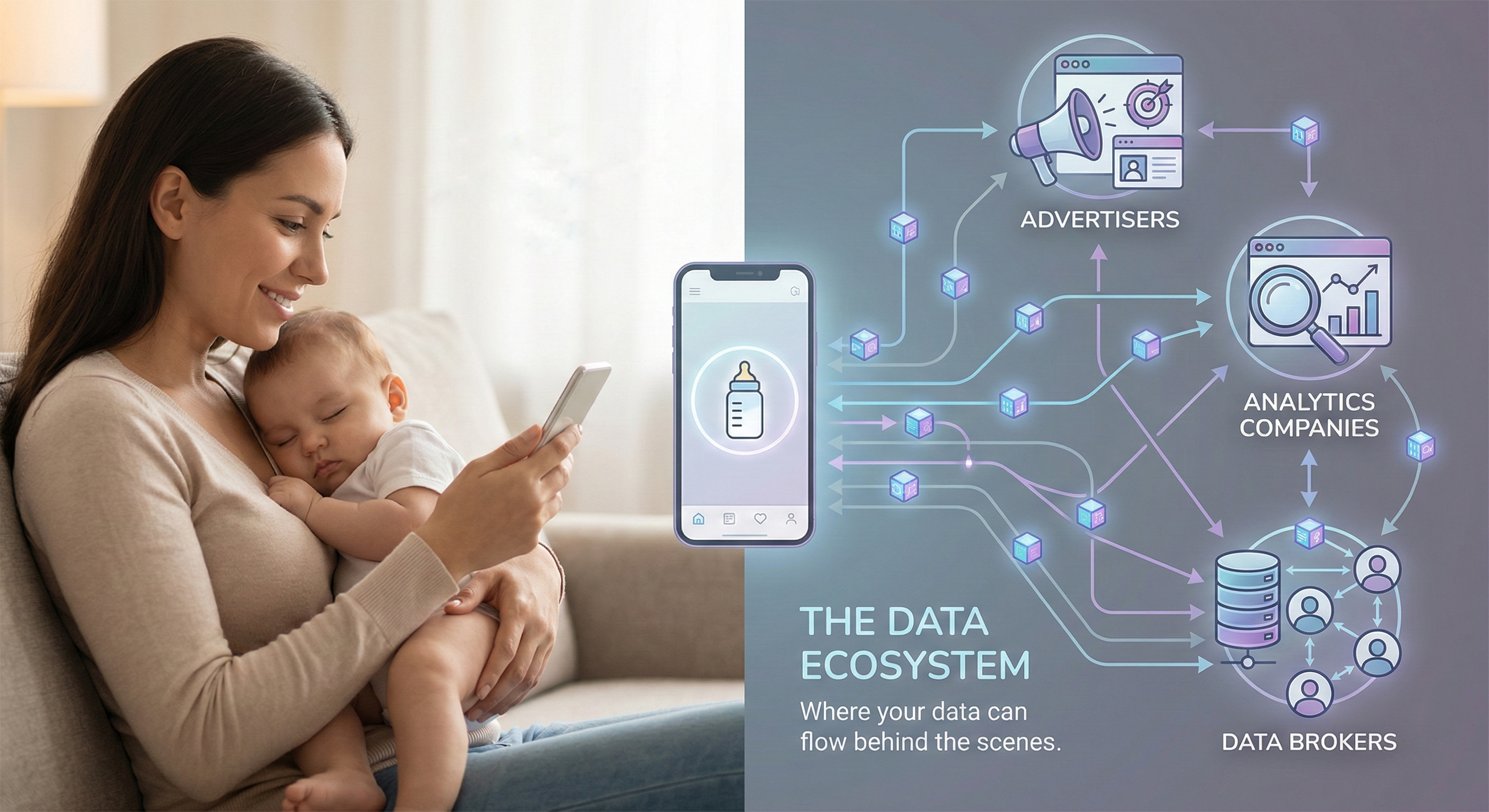
Many popular baby tracking apps are collecting, storing, and potentially selling this sensitive information to third parties. The app you use every day to log your infant's feeding times may also be logging your location, building an advertising profile, and sharing data with companies you have never heard of.
This is not speculation. It is written directly in the privacy policies that most parents never read.
The baby tracking app privacy landscape in 2026
The baby tracking app market has exploded over the past decade. New parents, exhausted and desperate for any tool that might help, download these apps without a second thought. They promise to make parenting easier, to help remember when the last feeding happened, to track patterns for better sleep.
Most parents do not realize that you are not the customer. Your data is the product.
Many free and freemium baby tracking apps operate on the same business model as social media platforms. They provide a free service in exchange for harvesting your personal information, which they then monetize through advertising and data sales.
The difference is that instead of vacation photos and political opinions, they are collecting your baby's health data.
At a Glance: How the Main Baby Tracker Apps Compare on Privacy
| App | Email Required | Shows Ads | Data Sharing Policy | Works Offline |
|---|---|---|---|---|
| Pebbi | No | No | No data resale, no advertising tracking | Yes |
| Huckleberry | Yes | No (subscription) | Third-party analytics integrations | No |
| Glow Baby | Yes | Yes (free tier) | Data shared for community features | No |
| Baby Connect | Yes | No | Limited third-party sharing, encrypted data | Limited |
| Baby Tracker (Nighp) | Yes | No (free tier) | Standard policy, unclear free-tier monetisation | No |
Data accurate as of March 2026 based on public privacy policies and app store listings. Verify current practices directly with each app before downloading.
Pebbi requires no account and no email. Download for iOS or Android. No ads, no data resale, works offline.
What popular baby apps actually collect
When examining the privacy policies and app permissions of popular baby tracking apps, the scope of data collection becomes clear. Some of this may surprise you.
Baby tracking apps naturally collect the basic health data you expect. Feeding times and amounts, sleep duration and patterns, diaper changes, growth measurements, medication doses and timing, symptoms and illness notes, developmental milestones. This is what you are using the app to track. The question is what happens to this data after you log it.
Many popular apps also collect device and technical data including unique device identifiers, operating system and version, app usage patterns, IP address, and time zone. They may track precise GPS coordinates or general location based on IP address, building location history over time. They often require email address, phone number, full name, date of birth, profile photos, and sometimes access to your contacts list.
Usage analytics show which features you use most, how long you spend in the app, which screens you view, when you are most active, and your search queries within the app. Third-party integration data flows from Facebook, Google, Apple Health, and Google Fit if you grant those connections.
Some baby tracking apps request microphone access for easier voice logging, though this technically allows listening at any time. Camera access for photo uploads means potential access to your camera anytime. Cross-app tracking sees what other apps you use. Purchase history from app stores, biometric data from fingerprint or face unlock, and contact information of other caregivers you invite all become part of your data profile.
What they do with your data
Collecting the data is concerning. What companies do with it becomes truly troubling.
Many baby tracking apps partner with advertising networks to show you relevant ads. Those ad networks are not just displaying advertisements. They are building comprehensive profiles about you and your baby. They know your baby's age and feeding method, whether you are breastfeeding or using formula, when you are sleep deprived based on late-night logging patterns, whether your baby has health issues based on symptom and medication tracking, your likely income level based on neighborhood from GPS data, what other parenting apps you use, and your purchasing patterns.
This profile grows more detailed every day you use the app. It is valuable to companies trying to sell you baby products, parenting courses, sleep training programs, and more.
Many privacy policies include vague language about sharing information with third-party partners for analytics and improvement purposes. This can mean sharing your data with analytics companies like Google Analytics or Mixpanel, crash reporting services, cloud storage providers, marketing platforms, data brokers who compile and sell consumer information, and research institutions.
The problem with third-party partners language is its vagueness. You do not know exactly who gets your data or how they use it.
Some baby tracking apps claim they only share anonymized or de-identified data with third parties. Research has repeatedly shown that supposedly anonymized health data can often be re-identified, especially when combined with other available information. Your baby's exact birthdate, feeding patterns, growth measurements, and location data create a unique fingerprint that might identify you even without your name attached.
Once data is anonymized and sold to a data broker, you lose all control. You cannot ask for it to be deleted. You cannot see who has it. It exists somewhere forever.
The newest concern involves AI training data. As artificial intelligence becomes more sophisticated, companies seek large datasets to train their models. Your baby's feeding patterns, sleep habits, and health data could be training the next generation of AI without your explicit consent. Some privacy policies now include language about using data to improve and train algorithms, meaning your baby's information may help build AI models that might be sold or licensed to other companies.
Real privacy policy red flags
Specific language from actual baby tracking app privacy policies reveals concerning patterns. These examples come from popular services, though we avoid naming them directly.
Vague data sharing language states that information may be shared with third parties to help provide and improve services. This means they can share your data with almost anyone for almost any reason, as long as they can justify it as improvement. A better alternative would clearly state that data is not shared with any third parties and remains encrypted.
Broad advertising permissions describe using your information to provide personalized advertising experiences across platforms and partner networks. This means your baby's health data targets you with ads that may follow you across the internet through partner networks. Better alternatives would clearly state no advertising exists and the business model relies on subscriptions, not ads.
Unlimited data retention policies retain your information for as long as necessary to provide services and as required by law. This means they might keep your data indefinitely. Even after deleting the app, your baby's information could remain on their servers. Better policies would allow you to delete all data at any time with permanent removal from servers within a clear timeframe.
Ownership claims grant companies a worldwide, royalty-free license to use, copy, and distribute your content. They are claiming ownership rights to your baby's data and can use it however they want. Better alternatives would clearly state that you own all your data and they simply store it on your behalf.
Mandatory account creation requiring email, phone number, and account setup before using any features means they want to tie all your baby's data to an identifiable account that can be cross-referenced with other databases. Better alternatives allow starting immediately with no account required, creating one only when wanting to sync across devices.
Vague references to partners and affiliates mean that if the company gets acquired, merges, or has complex corporate structures, your data could end up in unexpected hands. Better policies would state that data is never shared with third parties, affiliates, or subsidiaries, and that any company acquisition would trigger notification and data deletion options.
Why this matters more than you think
The immediate response might be that targeted ads for baby products seem harmless when you are buying those items anyway. The broader implications deserve consideration.
When we accept that tracking our baby's intimate moments requires surrendering privacy, we normalize surveillance capitalism in the most sacred spaces of our lives. This affects healthy families being treated as data sources rather than anything concerning criminal activity.
The data collection does not stop when your child turns two. This teaches us and our children that privacy is a luxury rather than a right.
Today baby tracking apps face minimal regulation. Tomorrow it might be apps for chronic disease management, mental health, elderly care. The precedent we set with free baby apps shapes expectations for all health-related technology. If we accept that health tracking apps harvest and sell our data, we signal that this trade-off is acceptable.
While no evidence yet exists of baby tracking app data being used by insurance companies, precedent exists in other domains. Life insurance companies already offer premium discounts for sharing fitness tracker data. Health insurers show increasing interest in wellness data. Could your baby's health data someday affect your health insurance premiums? Could early feeding difficulties or sleep problems be interpreted as risk factors? These questions are not paranoid.
Baby tracking app data has already been subpoenaed in custody disputes. Detailed logs of feeding times, medication doses, and care patterns can serve as evidence of parenting quality. Even without current custody disputes, having your private parenting data stored on company servers means it could potentially be accessed through legal channels.
Beyond practical concerns, something feels deeply unsettling about corporations profiting from intimate details of your baby's first months of life. Your child's first smile, first solid food, first night of sleep should not become data points in an advertising algorithm. These are your family's private memories.
How to evaluate a baby app's privacy
Not all baby tracking apps are privacy nightmares. Some are genuinely built with privacy as a core principle. Our guide to choosing a baby tracker covers what features actually matter alongside privacy.
Before downloading any baby tracking app, read the privacy policy. At minimum, skim it. Can you understand it without a law degree? Does it clearly state what data is collected? Does it specify who data is shared with? Does it explain how data is used?
Check app permissions carefully. Does it request access to contacts when this seems unnecessary? Does it want location access when a baby tracker does not need GPS? Does it need microphone access, which is concerning? Does it want to track you across other apps, which is a major warning sign?
Look for privacy certifications like SOC 2 compliance, GDPR compliance even if you are not in Europe, privacy shield certification, or independent security audits. These signal that privacy receives serious attention.
Understand the business model. How does the app make money? If it claims to be free forever, question how they fund development. Subscription-based models generally prove more privacy-friendly than ad-supported ones.
Test the account requirements. Can you use basic features without creating an account? What information is required to create an account? Can you use a pseudonym or is a real name required?
Check data deletion options. Can you export your data? Can you delete all your data? What happens to your data if you delete the app?
Look for encryption details. Is data encrypted in transit using HTTPS? Is data encrypted at rest on servers? Do they use end-to-end encryption?
Review third-party integrations. What third-party services does the app use? Can you see a list of all third parties that receive your data? Can you opt out of third-party sharing?
Privacy-first baby tracking apps
When searching for a baby tracking app that respected privacy, the options were limited. This is why Pebbi exists.
Pebbi requires no account to start using. Download and begin tracking immediately without email, phone number, or any personal information. Data lives on your device with local-first storage. We only sync when you explicitly invite other caregivers, and sync is free for up to 2 carers, which makes it ideal if you need a baby tracker for both parents without compromising on privacy. Encryption protects everything in transit and at rest. Even if servers were compromised, your data remains unreadable.
No advertising SDKs, no ad networks, no data brokers. Where analytics are used, they are GDPR-compliant and anonymised: aggregate traffic data, not your baby's care records. Your baby's feeding times, sleep logs, and medication entries are never used for advertising and never sold to third parties. Development is funded through Premium subscriptions (AI summaries, predictions, and extended carer access), not by monetising your data. The free tier is a permanent offering, not a trial with a countdown. You own your data completely. Export everything at any time. Delete everything at any time with no questions asked. The privacy policy is written in plain English rather than legalese.
This reflects genuine concern about baby tracking app privacy. Other parents should share this concern.
Pebbi is not the only privacy-conscious option. When evaluating any baby tracking app, including ours, use these guidelines and make an informed decision.
What about HIPAA and medical privacy
A common question asks whether baby tracking apps fall under HIPAA protection. The short answer is no.
HIPAA, the Health Insurance Portability and Accountability Act, only applies to covered entities including healthcare providers, health plans, and healthcare clearinghouses. Consumer baby tracking apps are not healthcare providers.
This means baby tracking apps are not required to protect your health data the way your doctor's office must. They can share your baby's health information with third parties. You have fewer privacy protections than you would with actual medical records.
Some apps claim to be HIPAA-compliant as a marketing term, but unless you receive actual medical services through the app like telemedicine, HIPAA does not apply.
Your pediatrician's patient portal has HIPAA protection. Your baby tracking app does not.
This makes choosing apps with strong privacy policies critically important, even though they face no legal requirement to have them.
What happens if a baby app leaks your data?
It has already happened. In 2020, the baby tracking app Glow Baby exposed the personal data of roughly 25 million users through a security vulnerability. Names, email addresses, and baby care logs were accessible to anyone who knew where to look.
If a company stores your baby's health data on their servers and those servers are compromised, that data is exposed. Feeding schedules, medication logs, sleep patterns, and any personal details you provided when creating your account become part of the breach.
This is one of the practical reasons local-first architecture matters. If your data mostly lives on your device and only syncs directly between trusted carers, a server breach has far less to expose. Apps that require you to upload everything to the cloud just to use basic features are creating a larger target. Apps that work offline and store data locally by default reduce the risk significantly, because the data is not sitting on a company server waiting to be leaked.
The future of baby tracking privacy
As AI becomes more sophisticated and data becomes more valuable, increased pressure on baby tracking apps to monetize user data seems inevitable.
More regulation appears likely. GDPR in Europe has already changed how apps handle data. California's CCPA produces similar effects in the United States. The FTC enforces COPPA to protect children's data online. Expect more privacy regulations, especially around health and children's data.
Greater transparency requirements may force apps to disclose data practices more clearly and give users more control. Privacy may become a competitive advantage as parents grow more aware of privacy issues, helping apps that genuinely protect privacy stand out in a crowded market.
Potential healthcare integration could bring baby tracking apps into actual medical records systems, which might provide HIPAA protections but also create new concerns about data access.
The question remains whether the industry moves toward privacy-first models voluntarily or gets dragged there by regulation and consumer backlash.
Taking back control of your family's data
You can take immediate action to protect your baby's privacy. Review your current baby tracking app's privacy policy by actually reading it. Check what permissions you have granted and revoke anything unnecessary. Opt out of advertising tracking in your phone's settings. Delete apps you are not actively using to reduce your data footprint. Use strong, unique passwords for any apps that require accounts.
When choosing new apps, start with privacy-first options. Our best baby tracker apps comparison includes privacy ratings for every major app. Use the privacy evaluation guidelines before downloading anything. Do not grant permissions the app does not absolutely need. Consider paid apps over free ones if they have better privacy policies. Read reviews specifically mentioning privacy to see what other parents have experienced.
Long-term privacy hygiene requires regularly auditing the apps on your phone and deleting ones you do not use. Check privacy settings on the apps you do use. Update apps to get security patches. Use privacy-focused browsers and search engines when researching baby-related topics. Be mindful about what you share on social media about your baby.
Which Baby Tracker Apps Sell Your Data?
This is the question parents most want a direct answer to, and it is worth being precise.
"Selling data" can mean different things. Some apps share data with advertising networks, which technically differs from selling it to a data broker, but the practical outcome for you is similar: your baby's information is used to target you with ads. Some apps share "anonymised" aggregate data, which they do not classify as a sale. Some have vague "third-party partners" language in their privacy policies that allows broad sharing without specifying who receives the data or why.
What is publicly confirmed from app store listings and privacy policies: Pebbi does not sell your data, does not run ads, and does not require an account. Baby care data is never used for advertising or shared with data brokers. This is stated clearly in Pebbi's privacy policy and is the model on which the app is funded (subscription for Premium features). For apps that operate a free tier supported by advertising, such as Glow Baby, some form of data use by ad partners is inherent to the model. For apps with vague "third-party partners for analytics and improvement" language, the scope of sharing is difficult to determine without a detailed policy review.
The safest approach is to read the privacy policy of any app you are considering, specifically looking for language about advertising networks, data brokers, "personalised experiences," and what happens to your data if the company is acquired. For a full guide to evaluating what you find, see how to evaluate a baby app's privacy earlier in this post.
If privacy is your top concern, our guide to choosing a baby tracker covers the three privacy tiers in detail and helps you match the right app to your situation.
Keeping your child's data safe: what to look for
A safe baby tracker should pass a short checklist. If any of these feel uncertain, keep looking.
- Works offline by default. Your child's data should live on your device first, not on a company server. Local-first storage means you are not depending on someone else's security to protect your family's information.
- No mandatory account. If you have to hand over your email, phone number, or name before you can log a single feed, ask why. A secure baby app should work without knowing who you are.
- You can delete everything. When you are done tracking, you should be able to wipe your data completely. Apps that comply with UK and EU data protection rules give you this right by default, but not all apps make it easy to use.
- No advertising SDKs. If the app shows ads or uses ad-supported tracking tools, your child's data is being used to target you. A private baby tracker funded by subscriptions does not need to do this.
- Encrypted sync. If data syncs between carers, it should be encrypted in transit and at rest. Even if a server were compromised, encrypted data remains unreadable.
- A privacy policy you can actually read. If it takes a lawyer to understand, that is a red flag. Clear, short, plain-language policies signal a company that takes your child's data seriously.
Pebbi passes all six. But the checklist works for evaluating any baby tracker, including ours.
If you only do one thing
Read the privacy policy of your current baby tracking app before your next feeding. If you cannot understand it or do not like what it says, switch to a privacy-first alternative like Pebbi. If you are still wondering whether you even need a tracker, that is a fair question too. Your baby's data deserves better protection than most popular apps provide.
Pebbi is free for two carers and one baby. No account, no ads, no data resale. Download on iOS or Android.