
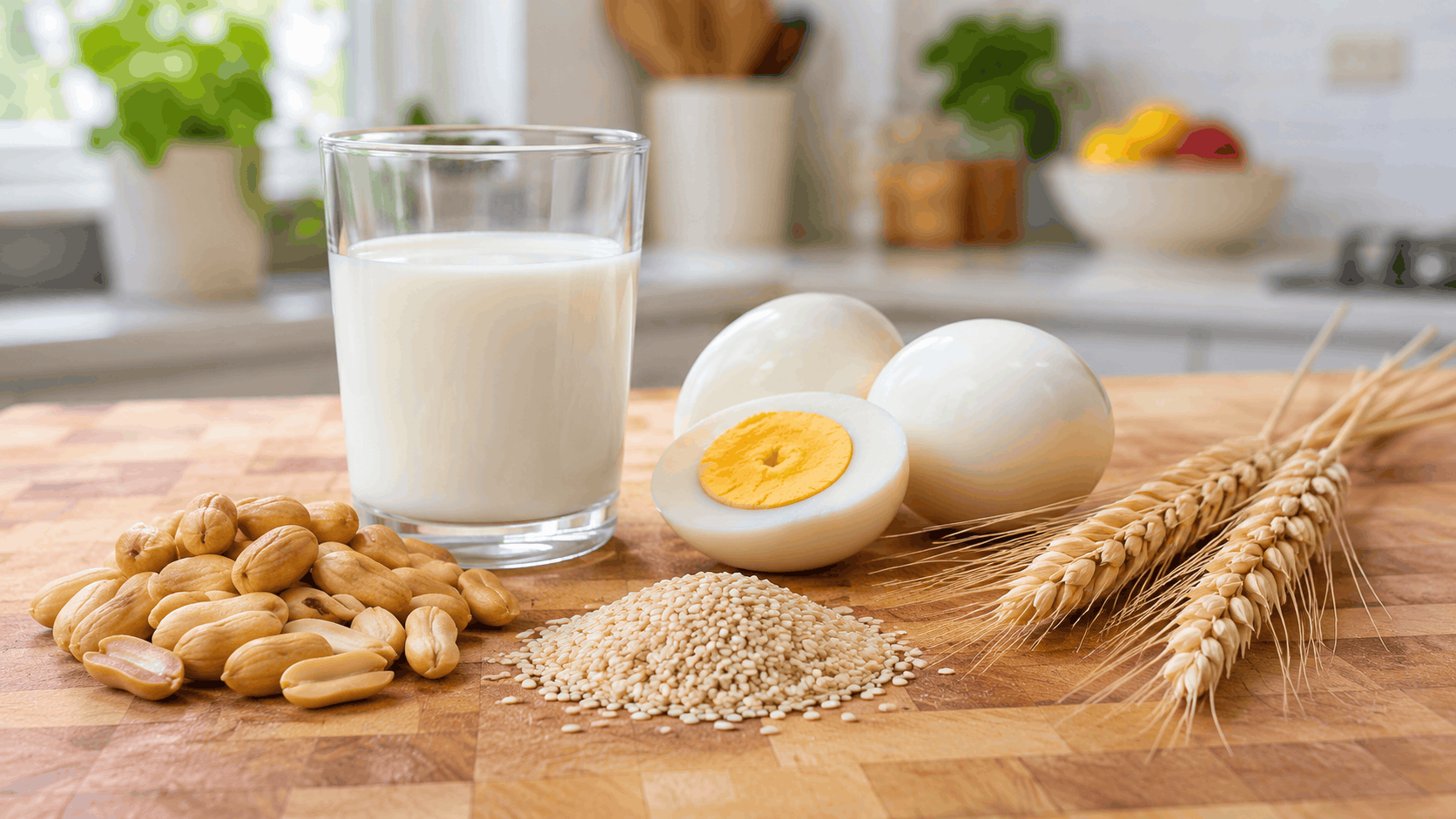
Quick answer: Introduce common allergens such as egg, peanut, cows' milk, wheat, sesame, soya and fish from around 6 months (and not before 4 months), one new allergen at a time, in a small amount, on a morning when your baby is well and you can watch them afterwards. Once a food is tolerated, keep offering it regularly. Most reactions appear within minutes to 2 hours, but some, such as cows' milk allergy, can take up to 3 days, so keep a dated allergen log and leave a few days between new allergens. Share that log with everyone who feeds your baby. Pebbi's allergen tracking is free: link a reaction to the feed you suspect and every allergen in it is flagged for every caregiver.
- If your baby has severe eczema, a known food allergy, or a family history of allergy, eczema, asthma or hay fever, speak to your doctor, paediatrician or health visitor before introducing allergens.
- The biggest shared-care risk is an assumption: a grandparent, nanny or daycare offering a food that has never been tried, or one that has already caused a reaction.
- Pebbi uses your region's allergen list, shows what has been tried and when it was last given, flags the allergens in any feed linked to a symptom with a warning, and includes allergens in Catch-ups and exports for doctor appointments.
Key takeaways
- Introducing allergens is one of the most nerve-racking parts of starting solids, and feeling scared is completely normal. A plan and a shared record make it far calmer.
- Introduce one new allergen at a time from around 6 months, start with a small amount, and keep offering it regularly once your baby has tolerated it.
- Reactions can appear within minutes or up to 3 days later. A dated allergen log is the most reliable way to connect a rash on Thursday to an egg on Tuesday.
- Everyone who feeds your baby needs the same information: what has been tried, how often, and what has caused a reaction.
The hospital car park peanut
Ask a group of parents about the first time they gave their baby peanut and you will hear some version of the same story. A tiny smear of peanut butter on a teaspoon. A baby in a high chair. And a parent who has quietly worked out exactly how long it takes to drive to the emergency department.
Some go further and do it in the hospital car park (or parking lot, depending on where you live). It sounds extreme until you are the one holding the spoon. Your baby cannot tell you that their mouth feels strange. You have read just enough about anaphylaxis to be terrified, and not quite enough to know how uncommon a serious first reaction is. Every instinct you have says protect this tiny person, and here you are, deliberately feeding them the food you have been warned about since before they were born.
If that is you, you are not overreacting and you are not alone. Allergen introduction asks you to do something that feels risky on purpose, because the evidence says introducing allergens early, and keeping them in the diet, helps protect against allergy. Holding both of those things at once is exhausting.
The reassuring part is that most babies do not react, and most reactions that do happen are mild. For most families, the hardest part is not the first spoonful. It is everything around it: remembering what has been tried, recognising a reaction that turns up days later, and making sure everyone else who feeds your baby knows what is and is not safe.
How to introduce allergens to your baby
Advice from the NHS on food allergies in babies and from the American Academy of Pediatrics lines up on the basics, and it is broadly similar in Australia and much of Europe. It applies whether you are spoon-feeding purees or following baby-led weaning.
- Start from around 6 months, alongside other first foods, and not before 4 months. Wait until your baby shows they are ready for solids.
- Introduce one new allergen at a time, so that if something happens, you know what caused it. Other new foods on the same day are fine.
- Start small. A little on a teaspoon, or stirred into a food your baby already eats happily.
- Do not put off peanut and egg. The NHS notes that delaying them beyond 6 to 12 months may increase the risk of your baby becoming allergic to them. The LEAP study, published in the New England Journal of Medicine in 2015, found that regularly giving peanut to babies at high risk of peanut allergy, starting in their first year, sharply reduced how many went on to develop it.
- Keep it going. Once a food is tolerated, keep offering it as part of your baby's usual diet. One successful taste is the start, not the finish line. Advice on exactly how often varies between countries, but many allergy specialists suggest each allergen at least once or twice a week.
There is no single official allergen introduction schedule and no required order. Egg and peanut have the strongest evidence for early introduction, so many families start there, then work through cows' milk, wheat, sesame, soya, fish, shellfish and tree nuts, leaving a few days between each new one. Once an allergen has been offered a few times without a problem, you can combine it with others, such as egg on wheat toast.
If your baby has severe eczema or an existing food allergy, or there is a family history of food allergy, eczema, asthma or hay fever, talk to your doctor, paediatrician or health visitor before you start. Your baby may need a more careful plan, and some babies are offered first tastes of certain allergens with medical support.
Which foods count as allergens?
The NHS lists these foods as ones that can trigger allergic reactions in babies: cows' milk, eggs, foods containing gluten (wheat, barley and rye), nuts and peanuts, seeds (especially sesame), soya, fish, shellfish, beans, lentils and peas, celery, mustard, and sulphur dioxide, which is found in some dried fruit and fruit juices.
For food labelling, the UK and EU recognise 14 major allergens and the US recognises nine, often called the Big 9: milk, eggs, fish, crustacean shellfish, tree nuts, peanuts, wheat, soybeans and sesame. Most families start with the allergens their baby is most likely to meet at home: egg, peanut, cows' milk, wheat, sesame, soya, fish and tree nuts.
Pebbi starts with the allergen list for your phone's region, with lists for the UK and EU, the United States, Canada, Australia and New Zealand, Brazil and Latin America, and you can add any other food as a custom allergen. Compare the allergen lists by region.
Keeping allergens in your baby's diet
Introducing an allergen is the start, not the finish. Once your baby has had a food a few times without a problem, the aim is to keep it in their usual diet, because stopping may allow an allergy to develop. Advice on exactly how often varies between countries, but many allergy specialists suggest offering each allergen at least once or twice a week. If your doctor or allergy team has given you a plan, follow that.
That gets harder as the list grows. By the time your baby has tried egg, peanut, milk, wheat, sesame, soya and fish, keeping all of them going every week is a juggling act, especially when several people do the cooking. A few things make it easier:
- Combine allergens once each is tolerated. Egg on wheat toast, salmon with a yogurt dip, hummus on toast fingers.
- Keep ready portions. Peanut butter or ground nuts stirred into porridge, a pot of plain yogurt, a jar of tahini.
- Check what was last given, not what you think was last given. A dated record beats memory, especially across carers.
- Share the plan. Make sure grandparents, nannies and nursery or daycare staff know which allergens are safe to keep offering.
In Pebbi, the Last logged column in Allergens Logged shows when each allergen was last given, whoever gave it, and the Times column shows how often. An allergen that has slipped is easy to spot.
Can my baby eat egg, peanut butter or dairy?
Yes, from around 6 months, as long as the food is prepared safely and introduced one allergen at a time. These are the questions parents ask most.
Can babies eat eggs?
Yes. Egg is one of the most common food allergies in babies, and current guidance encourages introducing it early rather than waiting. Start with a small amount of well-cooked egg, such as hard-boiled egg mashed into a puree, or scrambled egg cooked until firm. In the UK, eggs with a red lion stamp can be served soft. Everywhere else, cook eggs until the white and yolk are solid.
Can babies eat peanut butter?
Yes, and earlier is better than later. Use smooth peanut butter thinned with breast milk, formula or water, or finely ground peanut stirred into porridge, oatmeal or a puree. Never give whole or chopped nuts or chunky peanut butter, which are choking risks, and avoid thick spoonfuls of nut butter, which can stick in the mouth. If your baby has severe eczema or an egg allergy, check with your doctor before the first taste.
Can babies have dairy before 12 months?
Yes, in food. Plain full-fat yogurt, pasteurised cheese, and cows' milk cooked into porridge or a sauce are all fine from around 6 months. Cows' milk should not be your baby's main drink until 12 months. If your baby drinks standard infant formula, they have already had cows' milk protein, because most formula is made from it. Breastfed babies, and babies on soya or specialist formula, still need dairy introduced.
Can babies eat hummus?
Yes. Hummus contains tahini, which is made from sesame, so a first taste of hummus counts as a sesame introduction. Choose a low-salt version or make your own, and log it as sesame so everyone knows it has been tried.
First tastes for each common allergen
| Allergen | First-taste ideas | Good to know |
|---|---|---|
| Egg | Hard-boiled egg mashed into a puree, or strips of well-cooked omelette | Cook until the white and yolk are solid, unless you are in the UK and using red lion stamped eggs |
| Peanut | Smooth peanut butter thinned with breast milk, formula or water, or finely ground peanut stirred into porridge | Never give whole or chopped nuts, which are a choking risk for young children |
| Cows' milk | Full-fat plain yogurt, or milk cooked into porridge or a sauce | Fine in food from around 6 months, but not as a main drink until 12 months |
| Wheat (gluten) | Toast fingers, plain pasta or a wheat-based cereal | Gluten is also found in barley and rye |
| Sesame | Tahini stirred into yogurt or a puree, or a little hummus | Hummus contains tahini, so count it as a sesame exposure |
| Soya | Plain soya yogurt or mashed tofu | Flavoured soya products can contain added sugar |
| Fish | Flaked salmon or white fish, with every bone removed | Avoid shark, swordfish and marlin |
| Tree nuts | Finely ground almonds, cashews or hazelnuts, or smooth nut butters | Each nut is a separate allergen, so log them individually |
| Shellfish | Well-cooked prawns (shrimp), finely chopped | Never serve raw or lightly cooked shellfish to babies |
Match textures and portions to your baby's stage. Your doctor or health visitor can help if you are unsure what is suitable.
Immediate and delayed allergic reactions in babies
This is the part that keeps parents awake, and with good reason. Not every allergic reaction happens straight away.
| Immediate reactions | Delayed reactions | |
|---|---|---|
| When they appear | Usually within a few minutes, and up to 2 hours after eating | Hours later, and sometimes up to 3 days, for example with cows' milk allergy |
| Common signs | Hives or an itchy rash, swelling of the lips, face or eyes, vomiting, coughing, sneezing, a runny nose | Worsening eczema, tummy pain, vomiting, diarrhoea, constipation, changes in nappies (diapers), an unsettled baby |
| Why they are hard | Fast and frightening, but the cause is usually obvious | By the time they appear, your baby has eaten several other foods |
Delayed reactions are where memory fails. Picture a normal week of weaning. On Tuesday your baby has egg for the first time and seems fine. On Wednesday they have toast fingers, so wheat. On Thursday morning their cheeks are red and the eczema behind their knees has flared. They are also teething, you changed laundry detergent last week, and they spent Wednesday afternoon with their grandparents.
Was it the egg? The wheat? Something at Grandma's? The heat? Nothing at all? After weeks of broken sleep, nobody's memory is reliable enough to answer that, and every person who cared for your baby that week holds a different piece of the picture.
A dated record changes the question from "what do we think happened?" to "what actually happened, and when?". Leaving a few days between new allergens helps too, because it narrows down what a delayed reaction could be linked to.
It is also worth knowing that not every rash is an allergy. Redness around the mouth where food touched the skin, especially after acidic foods such as tomato, citrus or berries, is often simple irritation that fades within an hour or so. Hives that spread beyond the mouth, swelling or other symptoms point more towards an allergic reaction. Rashes in general are very common in babies and often have nothing to do with food, so do not cut a major food such as milk out of your baby's diet on a hunch. The NHS advises speaking to your doctor first, who may refer you to a dietitian.
Symptoms after milk feeds, rather than solids, are a related but different question. Vomiting, coughing or distress after breast or bottle feeds is more often reflux, although cows' milk allergy can look similar. Our guide to baby reflux after feeding covers how to tell them apart and how to track them.
When to get emergency help. Call your local emergency number straight away (999 in the UK, 911 in the US, 000 in Australia) if your baby has difficulty breathing, wheezing, a swollen tongue or throat, becomes pale or floppy, or collapses. These can be signs of anaphylaxis, which is a medical emergency. If your baby has been prescribed an adrenaline (epinephrine) auto-injector, use it as you have been shown and call for help. For milder symptoms, speak to your doctor, paediatrician or health visitor, or a non-emergency medical helpline such as NHS 111 in the UK.
When grandparents and nannies assume a food is safe
You can do everything right at home and still be caught out by someone else's kitchen.
Many grandparents raised children when the advice was close to the opposite of today's, and some families were told to keep peanuts away until age three. So when a grandparent says "we gave you peanut butter and you were fine", they are not being careless. They are working from a different rulebook, with a lot of love and very little information about what your baby has actually tried.
Shared care tends to go wrong through two assumptions:
- Assuming a food has been tried when it has not. Allergens hide in ordinary food. Egg in a cookie or biscuit, sesame in hummus or a breadstick, milk in a cheese sauce, wheat in a teething biscuit, fish in fish fingers. "It was only a little bit of my sandwich" can be an allergen introduction that nobody planned or watched.
- Assuming a food was fine when it was not. Your partner noticed hives after scrambled egg on Sunday. On Monday, the nanny makes French toast, because nobody passed it on.
There is a quieter version of the problem too. If carers do not know which allergens are already safe for your baby, they may avoid them, and the regular exposure that helps keep allergy at bay quietly stops.
Many nurseries, daycare providers and childminders ask parents to introduce common allergens at home before they offer them. A nanny or grandparent caring for your baby at home needs the same clarity: which allergens are tried and safe to keep offering, which are still new and should wait for you, and which have caused a reaction. Families with shared care across two homes have the same challenge with two kitchens and two shopping lists.
If it has already happened and someone gave your baby an allergen you had not introduced yet, try not to panic. Most babies do not react. Watch your baby closely for the next two hours and keep an eye out over the following days. Call for emergency help if you see any severe signs, and speak to your doctor about milder symptoms. If all is well, log it as that allergen's first introduction, and agree how new foods will be handled from now on.
A rushed handover at the front door is exactly where this gets lost. Our guides to sharing baby updates with grandparents and nanny handovers cover why a shared record works better than trying to remember everything out loud.
What to record in a baby allergen log
Whether you use a notebook, a spreadsheet or an app, a useful allergen log or baby food diary includes:
- The food and the allergens in it. Toast with tahini is both wheat and sesame.
- The date and time. With delayed reactions, this is the most important detail.
- Roughly how much. A smear, a quarter of a teaspoon or a full portion.
- Who gave it. This matters when care is shared.
- How many times it has been given. First tastes and regular exposure both count.
- Any symptom, and when it started. Log it even if you are not sure it is related.
- A photo, if you can. Rashes often fade before the doctor's appointment.
- What happened next. Whether it settled on its own, and any advice you were given.
A simple allergen tracker template
Copy this into a notebook or spreadsheet, or print it and stick it on the fridge. Add a row for each tree nut you introduce, since each nut is a separate allergen.
| Allergen | First tried | Times given | Last given | Any reaction? |
|---|---|---|---|---|
| Egg | ||||
| Peanut | ||||
| Cows' milk | ||||
| Wheat | ||||
| Sesame | ||||
| Soya | ||||
| Fish | ||||
| Tree nuts | ||||
| Shellfish |
For a ready-made version, Pebbi offers free printable allergen tracker sheets for each regional allergen list.
A paper log on the fridge works well, right up until your baby is at the grandparents', the nanny is at the park and your partner is at work.
How Pebbi tracks allergens and reactions
Pebbi is a shared baby tracker built around handovers, so its allergen tracking is designed for the moment things usually get missed: when care moves from one person to another. Allergen tracking is free for everyone.
- Log allergens with each solids feed. Choose from the allergen list for your region, or search by food, such as peanut butter, tahini or tofu. Allergens sit in the same timeline as feeds, sleep and nappies.
- See what has been tried, how often and when. Allergens Logged in Feed History lists every allergen your baby has had, how many times and when it was last logged, and can show the allergens not tried yet. It makes "keep it going" easy, and it shows any carer at a glance what is already part of your baby's diet.
- Link a reaction to the feed you suspect. When a rash or another symptom appears, log it and link it to the solids feed you think is responsible, even if that is a day or two later. Every allergen in that feed is then marked with a warning in Allergens Logged for everyone in the household, with the most severe linked symptom. That is one more reason to introduce one new allergen at a time: if a linked feed had two, both are flagged. Over time, it becomes a clear list of possible triggers to discuss with your doctor.
- Allergens in Catch-ups. Catch-ups summarise recent care for the next person taking over, and allergens are included. A grandparent starting the afternoon shift can see that egg was introduced at breakfast, without anyone having to remember to mention it.
- Exports for appointments. Allergens are included in CSV exports, which are free, and in PDF exports with Premium, alongside feeds and symptoms. Take them to your doctor, paediatrician or allergy clinic instead of relying on memory. Symptom photos are also part of Premium.
- Works offline. Yes, even in a hospital car park with one bar of signal. Entries sync when you reconnect.
- Private by design. Allergy information is sensitive health data. Pebbi needs no email and password account, shows no ads and does not resell family care data.
Pebbi is a record, not a diagnosis. The warning only appears where someone has linked a symptom to a feed, so the list is only as complete as what your household logs. It cannot tell you whether a reaction was allergic, and it is no substitute for medical advice. See how the free baby allergen tracker works, or how linking feeds and symptoms fits with the rest of Pebbi's features.
An allergen day plan you can share
- Pick the right morning. Choose a day when your baby is well, and offer the new food early so you can watch them over the next couple of hours while they are awake. If their eczema is flaring, wait, as it makes changes harder to read.
- Tell the household. Let your partner and anyone caring for your baby that week know a new allergen is being introduced, and that nobody should introduce another new one for the next few days.
- Offer a small amount and stay close. Stay with your baby while they eat and watch for any signs over the next two hours.
- Log it straight away. Record the food, the allergen, the time and roughly how much.
- Keep an eye out for a few days. Log anything unusual, even if you suspect teething.
- If something appears, link it. Log the symptom, link it to the feed you suspect, and speak to your doctor or health visitor. Call your local emergency number for any sign of a severe reaction.
- If all is well, keep it going. Offer the allergen regularly and let the count in your log remind you.
If you only do one thing
Make your allergen record shared, not stored in your head. The first spoonful is frightening, but the bigger risk over the months that follow is a well-meaning person who does not know what your baby has tried, or what has already caused a reaction.
Pebbi is a free baby allergen tracker on iPhone and Android, with no account required. Invite your partner, a grandparent or your nanny in under a minute, and everyone sees the same record. Download on iOS or Android.
For a wider care circle, see how Pebbi supports shared care between multiple caregivers.
This article is general information, not medical advice. Always follow guidance from your own doctor, health visitor or allergy team. Food allergy guidance was checked against NHS and American Academy of Pediatrics advice in November 2026.
FAQs
When should I start introducing allergens to my baby?
From around 6 months, when your baby is ready for solids, and not before 4 months. The NHS advises introducing foods that can trigger allergic reactions one at a time, and notes that delaying peanut and egg beyond 6 to 12 months may increase the risk of allergy to them. In the US, the American Academy of Pediatrics says there is no benefit in delaying these foods. If your baby has severe eczema or a known food allergy, or there is a family history of allergies, speak to your doctor first.
What order should I introduce allergens in?
There is no required order. Egg and peanut have the strongest evidence for early introduction, so many families start with those, then add cows' milk, wheat, sesame, soya, fish, shellfish and tree nuts one at a time. Starting with the foods your family eats most often makes it easier to keep them in your baby's diet afterwards.
Can I introduce two allergens on the same day?
Avoid introducing two new allergens on the same day, because if your baby reacts you will not know which food caused it. Other new, non-allergen foods are fine. Once each allergen has been offered a few times without a problem, you can combine them in the same meal, such as egg on wheat toast.
How long should I wait between introducing new allergens?
Many families leave two or three days before introducing the next new allergen, so a delayed reaction can be linked to the right food. There is no single official allergen introduction schedule, so if your doctor or allergy team has given you a specific plan, follow that instead.
How often should I give my baby allergens after the first try?
Keep each allergen in your baby's diet regularly once it has been tolerated. Health services agree on the principle, because offering a food once and then stopping may allow an allergy to develop. Exact advice on frequency varies between countries, and many allergy specialists suggest offering each one at least once or twice a week. Pebbi's Allergens Logged list shows how many times each allergen has been given and when it was last logged, so it is easy to spot one that has not been offered for a while.
How long after eating can a baby have an allergic reaction?
Most allergic reactions start within a few minutes of eating, and immediate reactions can take up to 2 hours to appear. Some, such as cows' milk allergy, can take up to 3 days to show, often as worsening eczema, vomiting, tummy pain, diarrhoea or constipation. That delay is why a dated allergen log, and a gap of a few days between new allergens, makes a reaction much easier to link to the right food.
What does an allergic reaction look like in a baby?
Common signs include hives or an itchy rash, swelling of the lips, face or around the eyes, red, itchy or watery eyes, vomiting, tummy pain, diarrhoea, sneezing, a runny nose, coughing or worsening eczema. Call your local emergency number straight away (999 in the UK, 911 in the US, 000 in Australia) if your baby has difficulty breathing, wheezing, a swollen tongue or throat, becomes pale or floppy, or collapses. These can be signs of anaphylaxis, which is a medical emergency.
Is a rash around my baby's mouth an allergic reaction?
Not always. Redness around the mouth where food touched the skin, especially after acidic foods such as tomato, citrus or berries, is often skin irritation rather than allergy, and it usually fades within an hour or so. Hives that spread beyond the mouth, swelling of the lips or face, vomiting or any other symptom point more towards an allergic reaction. Log it with a photo either way, and speak to your doctor if you are unsure.
What should I do if someone gave my baby an allergen we had not introduced yet?
Try not to panic: most babies do not react. Watch your baby closely for the next two hours and keep an eye out for delayed symptoms over the next few days. Call your local emergency number for any sign of a severe reaction, and your doctor for milder symptoms or if your baby has severe eczema or a known allergy. If all is well, log it as that allergen's first introduction and keep offering it regularly.
Will my baby outgrow a food allergy?
Many children outgrow milk and egg allergies, often by school age. Peanut and tree nut allergies are more likely to last, although some children do outgrow them. Never re-test a suspected allergy at home. An allergist can advise on whether and when to check.
Can grandparents and nannies see which allergens my baby has tried?
In Pebbi, yes. Everyone in your household sees the same record on their own phone: which allergens have been tried, how many times, and any allergen flagged after a reaction. Allergens also appear in Catch-ups, so whoever takes over care sees what was introduced that day. Two caregivers share free, and Premium supports up to 10.
What is the best app for tracking baby allergens?
Look for a baby allergen tracker that uses the allergen list for your country, logs each allergen with the date, shows what has been tried and when it was last given, links reactions to the feed you suspect, shares the record with every carer and exports it for appointments. Pebbi does this free on iPhone and Android, with lists for the UK and EU, the US Big 9, Canada, Australia and New Zealand, Brazil and Latin America. It works offline, needs no email and password account and has no ads. CSV export is free, and PDF export is part of Premium.
Can Pebbi tell me if my baby is allergic to a food?
No. Pebbi records what you and your carers log, and highlights the allergens in any feed you have linked to a symptom. It does not diagnose allergies. If you suspect a reaction, speak to your doctor, paediatrician or health visitor, and take your log or export with you.