
14 allergens
Baby allergen tracker
A free baby allergen tracker
for everyone who feeds your baby.
Pebbi is a free baby allergen tracker for iPhone and Android. Log the allergens in every solids feed from your region’s allergen list, see which ones your baby has tried, how often and when they last had them, and link a reaction to the feed you suspect. Your partner, a grandparent or a nanny sees the same record on their own phone, offline or online, with no email and password account to create.
- Free
- Allergen logging, regional lists, reaction links, Catch-ups and CSV export are free for one baby and two caregivers.
- Built for where you live
- Lists for the UK and EU, the US Big 9, Canada, Australia and New Zealand, Brazil and Latin America.
- Shared
- One record for every caregiver: two free, up to 10 with Premium, on iPhone and Android.
- Private
- No account to create, no ads and no AI. Works offline, and family care data is never resold.
How to track allergen introduction in Pebbi
Four steps, shared with everyone in your household.
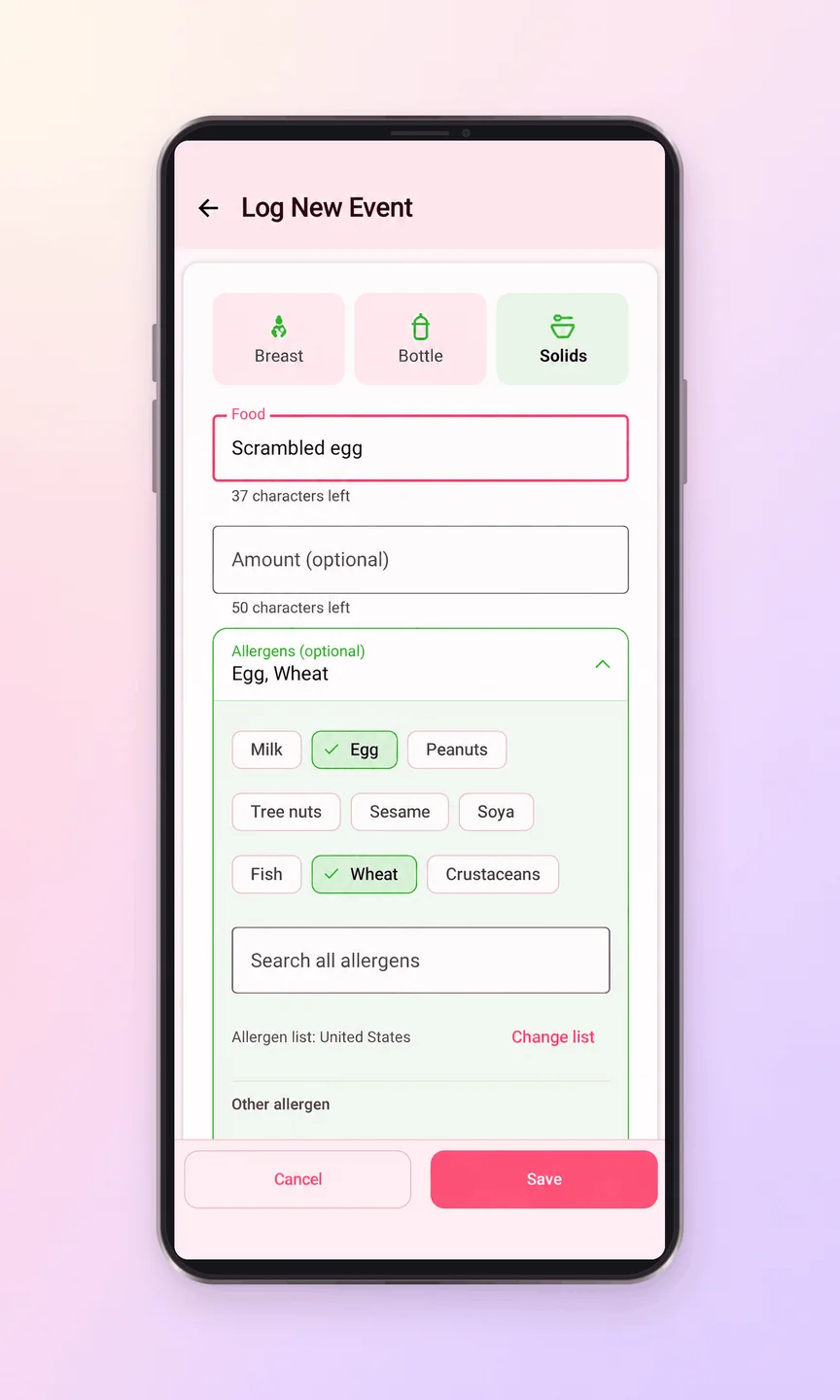
- Log allergens with each solids feed. When you log solids, open Allergens and choose from your region’s list, or search by food, such as peanut butter, tahini or tofu. Any other food can be added as a custom allergen.
- See what is tried and what is next. Allergens Logged in Feed History lists each allergen with how many times it has been given and when it was last logged. Show allergens not logged yet to see what your baby still has to try.
- Link a reaction to the feed. If a rash, vomiting or another symptom appears, minutes or days later, log it and link it to the solids feed you suspect. Every allergen in that feed is flagged with a warning for every caregiver.
- Share it with everyone who feeds your baby. Invite a partner, grandparent or nanny to your household. Each person sees the same allergen record on their own phone, and allergens appear in Catch-ups for whoever takes over next.
Allergen tracking is free, and so are Catch-ups and CSV export. There is no separate allergen app to install: allergens sit in the same timeline as feeds, sleep and diapers.
The allergen list for where you live
Food labelling rules name different allergens in different countries. Pebbi starts with the list for your phone’s region, and you can switch lists for the whole household.
| Region | Allergens on the list | How many |
|---|---|---|
| UK and EU | Milk, egg, peanuts, tree nuts, sesame, soya, fish, cereals containing gluten, crustaceans, molluscs, celery, mustard, lupin and sulphites | 14 allergens |
| United States | Milk, egg, peanuts, tree nuts, sesame, soy, fish, wheat and crustacean shellfish | 9 allergens, the Big 9 |
| Canada | Milk, egg, peanuts, tree nuts, sesame, soy, fish, wheat, cereals containing gluten, crustaceans, molluscs, mustard and sulphites | 13 allergens |
| Australia and New Zealand | Milk, egg, peanuts, tree nuts, sesame, soy, fish, wheat, cereals containing gluten, crustaceans, molluscs, lupin and sulphites | 13 allergens |
| Brazil | Milk, egg, peanuts, tree nuts, soy, fish, cereals containing gluten and crustaceans | 8 allergens |
| Latin America | Milk, egg, peanuts, tree nuts, sesame, soy, fish, cereals containing gluten, crustaceans and sulphites | 10 allergens |
Every allergen stays searchable whichever list you use, and anything else can be added as a custom allergen. If your region has no list of its own, Pebbi starts with the US list. These lists follow food labelling rules. They are not a complete list of everything a baby could be allergic to.
Free printable allergen tracker sheets
Want paper on the fridge as well? Download a printable allergen tracker for your region, with space to record first tastes, repeat exposures and any reactions.
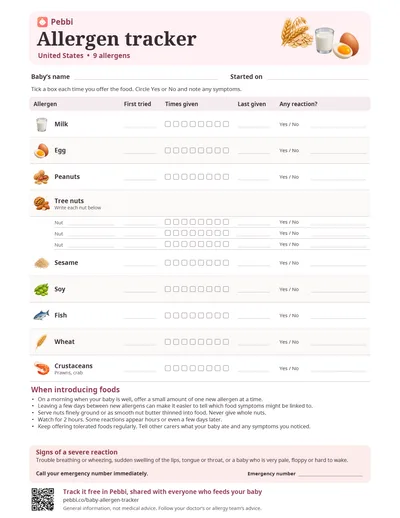
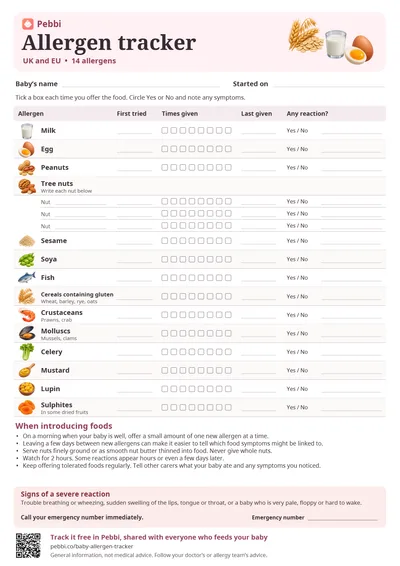
9 allergens, the Big 9
United States
13 allergens
Canada
13 allergens
Australia and New Zealand
8 allergens
Brazil
10 allergens
Latin America
The sheets are free to print and share. For a record that every caregiver can update from their own phone, use the Pebbi app alongside them.
Keep allergens in your baby’s diet
Introducing an allergen is the start, not the finish. Once a food is tolerated, health services advise offering it regularly so it stays part of your baby’s diet, and many allergy specialists suggest at least once or twice a week. Follow your own doctor’s advice if it differs.
The Last logged column in Allergens Logged shows when each allergen was last given, whoever did the cooking, so it is easy to spot one that has slipped. The Times column shows how often each one has been offered.
Link a reaction to the feed you suspect
Reactions do not always appear straight away. A shared, dated record makes a delayed reaction much easier to connect to the right feed.
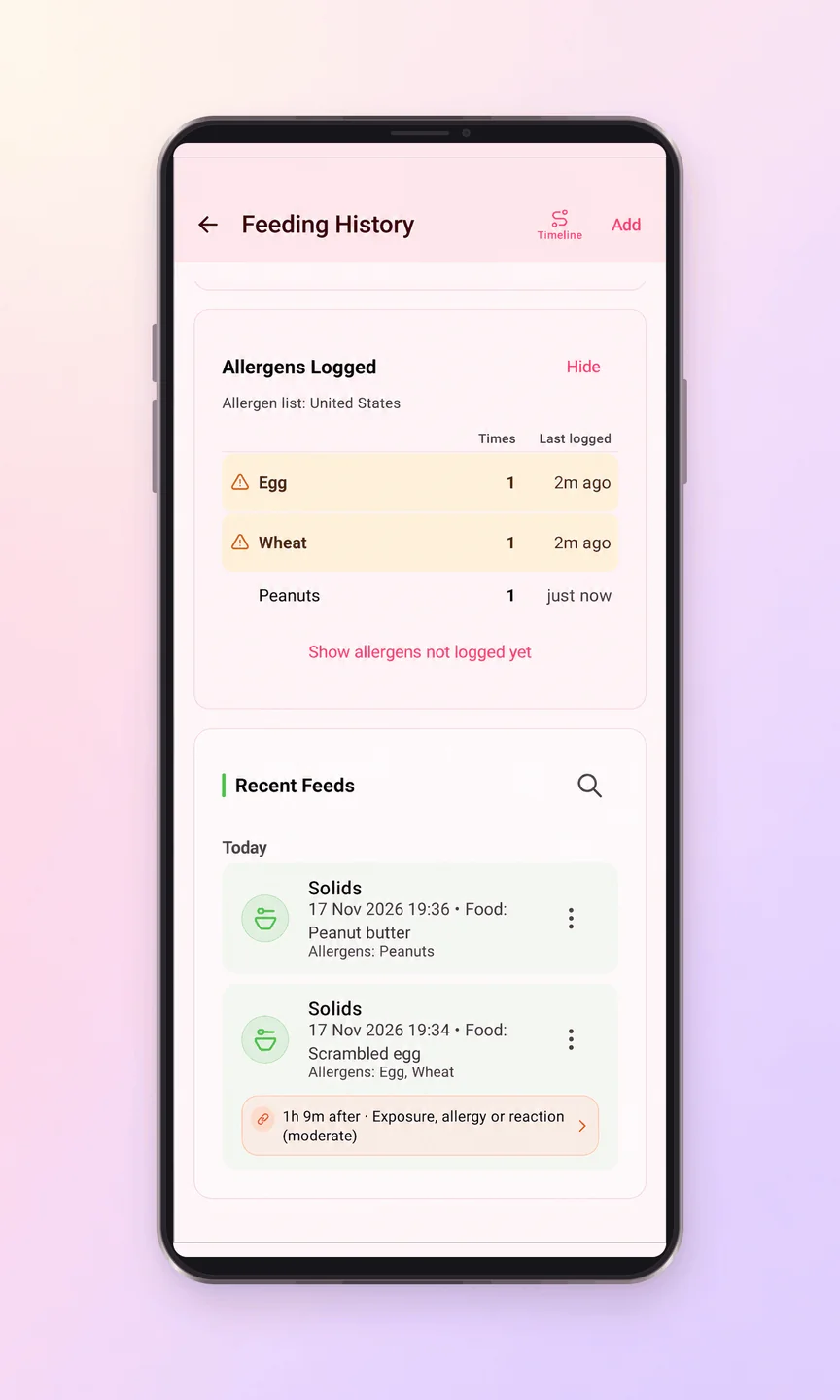
Most allergic reactions start within minutes to 2 hours of eating, but some, such as cows’ milk allergy, can take up to 3 days to show. By then your baby may have eaten several other foods, often in someone else’s care.
- Link from either side. Choose a related feed when you log the symptom, or add the symptom from the feed. Feeds from the previous 24 hours are offered first, and you can browse back further.
- Flagged for everyone. Every allergen in a linked solids feed is marked with a warning in Allergens Logged, with the most severe linked symptom and a shortcut to the linked symptoms.
- The time between them. Both entries show how long after the feed the symptom started.
- Severity, notes and photos. Record how severe a symptom is and add notes. Premium adds symptom photos, useful when a rash fades before the appointment.
- Emergency signs when it matters. When you log a severe symptom that is happening now, Pebbi lists the signs that mean you should call emergency services.
Introduce one new allergen at a time. If a linked feed contained more than one allergen, all of them are flagged, because a record cannot tell which one was responsible.
Pebbi is a record, not a diagnosis. A link is your household’s note of a possible connection. If you think your baby has had a reaction, speak to your doctor before offering that allergen again.
Symptoms after milk feeds, such as reflux, can be linked to breast and bottle feeds in the same way. Read how to track reflux after feeding
One allergen record for everyone who feeds your baby
Most allergen mix-ups happen between people, not foods: a grandparent offering something never tried, or a nanny unaware of last week’s reaction.
- Partners. Check what was introduced at breakfast before making dinner.
- Grandparents. Check which allergens are already part of your baby’s diet and which are still new.
- Nannies and night nannies. Log a reaction and link it to the feed, so parents see it straight away.
- Two homes. Share one record, so a reaction that appears after a handover can be linked to the right feed.
- Catch-ups. Allergens are included, so whoever takes over sees what was tried recently.
Two caregivers share one baby free. Premium supports up to 10 caregivers and 5 babies in one household.
Pebbi compared with a paper chart or an allergen-only app
A printable chart or a solids-only app can record first tastes. Pebbi adds every caregiver, the rest of your baby’s day and the link between a feed and a reaction.
| Feature | Pebbi | Paper chart | Allergen-only app |
|---|---|---|---|
| Cost | Allergen tracking is free | Free | Varies, often a subscription |
| Shared with every caregiver | Yes, live on each person’s phone | Only where the paper is | Varies |
| Your region’s allergen list | Six regional lists, plus custom allergens | Depends on the chart | Often the US Big 9 only |
| Times given and last given | Counted automatically | Counted by hand | Varies |
| Allergens not tried yet | Listed in the app | Checked by hand | Varies |
| Reaction linked to the exact feed, with timing | Yes, with the time between them | A note in the margin | Usually a note on the food |
| Milk feeds, sleep, diapers and symptoms such as reflux | Yes, in the same app | No | Usually solids only |
| Works offline | Yes | Yes | Varies |
| Exports for appointments | CSV free, PDF with Premium | A photo of the sheet | Varies |
Questions about tracking your baby’s allergens
Is there a free baby allergen tracker app?
Yes. Allergen tracking in Pebbi is free on iPhone and Android, including regional allergen lists, exposure counts, last-logged dates, the list of allergens not tried yet, linking reactions to feeds, Catch-ups and CSV export. Two caregivers can share one baby’s record free. Premium adds up to 10 caregivers and 5 babies, symptom photos and PDF exports.
How do I track allergen introduction for my baby?
Record each allergen with the date, the food and roughly how much, introduce one new allergen at a time, and keep offering each one once it is tolerated. In Pebbi, add the allergens when you log a solids feed. Allergens Logged then shows what has been tried, how often and when it was last given, and which allergens are still to try.
Which allergens should I track?
Start with the allergens on your country’s food labelling list. Pebbi includes lists for the UK and EU (14 allergens), the United States (the Big 9), Canada, Australia and New Zealand, Brazil and Latin America, and you can add any other food as a custom allergen. Your doctor or allergy team may suggest others for your baby.
How do I keep track of allergen maintenance?
Once an allergen is tolerated, keep offering it regularly so it stays in your baby’s diet. Many allergy specialists suggest at least once or twice a week, but follow your own doctor’s advice. In Pebbi, the Last logged column shows when each allergen was last given and the Times column shows how often, so it is easy to spot one that has not been offered for a while.
Can I log an allergic reaction and link it to a food?
Yes. Log the symptom with its severity and notes, then link it to the solids feed you suspect, even if the symptom appeared hours or days later. Every allergen in that feed is flagged with a warning for everyone in the household, and both entries show how long after the feed the symptom started. If the feed contained more than one allergen, all of them are flagged, which is one reason to introduce one new allergen at a time.
Can grandparents and nannies see which allergens my baby has tried?
Yes. Everyone you invite to your Pebbi household sees the same allergen record on their own phone, including which allergens have been tried, how often, and any allergen flagged after a reaction. Allergens also appear in Catch-ups, so whoever takes over care sees what was introduced recently.
Can I export my baby’s allergen log for a doctor or allergist?
Yes. CSV export is free and PDF reports are part of Premium. Both include allergens, symptoms and linked events, so you can show when each allergen was given and how long after a feed a symptom started.
Is there a printable allergen tracker?
Yes. Pebbi offers free printable allergen tracker sheets for each regional allergen list, with space to record first tastes, repeat exposures and reactions. For a record that every caregiver can update from their own phone, use the free Pebbi app.
Does the allergen tracker work offline?
Yes. You can log allergens and symptoms without a connection, and entries sync with your household when the phone reconnects.
Can Pebbi track reflux and symptoms after milk feeds too?
Yes. Any symptom, such as reflux, vomiting or a rash, can be linked to the breast, bottle or solids feed before it, and both entries show the time between them. Pebbi is a full baby tracker, so milk feeds, solids, sleep, diapers and medicines sit in the same timeline as your allergen record.
Does Pebbi tell me if my baby is allergic to a food?
No. Pebbi records what you and your caregivers log and highlights any allergen in a feed you have linked to a symptom. A link is your own note of a possible connection, not a diagnosis. If you think your baby has had a reaction, speak to your doctor before offering that allergen again.
Start your baby’s allergen record today.
Download Pebbi free for iPhone or Android and invite the people who feed your baby.