

Quick answer: Reflux after feeding is very common: at least 4 in 10 babies bring milk back up, usually during or shortly after a feed. It tends to start before 8 weeks, peaks at around 4 to 5 months and has settled for 9 in 10 affected babies by their first birthday. Holding your baby upright during and after feeds, burping regularly and offering smaller, more frequent feeds can help. See your doctor if your baby is distressed, refuses feeds or is not gaining weight, and get urgent help for green, yellow or bloody vomit, projectile vomiting or blood in their poo. A dated record that links each episode to the feed before it shows your doctor the pattern. Pebbi links reflux to a feed for free and shows how long after the feed it started.
- Silent reflux has no visible spit-up. Look for coughing, gulping or swallowing during and after feeds, and a baby who is unsettled while feeding.
- Cows' milk allergy can look like reflux. Do not switch formula, add thickener or cut dairy from your own diet without speaking to your doctor first.
- Pebbi links each reflux episode to the breast or bottle feed before it, shows the time between them on both entries, and shares the record with every caregiver.
Key takeaways
- Reflux after feeding is one of the most common things babies do. At least 4 in 10 babies bring milk back up, and for 9 in 10 of them it has settled by their first birthday.
- Most reflux is harmless, but some signs need a doctor, and a few need urgent help. Knowing which is which takes a lot of the fear out of it.
- Silent reflux has no spit-up to see, so the pattern is easier to miss and harder to explain.
- The question doctors keep asking is "how long after feeds?". A record that links each episode to the feed before it answers that, even when different people did the night feeds.
The 3am bottle and the 4am spit-up
At 3am the bottle goes down well. At 3:40 there is a cough, a gulp, a damp muslin and a baby who will not settle. At 6am you hand over to your partner, who notices more milk on the sheet and wonders whether it was the same feed or the one after.
By the time you are sitting in front of a doctor, the questions sound simple. How often does it happen? How long after feeds? Is it worse with bottles or breastfeeds? Is it getting better? And between broken sleep, two or three people doing feeds and a week that blurred into one long night, nobody is quite sure.
If you have been told "it's just reflux" and left feeling unheard, you are not alone. Reflux is common and usually harmless, but living with it is exhausting: the constant laundry, the worry about whether your baby is keeping enough down, and the sense that something is hurting them and you cannot work out what.
This guide covers what reflux after feeding looks like, what is normal, what helps, the signs that need a doctor, and how to keep a record that turns "we think it's after most feeds" into something your doctor can actually use.
Is reflux after feeding normal?
Usually, yes. Reflux happens when milk comes back up from the stomach into the food pipe (oesophagus, or esophagus). In babies, the muscle at the bottom of the food pipe is still developing, and their diet is entirely liquid, so milk comes back up easily.
NICE guidance on gastro-oesophageal reflux says effortless regurgitation affects at least 40% of infants, and that it resolves in 90% of affected babies before they are 1. The NHS says reflux usually starts before a baby is 8 weeks old and gets better by the time they are 1, and the American Academy of Pediatrics puts it bluntly: all babies spit up.
Many babies bring up milk after most feeds and are otherwise content, feeding well and gaining weight. Doctors sometimes call them happy spitters. The laundry is real, but the baby is fine.
Spit-up, reflux, GERD or silent reflux: what is the difference?
| Term | What it means | What you might notice |
|---|---|---|
| Spit-up (posseting, regurgitation) | Small amounts of milk coming back up easily | Milk dribbling or flowing out during or soon after a feed, with a baby who is otherwise content |
| Reflux (GER, or GOR in the UK) | Milk or stomach contents moving back up the food pipe | Spit-up, hiccups, gulping or coughing around feeds. Normal in babies |
| Silent reflux | Reflux where the milk is swallowed again rather than spat out | Coughing or hiccupping during feeds, swallowing or gulping after feeds, being unsettled while feeding |
| GERD (GORD in the UK) | Reflux that causes problems | Marked distress, refusing feeds, poor weight gain, breathing symptoms. Needs a doctor |
| Vomiting | Milk coming up forcefully | Larger amounts, sometimes shooting out. Projectile vomiting needs urgent advice |
What does silent reflux look like?
The NHS lists the signs of reflux as bringing up milk or being sick during or shortly after feeding, coughing or hiccupping when feeding, being unsettled during feeding, swallowing or gulping after burping or feeding, crying and not settling, and not gaining weight. With silent reflux, babies have those signs without bringing milk up.
Those signs are also common in babies for plenty of other reasons, including wind, hunger, tiredness and normal fussiness. That is exactly why a record helps: a cough that happens 10 minutes after most bottles is a different picture from a cough that happens at random. Our guide to why babies cry and how to spot patterns covers the wider list.
When does reflux peak, and when does it stop?
| Age | What usually happens |
|---|---|
| First few weeks | Reflux usually starts, often from around 2 to 3 weeks and before 8 weeks |
| Around 4 to 5 months | Often at its peak, according to the American Academy of Pediatrics |
| Around 6 months | Sitting up, more head control and starting solids often help. Reflux that starts for the first time after 6 months should be checked by a doctor |
| 9 to 12 months | Most babies have grown out of it |
| After 1 year | Reflux that is still going on should be checked by a doctor |
If your baby is in the peak weeks, it can feel as though it is getting worse, not better. A record that covers a few weeks makes it much easier to see the trend, rather than judging each day on its own.
What helps a baby with reflux after feeds
Most of what helps is simple, and it comes from the NHS, NICE and the American Academy of Pediatrics:
- Keep your baby upright during feeds and afterwards. The NHS suggests holding your baby upright for as long as possible after a feed, and the AAP suggests around 30 minutes, with your baby supervised.
- Burp regularly. Burp at natural pauses during the feed, not only at the end.
- Ask about smaller, more frequent feeds. For formula-fed babies, NICE suggests reviewing the feeding history and trying smaller, more frequent feeds, while keeping the total amount over the day right for your baby.
- Get help with feeding position or bottle technique. A health visitor, midwife, lactation consultant or doctor can check positioning, latch, teat flow and how much your baby is taking.
- Keep sleep safe. Always put your baby to sleep flat on their back. Do not raise the head of the cot, crib or Moses basket, and do not use wedges or positioners.
- Do not start treatments on your own. Thickened formula, special formulas, dairy-free diets and medicines are all things a doctor may suggest after checking your baby. They are not safe guesses to make alone.
Whatever you try, write it down next to the feed. "Smaller bottle, upright for 30 minutes" in a feed note is how you find out, a week later, whether it made any difference.
Reflux after night feeds and handovers
Reflux rarely sticks to office hours. The episodes you most need to describe often happen at night, when the person doing the feed is the least likely to remember the details in the morning, and the least likely to be the one at the appointment.
In many families, nights are split. A partner takes the late bottle, you take the early one. A night nanny covers a few nights a week. A grandparent helps at the weekend. Each person sees part of the pattern, and nobody sees all of it.
A shared record fixes that, as long as it records what came before what. "Reflux, moderate, 35 minutes after the 2am bottle" logged by whoever was awake is far more useful at breakfast than "she was sicky in the night". Pebbi was built for these handovers: see how it works for night nannies and other caregivers and for shared care between several caregivers.
Is it reflux or cows' milk allergy?
Sometimes symptoms that look like reflux are caused by cows' milk allergy, also called cows' milk protein allergy or CMPA. The NHS notes that a doctor may check for cows' milk allergy, because its symptoms can look similar to reflux.
The North West Allergy Network, part of the NHS, describes two kinds of reaction:
- Immediate reactions, such as hives (a nettle-type rash), swelling of the lips, vomiting or diarrhoea, usually soon after milk. Difficulty breathing, wheezing or throat swelling is an emergency.
- Delayed reactions, such as eczema flares, vomiting after feeds, colic and diarrhoea, sometimes with blood in the poo. These can appear hours or up to a day or two after milk, which makes them much harder to connect to a particular feed.
Signs that are worth mentioning to your doctor, because they can point beyond simple reflux, include eczema, blood or mucus in your baby's poo, diarrhoea or constipation, hives or swelling, poor weight gain and a family history of allergy.
What you should not do is change formula or cut dairy from your own diet on a hunch. The North West Allergy Network says breastfeeding mothers should not exclude cows' milk and dairy without professional advice, and the AAP recommends asking your paediatrician before trying a dairy-free diet or a special formula. If your doctor does suggest a trial, a record from before and after the change is exactly what helps you both judge whether it worked.
Milk is also one of the allergens in every regional allergen list Pebbi uses. When your baby moves on to solids, our guide to introducing allergens to your baby and the free baby allergen tracker cover the next stage.
How to keep a reflux diary your doctor can use
A reflux diary does not need to be perfect, and it does not need to cover every feed forever. A week or two of honest records before an appointment is usually enough to show a pattern. Our guide to tracking without needing perfect records is a good reminder of that.
Record:
- Each feed. The time, whether it was a breastfeed (and which side), a bottle (breast milk or formula, and how much) or solids, and any change of formula.
- Each episode. What happened (spit-up, vomiting, coughing, gulping, arching, crying), roughly how much came up and how distressed your baby was.
- The time between them. How long after the feed it started. This is the detail that disappears first from memory.
- What you tried. Keeping your baby upright, burping more often, a smaller bottle, a different teat.
- Nappies and weight. Wet and dirty nappies (diapers) and any weight checks help your doctor judge whether your baby is keeping enough milk down. Our guide to newborn wet and dirty nappies explains what to look for.
- Who was caring. It matters when care is shared, because that person may remember details that were not logged.
Here is what a few hours of a useful diary can look like:
| Time | Feed | What happened | Time after the feed | Notes |
|---|---|---|---|---|
| 02:10 | Bottle, 120 ml formula | Reflux, moderate: milky spit-up and coughing | 35 minutes | Upright for 20 minutes, then laid down |
| 05:40 | Breastfeed, left side, 15 minutes | Nothing | Burped twice | |
| 08:30 | Bottle, 90 ml formula | Reflux, mild: small spit-up | 10 minutes | Smaller bottle, kept upright |
Three lines are not a diagnosis. Two weeks of lines like these, though, can show your doctor whether episodes cluster after bigger feeds, after bottles rather than breastfeeds, at night, or after a formula change.
Why a linked record beats a list of times
Most baby trackers, and most notebooks, keep feeds and symptoms as two separate lists. You can see that there were six feeds and four spit-ups yesterday, but working out which spit-up followed which feed, and how long afterwards, is left to you, usually at 3am or in a waiting room.
Linking changes the question from "what do we think happened?" to "what actually happened, and when?":
- Each episode stays attached to its feed. Whoever logged it, and whenever they logged it, the reflux episode is tied to the feed you think it followed.
- The time between them is worked out for you. No mental arithmetic across two lists.
- Patterns become visible by scrolling. Look back over a week of linked episodes and you can see for yourself whether most came within 40 minutes of larger bottles, or mostly at night.
- Everyone adds to the same picture. The partner, the night nanny and the grandparent each link the episodes they saw.
Pebbi does not analyse those links for you, and it does not need to. A list of episodes, each linked to its feed with the time between them, is exactly what a doctor wants to look through.
How Pebbi links reflux to feeds
Pebbi is a shared baby tracker for iPhone and Android. Feeds, sleep, nappies, medicines and symptoms sit in one timeline that everyone in your household sees on their own phone, and any symptom can be linked to the feed before it.
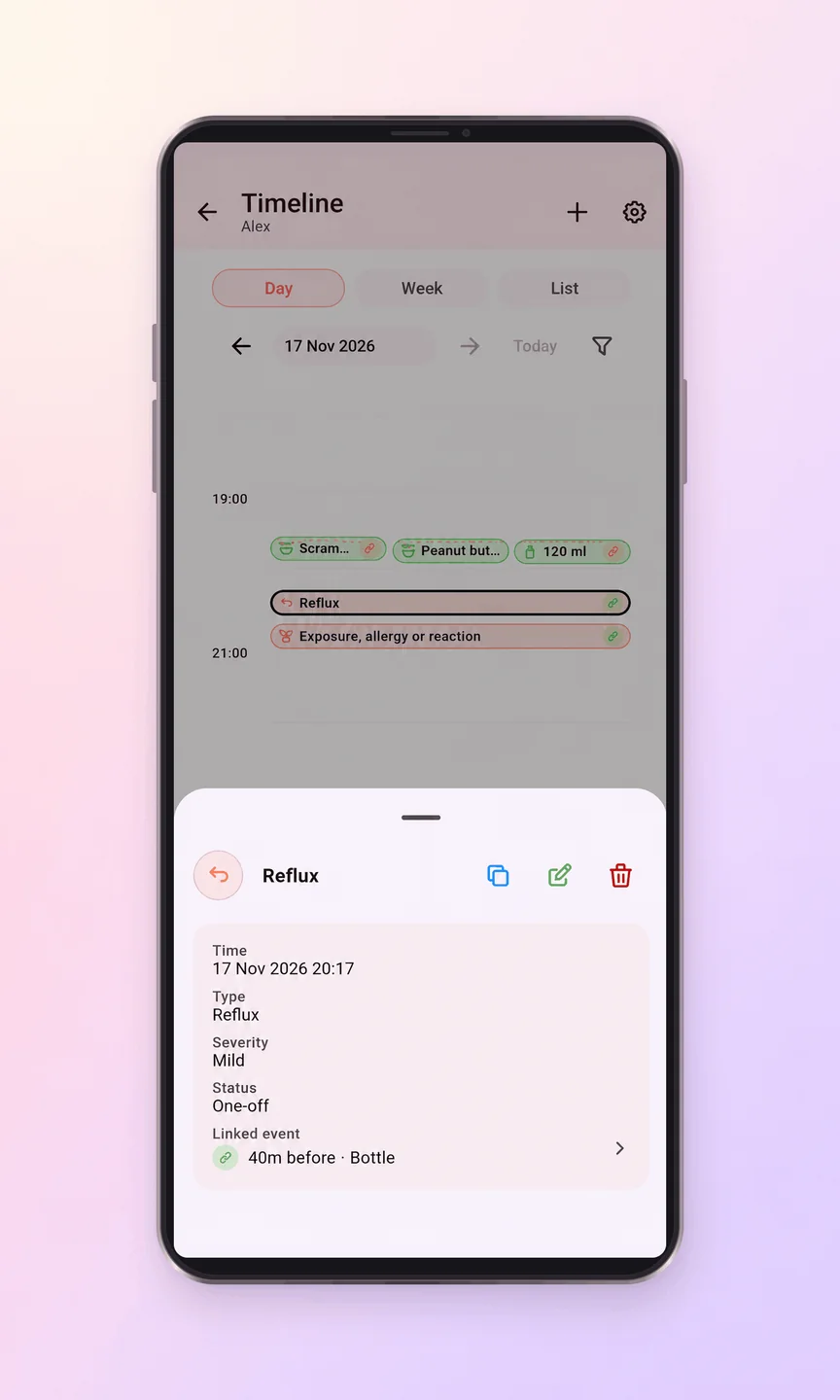
- Log the symptom. Choose Reflux (or Vomiting, Rash or skin issue, and others), set the severity and add notes.
- Choose the related feed. Feeds from the 24 hours before the symptom started are offered first, nearest first, and you can browse earlier feeds if you need to.
- Or start from the feed. Open a feed and link it to a symptom from the 24 hours after it.
- See the time between them. Both entries show the gap: the reflux shows "40m before · Bottle" and the bottle shows "40m after · Reflux (mild)". Tap either one to jump to the other.
- Every caregiver sees it. Links sync to your household, so the morning shift sees what happened after the 3am bottle.
- Breast, bottle or solids. Any feed can be linked. For solids, every allergen in a linked feed is flagged in Allergens Logged, which is how the baby allergen tracker keeps possible reactions in view.
- One link each. Each feed and each symptom can have one link, which keeps every episode tied to a single feed.
- Ready for appointments. CSV exports, which are free, include linked events. Premium PDF reports print each link under the entry, for example "Linked event: 35m after · Reflux (moderate)".
- Emergency signs when it matters. If you log a severe symptom that is happening now, Pebbi lists the signs that mean you should call emergency services.
Linking is free, along with everyday tracking, Catch-ups and CSV export for one baby and two caregivers. Pebbi works offline, needs no email and password account, shows no ads and uses no AI.
Pebbi is a record, not a diagnosis. A link is your household's note of a possible connection. It cannot tell you whether your baby has reflux, GERD or an allergy, or what caused a symptom. See how linking feeds and symptoms fits with the rest of Pebbi's features.
Taking your record to the appointment
Doctors usually start with the feeding history: how often your baby feeds, how much, how the feeds go, what happens afterwards and how your baby is growing. A record lets you answer with facts rather than impressions.
- Bring two weeks if you can. Enough to show a pattern, not so much that it is overwhelming.
- Lead with your main worry. For example: "Most episodes come within 40 minutes of a bottle, and she cries for longer than she used to."
- Mention anything beyond spit-up. Eczema, blood or mucus in poo, fewer wet nappies, refusing feeds or weight concerns all matter.
- Keep logging after any change. If your doctor suggests smaller feeds, a thickened formula, a medicine or a dairy-free trial, keep the record going so you can both see whether it helps.
In Pebbi, export a CSV for free, or a PDF report with Premium, and take it with you. Symptom photos, also part of Premium, help when something has faded by the time you are seen.
When to get urgent help
Do not wait if you are worried. Ask for an urgent doctor's appointment, or use a non-urgent medical helpline such as NHS 111 in the UK, if your baby has green, yellow or bloody vomit, is projectile vomiting, has blood in their poo, has a swollen or tender tummy, has a very high temperature, keeps being sick and cannot keep fluids down, has diarrhoea for more than a week or signs of dehydration, will not stop crying and is very distressed, or is refusing to feed. Call your local emergency number straight away (999 in the UK, 911 in the US, 000 in Australia) if your baby is struggling to breathe, has swelling of the lips, tongue or throat, is floppy, very pale or blue, or is hard to wake.
See your doctor, paediatrician or health visitor, less urgently, if reflux is not improving after trying the simple changes above, starts for the first time after 6 months, continues after your baby's first birthday, or your baby is not gaining weight.
If you only do one thing
Link each episode to the feed before it. You do not need to log everything perfectly, and you do not need to work out the pattern yourself at 3am. A record that says which feed came first, and how long afterwards the reflux started, gives your doctor the answer to the question they will almost certainly ask.
Pebbi links symptoms to feeds for free on iPhone and Android, with no account required. Invite your partner, a night nanny or a grandparent in under a minute, and everyone adds to the same record. Download on iOS or Android.
This article is general information, not medical advice. Always follow guidance from your own doctor, paediatrician or health visitor. Reflux guidance was checked against NHS, NICE and American Academy of Pediatrics advice in November 2026.
FAQs
How long after feeding does reflux happen?
Reflux usually happens during a feed or shortly afterwards, while your baby's tummy is full. That is why keeping your baby upright for around 30 minutes after a feed often helps. Some babies bring milk up later, especially when they are laid down or moved around. Logging each episode against the feed before it shows you, and your doctor, what is typical for your baby.
Is it normal for a baby to spit up after every feed?
It can be. Many babies spit up after most feeds and are still content, feeding well and gaining weight, which doctors sometimes call being a happy spitter. Speak to your doctor, paediatrician or health visitor if your baby seems in pain, refuses feeds, is not gaining weight or has fewer wet and dirty nappies (diapers).
When does baby reflux peak, and when does it stop?
Reflux usually starts in the first few weeks, before 8 weeks of age, and is often at its worst at around 4 to 5 months. It then eases as your baby grows, sits up and starts solids, and it has gone for 9 in 10 affected babies by their first birthday. Reflux that starts after 6 months, or carries on after 1 year, should be checked by a doctor.
What is silent reflux in babies?
Silent reflux is reflux where milk comes back up the food pipe but is swallowed rather than spat out. There is little or no visible spit-up, so the signs are easier to miss: coughing or hiccupping during feeds, gulping or swallowing after feeds, being unsettled while feeding, and crying that is hard to settle. These signs are common in babies generally, so a record of when they happen helps your doctor judge whether reflux is likely.
What is the difference between reflux and GERD (GORD)?
Reflux (GER, or GOR in the UK) is milk or stomach contents coming back up the food pipe. It is a normal part of being a baby and usually needs no treatment. GERD (GORD in the UK) is reflux that causes problems, such as marked distress, feeding refusal, poor weight gain or breathing symptoms. Only a doctor can decide whether your baby has GERD.
Is it reflux or cows' milk allergy?
The two can look alike. Delayed cows' milk allergy can cause vomiting after feeds, colic, eczema flares and diarrhoea, sometimes with blood in the poo, and can appear hours or a day or two after milk. Hives or swelling soon after a feed point more to an immediate allergy. Your doctor may check for milk allergy if reflux does not improve. Do not change formula or cut dairy from your own diet without professional advice.
What helps a baby with reflux after feeding?
Hold your baby upright during feeds and for as long as possible afterwards, burp them regularly at natural pauses, and ask your doctor or health visitor about smaller, more frequent feeds and your feeding position or bottle technique. Always put your baby to sleep flat on their back, and do not raise the head of the cot or crib. Thickened formula and medicines are options a doctor may suggest, not ones to start on your own.
Should I keep a reflux diary for my baby?
A short record is one of the most useful things you can take to an appointment. Note each feed (time, type, amount or side), each episode (what happened, how much, how distressed your baby was), the time between them, and anything you tried, such as a smaller bottle or keeping your baby upright longer. Keep going after any change your doctor suggests, so you can both see whether it helps.
What is the best app to track baby reflux?
Look for an app that logs breast, bottle and solid feeds alongside symptoms, lets you link each symptom to the feed before it, shows the time between them, shares the record with every caregiver and exports it for appointments. Pebbi does all of this free on iPhone and Android, with no email and password account and no ads. CSV export is free, and PDF reports are part of Premium.
When should I take my baby to a doctor for reflux?
See your doctor if things are not improving after trying simple changes, if reflux starts after 6 months or continues after 1 year, or if your baby is not gaining weight. Get urgent advice for green, yellow or bloody vomit, projectile vomiting, blood in their poo, a swollen or tender tummy, a high temperature, repeated vomiting with no fluids kept down, signs of dehydration, refusing feeds, or crying that will not stop. Call your local emergency number for breathing difficulties or a baby who is floppy or unresponsive.
Can Pebbi tell me what is causing my baby's reflux?
No. Pebbi records what you and your caregivers log, and shows the links you make between feeds and symptoms with the time between them. It does not diagnose reflux, GERD or allergies, or decide what caused a symptom. Take your record to your doctor, paediatrician or health visitor.