
Published
Quick answer: AI baby trackers excel at sleep prediction and pattern recognition when you have enough data. Manual trackers are simpler, more private, and work without consistent logging. The right choice depends on what you need the tracker to do.
- AI features require consistent, detailed logging to work. If you track sporadically, manual is more practical.
- Sleep prediction is the most genuinely useful AI feature. Most other AI additions are nice-to-have rather than essential.
- Pebbi offers optional AI insights in Premium but is fully useful without them; manual tracking with shared sync is the core.
Key takeaways
- AI in baby trackers is not one thing. It ranges from genuinely useful sleep predictions to marketing-driven features that add complexity without clear benefit.
- Manual tracking is simpler, more private, and works well for coordination and basic record-keeping. AI tracking is more powerful for pattern analysis but requires more data input.
- The best approach for most families is a tracker that works well manually and offers AI as an option, not a requirement.
What Are We Actually Comparing?
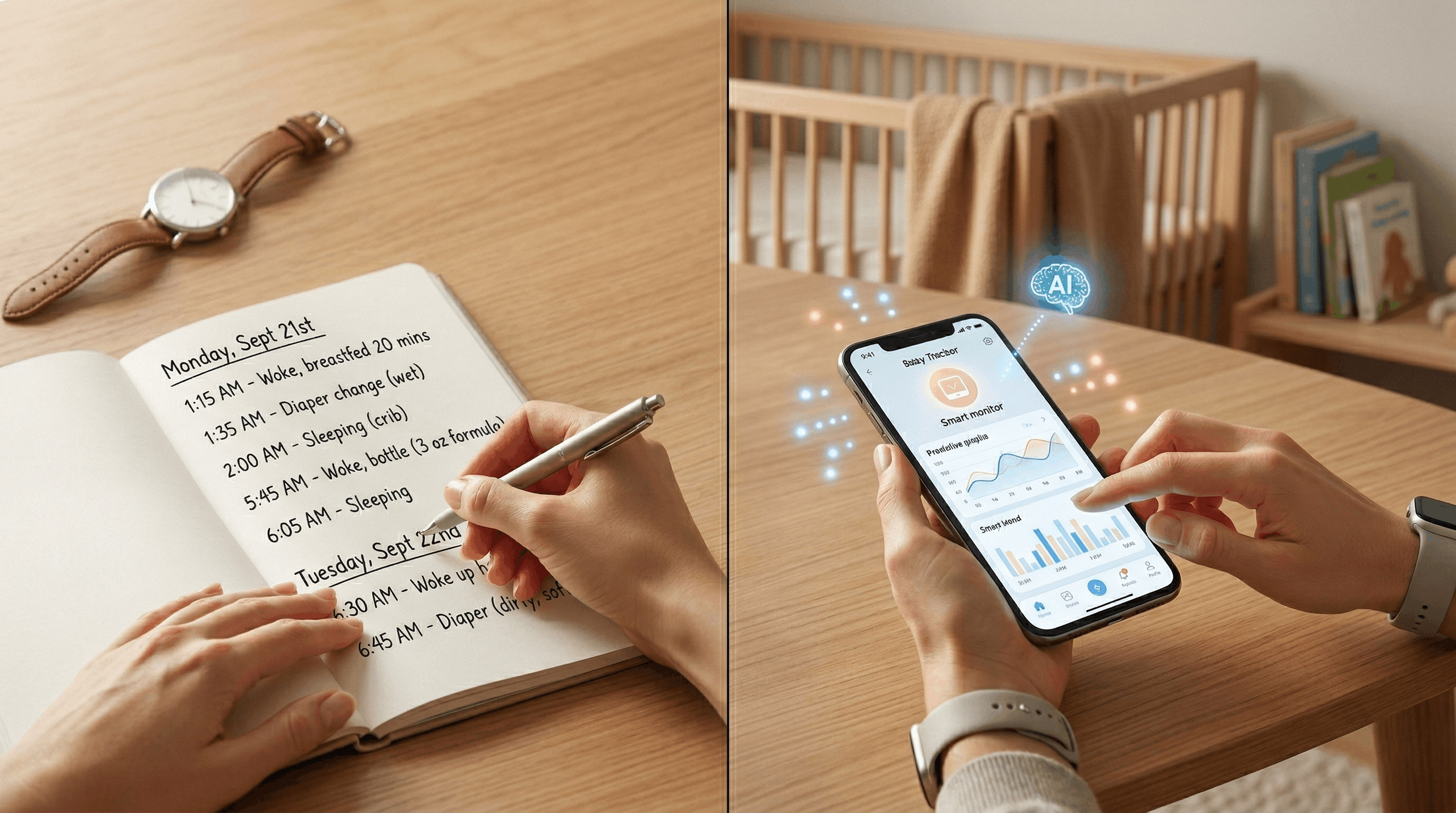
Manual tracking can mean hand-entered taps in an app, a notebook on the counter, or any setup where you decide what to record without algorithmic nudges. AI in baby apps usually means automated or predictive features: pattern analysis on your history, smart nap suggestions, natural-language summaries, or adaptive reminders. The useful distinction is optional AI versus AI-first: can the app still work if you log sporadically, or does it quietly need you to feed the model every day?
"AI baby tracker" has become a marketing term that covers a wide range of features. Before comparing manual vs AI, it is worth being specific about what AI actually does in this context.
Sleep prediction. The most established AI feature in baby tracking. Apps like Huckleberry use logged sleep data to predict when your baby will next be ready for a nap. This uses pattern recognition on your historical data to suggest optimal nap windows. When it works, it is genuinely helpful. When the data is inconsistent, the predictions are unreliable.
Pattern recognition. Some apps analyse feeds, sleep, and fussiness to identify correlations. "Your baby tends to be fussier after short naps" or "feeds are closer together on Mondays." This can surface insights you might not notice yourself, but it requires weeks of consistent data.
Natural language summaries. Newer apps use AI to generate daily or weekly summaries in plain English: "Tuesday was a typical day. Three naps totalling 3.5 hours, six feeds, and no concerns." This is a convenience feature: the information already existed in your logs, the AI just narrates it.
Milestone predictions. Some apps claim to use AI to predict developmental milestones or flag potential concerns. This is the most controversial category. Developmental variation in healthy babies is enormous, and AI predictions based on limited data risk creating unnecessary anxiety.
Smart notifications. AI-timed reminders that adapt to your baby's patterns rather than using fixed intervals. "Based on recent patterns, your baby may be ready for a nap in about 20 minutes."
A manual baby tracker, by contrast, lets you log events and view a timeline. No predictions, no analysis, no notifications unless you specifically set a reminder. You decide what to track, you look at the data when you want to, and you draw your own conclusions.
When AI Tracking Genuinely Helps
AI is not universally good or bad. It is useful in specific situations and unnecessary in others.
Sleep is your main challenge. If you are struggling with wake windows, nap timing, and the exhausting cycle of overtiredness, sleep prediction tools can genuinely help. Huckleberry's SweetSpot feature, for example, has helped many parents find a nap rhythm that works. The AI takes the guesswork out of "is she tired yet?" by learning your baby's specific patterns rather than relying on generic age-based guidelines.
You are troubleshooting a specific problem. If your baby's fussiness has no obvious cause, pattern recognition across multiple variables (feeds, sleep, environment) might surface a correlation you would not spot manually. This is where AI's ability to process more data points than a human can hold in their head becomes useful.
You enjoy data and optimisation. Some parents genuinely enjoy seeing insights, trends, and predictions. It is satisfying to see the AI "learn" your baby's patterns and become more accurate over time. If data is your love language, AI features will feel like a natural extension of what you already want to do.
You have the bandwidth to log consistently. This is the critical dependency. AI features need data to work. If you log sporadically, which is perfectly normal when you are sleep-deprived and managing a baby, the AI has gaps to work with and its predictions become unreliable. AI tracking is most useful for parents who can and want to log consistently.
When Manual Tracking Is Better
You track for coordination, not analysis. If the main reason you use a baby tracker is so that your partner, nanny, or grandparent knows what happened, you need a shared timeline, not predictions. The information flowing between caregivers is simple (last feed, last nap, medication given) and does not benefit from AI analysis.
You track sporadically. Logging every feed and nap is not realistic for every parent. If you log when you remember and skip when you do not, a manual tracker treats those gaps as normal. An AI tracker treats them as missing data that degrades its predictions, which can make you feel like you are not using the tool "properly."
Privacy matters to you. AI features typically require your data to be processed on a server. Pattern recognition, sleep prediction, and natural language summaries all need cloud computing. A manual tracker that stores data on your device and syncs peer-to-peer avoids this entirely. If you are uncomfortable with your baby's health data being processed remotely, manual tracking is more private.
You are overwhelmed, not under-informed. Some parents already feel like they have too much information and too many decisions. Adding AI-generated insights and predictions on top of that can feel like another source of pressure. "The AI says she should nap at 10:15 but she doesn't seem tired" creates a conflict between the algorithm and your instincts that a manual tracker never introduces.
You are past the intense early phase. AI sleep prediction is most useful in the first year when patterns are rapidly changing. By the time your baby has an established routine, you probably know their sleep needs better than any algorithm. Manual tracking, if you are still tracking at all, is sufficient for coordination.
The Data Requirements Trade-Off
This is the point that AI baby tracker marketing rarely mentions: AI features have a data cost. Not a monetary cost (though many are behind paywalls), but an effort cost.
For sleep predictions to work well, you need to log every sleep event: start time, end time, every nap, every night wake. For pattern recognition, you need to log feeds, nappies, mood, and ideally environmental factors too. The AI needs weeks of consistent data before its predictions are useful, and gaps in the data degrade the model.
This creates a commitment cycle. You start using AI features. The app tells you to keep logging so the predictions improve. You feel pressure to log consistently because inconsistent data means useless predictions. The tool that was supposed to reduce your mental load has added a new obligation: feeding the algorithm.
For parents who enjoy detailed tracking, this is not a burden. For parents who want to log the essentials and get on with their day, it is an unnecessary tax.
The Middle Ground: AI as Optional
There is a third approach that avoids the all-or-nothing choice: a tracker that works well manually and offers AI as an option you can turn on when it helps and ignore when it does not.
This is, frankly, how most parents should think about AI in baby tracking. It is not a core requirement. It is a tool that is useful in specific situations (sleep regressions, troubleshooting, the early months) and unnecessary in others.
The checklist for a good "AI optional" tracker:
- Core value works without any AI features (manual logging, shared timeline, sync)
- AI features are available but not pushed or required
- The app does not degrade or nag when you do not use AI
- AI analysis does not require data to be sent to servers you do not control (or if it does, this is transparent)
- You can turn AI features on for a phase and off when the phase passes
This is the approach Pebbi takes. The core experience (manual logging, shared timeline, instant sync between caregivers) works without any AI. Premium subscribers can access AI-generated insights, but the app is fully useful without them. There is no pressure to log more so the AI can work better. The intelligence is optional, not foundational.
Philosophical: Whose Judgement Matters?
There is a broader question beneath the manual vs AI debate that is worth sitting with for a moment.
AI baby trackers implicitly suggest that an algorithm can understand your baby's needs better than you can. When the app says "nap window opens in 15 minutes," it is making a judgement based on data. When you look at your baby and think "she seems tired," you are making a judgement based on lived experience, physical cues, and parental intuition.
Neither judgement is always right. Your instincts can be wrong, especially in the fog of early parenthood. But the AI can be wrong too, especially when the data is limited or the baby is going through a phase that does not match historical patterns.
The healthiest relationship with an AI tracker is to treat it as one input, not the authority. "The app suggests a nap at 10:15, she seems tired, let's try it" is a good use of AI. "The app says 10:15 but she's happily playing and showing no tired signs, I'll wait" is a good use of parental judgement. The two approaches (data and instinct) are complementary, not competing.
The risk comes when parents defer entirely to the algorithm and stop trusting their own observations. Or, on the other side, when parents dismiss AI entirely and miss a pattern that the data would have surfaced. Neither extreme serves the baby well.
Quick Decision Guide
| Your situation | Recommended approach |
|---|---|
| Sleep is your main challenge and you can log consistently | AI sleep prediction (Huckleberry or similar) |
| You need to coordinate between multiple caregivers | Manual with shared sync (Pebbi or similar) |
| You want simplicity above everything | Manual (Nara Baby or similar) |
| You want AI available but not required | AI-optional (Pebbi Premium or similar) |
| You are past the first year and just maintaining a routine | Manual or stop tracking entirely |
| Privacy is your top priority | Manual with device-only storage |
For detailed comparisons of specific apps, see our best baby tracker apps 2026 guide or the Pebbi vs Huckleberry vs Nara comparison.
If you only do one thing
Ask yourself whether you are tracking to understand patterns (AI helps) or to keep caregivers aligned (manual is enough). Most parents are doing the latter, and most AI features are designed for the former. Matching the tool to the need saves effort, money, and the guilt of not using features you never needed.
If you want a tracker that works beautifully as a manual shared log and offers AI as an option when you want it, Pebbi does exactly that. Manual logging and caregiver sync are free. AI insights are available in Premium for the phases when you want them. No pressure either way. Download on iOS or Android.